(908) 369-3110

IN THIS ARTICLE
Comparing Warehouse Floor Repair Cost and Replacement in NJ
Should you repair your warehouse floor or replace it? It’s one of the most common questions we hear from facility managers, property owners, and tenants across New Jersey. And it’s a fair question. Both options cost real money, and picking the wrong one either wastes your budget on a temporary fix or spends far more than necessary on a problem that didn’t require a full tear-out.
The answer depends on several things: what kind of damage you’re dealing with, how much of the floor is affected, what the slab condition looks like underneath, and what your operational and financial constraints are.
At Warehouse Floor Repairs, we help warehouse operators in New Jersey and Pennsylvania work through this decision regularly. Sometimes we tell people that repair is the clear choice. Sometimes we tell them the slab is done and replacement is the only real option. And sometimes the right answer is somewhere in between.
Here’s a detailed breakdown of both options so you can start thinking through what makes sense for your facility.
The Real Cost of Warehouse Floor Repair in NJ
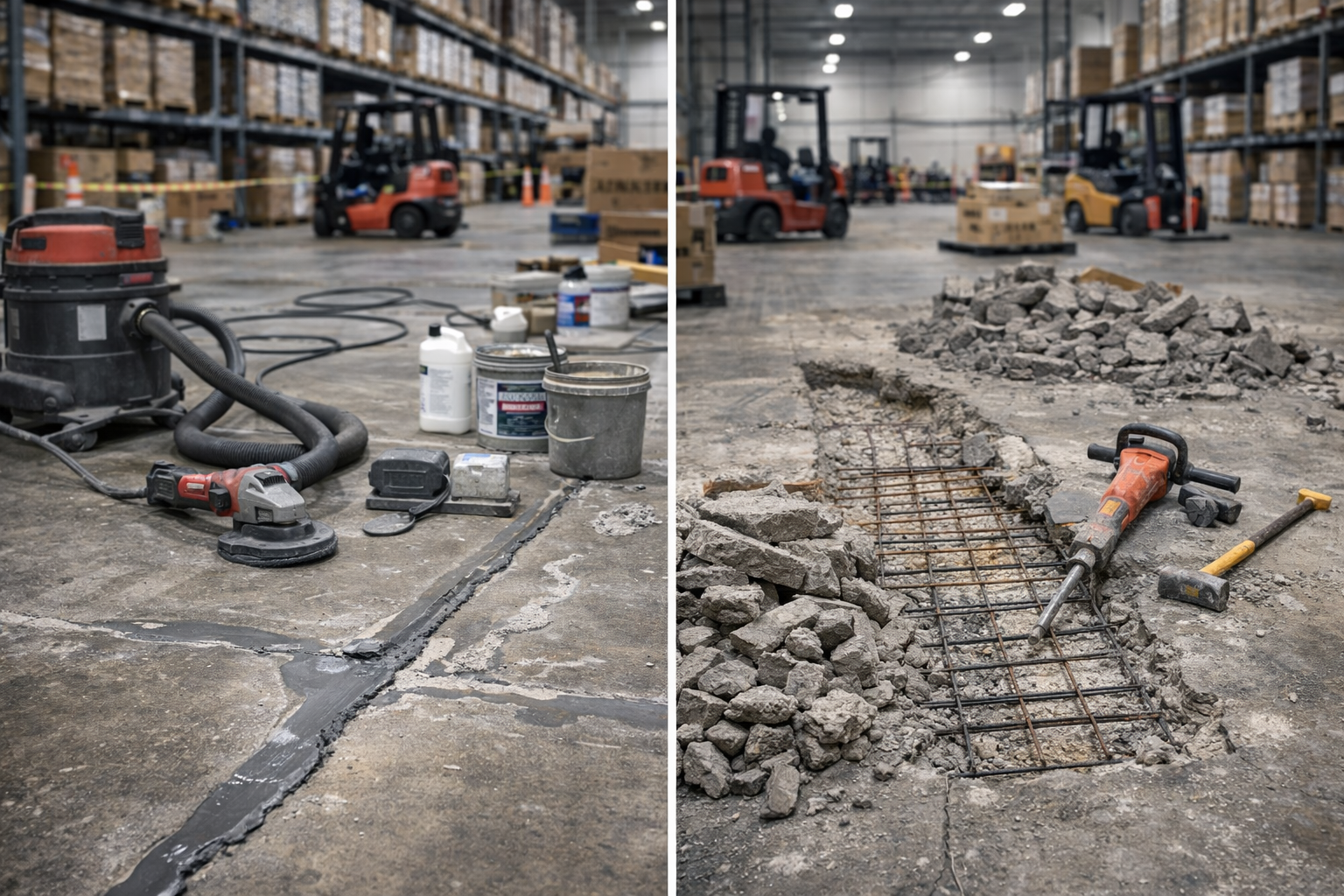
Repair costs vary based on the type of work, the extent of the damage, the size of the facility, and the scheduling required. A small joint repair job in a single-shift warehouse is a very different project from a facility-wide crack repair program in a 24/7 distribution center.
What Affects Repair Costs
Several factors push repair costs up or down.
Severity matters. A stable hairline crack is a simpler fix than a wide, active crack with vertical displacement on both sides. Surface scaling over a small area costs less to address than deep spalling across thousands of square feet.
Access and scheduling play a role. If your facility runs 24/7, repairs need to happen in phases during off-peak hours using fast-cure materials. That takes more planning and coordination than working in an empty building during business hours.
Total area is obvious — more damage means more work. But it’s not always linear. Larger projects can sometimes bring per-unit costs down because mobilization and setup costs are spread across more work.
The bottom line: most warehouse floor repair projects in New Jersey fall somewhere between $5,000 and $75,000. Small targeted repairs sit at the low end. Large-scale programs involving crack injection, joint overhaul, and resurfacing across a big facility sit at the high end. Very few repair jobs exceed the cost of replacement.
The Real Cost of Warehouse Floor Replacement in NJ
Full slab replacement is a major undertaking. It’s not just pouring new concrete. Here’s what’s actually involved.
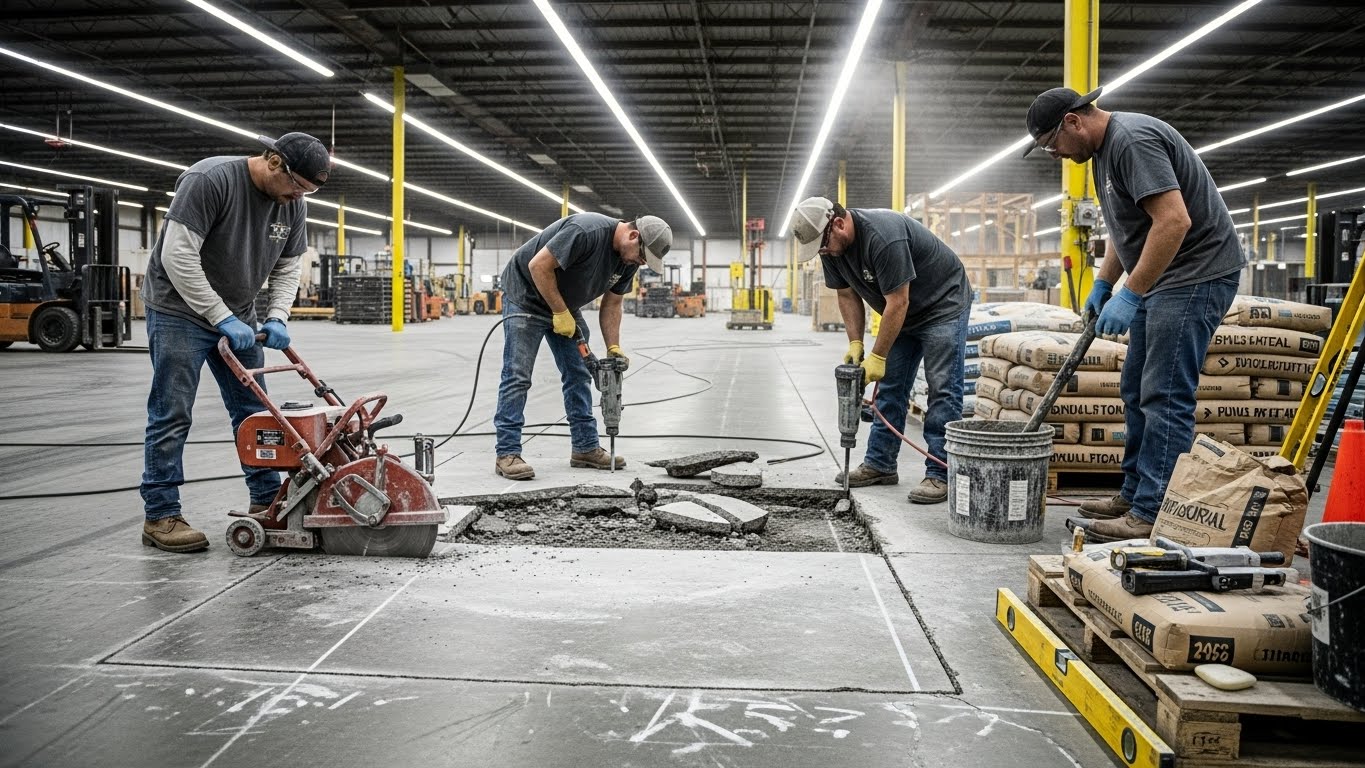
First, the existing slab has to be demolished and removed. That means saw-cutting the concrete into manageable sections, breaking it up with hydraulic equipment, loading it into trucks, and hauling it away.
Next, the subgrade — the compacted soil or stone base beneath the slab — needs to be inspected, regraded, and compacted. If the subgrade has failed (which is often why the floor failed in the first place), it may need to be excavated and replaced with engineered fill. That adds cost.
Then comes the new pour. New warehouse concrete replacement costs typically vary per square foot for a standard 6-inch slab with wire mesh or fiber reinforcement. Thicker slabs, rebar reinforcement, vapor barriers, and special finishes push that number higher.
After the pour, the concrete needs time to cure. Depending on conditions, you’re looking at 7 to 28 days before the floor can handle full warehouse traffic. Some accelerated mixes shorten that window, but they come at a premium.
The Hidden Costs Most People Miss
The per-square-foot number is only part of the picture. Replacement comes with a list of secondary costs that can rival the concrete work itself.
Operational downtime. Your warehouse is out of commission for weeks, potentially longer. If you’re a tenant in a leased facility, you’re still paying rent on a space you can’t use. If you own the building, you’re losing revenue every day the floor is out.
Inventory relocation. Everything on the floor — racking, product, equipment — has to go somewhere. Temporary storage isn’t cheap, and moving inventory twice (out and back in) costs labor and risks product damage.
Racking and equipment removal. Pallet racking, conveyor systems, charging stations, and dock equipment — all of it needs to be disassembled before demolition and reinstalled after the new pour cures. That’s specialized labor.
Permitting. Some New Jersey municipalities require permits for major concrete work, especially if it involves subgrade excavation or changes to drainage. Permit timelines add weeks to the project.
Temporary facility costs. If your operation can’t pause, you may need to lease temporary warehouse space to keep running during the replacement. That’s a significant expense on top of everything else.
When you add these hidden costs to the base concrete work, the true cost of full slab replacement often runs 30% to 50% higher than the initial estimate.
When Repair Is the Right Call
Repair makes sense more often than most people expect. Here are the situations where it’s clearly the better financial decision.
The damage is localized. If you’ve got cracking in specific aisles, deteriorated joints in the dock area, or surface damage in high-traffic zones — but the rest of the floor is in reasonable shape — there’s no reason to replace the entire slab. Targeted repairs address the problem areas at a fraction of the replacement cost.
The cracks are stable. Cracks that have stopped moving can be permanently repaired with epoxy injection. The bonded repair is as strong as or stronger than the original concrete. If the slab isn’t actively shifting or settling, the repair will hold.
Surface damage without structural failure. Scaling, spalling, and worn coatings look bad, but they don’t necessarily mean the slab is failing. If the concrete underneath is structurally intact, resurfacing or spot repairs can restore the floor to full working condition.
Budget or lease constraints. If you’re a tenant, investing hundreds of thousands in a new slab in someone else’s building rarely makes sense. Repair keeps the floor functional for the remainder of your lease at a manageable cost. Even if you own the building, repair buys you time if the capital budget isn’t there for a full replacement right now.
You can’t afford extended downtime. Repair can be done in phases, often during off-hours, with fast-cure materials that allow traffic within hours. Replacement shuts you down for weeks. For 24/7 distribution centers and high-volume warehouses, that downtime cost alone can tip the decision toward repair.
When Replacement Is Necessary
There are situations where repair isn’t a viable long-term solution. Being honest about that is part of our job.
Widespread structural failure. If the majority of the slab is cracked, settled, or broken into sections, spot repairs won’t hold. When the structural integrity of the floor is compromised across a large area, replacement is the only path to a floor that will perform long-term.
Severe subgrade problems. If the base beneath the slab has washed out, settled unevenly, or was never properly compacted, the floor above it will keep failing no matter how many times you repair the surface. You need to fix what’s underneath, and that means removing the slab to access the subgrade.
The slab is undersized for current loads. Some older NJ warehouses were built with 4-inch slabs intended for light storage. If the facility has been converted to heavy distribution with loaded forklifts and dense racking, the slab isn’t thick enough. No surface repair changes the thickness of the concrete.
Repeated repair failures. If the same areas keep cracking after multiple professional repairs, the slab is telling you something. There’s likely a deeper structural or subgrade issue that surface work can’t resolve.
The Middle Ground: Resurfacing
Not every floor decision is a binary choice between spot repairs and full replacement. Industrial concrete resurfacing sits between the two and is worth considering when the damage is too extensive for patching, but the slab is still structurally sound.
Resurfacing involves applying a polymer-modified overlay — typically 1/8 to 1/4 inch thick — over the existing concrete. It bonds to the slab and creates a new, dense, abrasion-resistant surface capable of handling heavy warehouse traffic.
Resurfacing also causes far less disruption. It can be done in sections, doesn’t require demolition, and most systems are traffic-ready within hours or overnight. In a busy NJ distribution center, that operational advantage alone makes it worth considering.
The limitation is that resurfacing doesn’t fix what’s happening below the surface. If the slab has deep structural cracks, significant settlement, or subgrade failure, an overlay on top won’t solve those problems. It’s a surface solution for surface problems — but a very effective one when the conditions are right.
Why We Don’t Recommend Foam Jacking for Warehouse Floors
We occasionally get asked about foam jacking — injecting expanding polyurethane foam beneath the slab to raise settled sections. We don’t offer this service.
Foam jacking doesn’t repair cracks. It doesn’t restore joints. It doesn’t fix surface deterioration. It addresses slab elevation only, and even then, it doesn’t give you the precision control that grinding and leveling provide.
For warehouse environments where the actual floor surface is what’s failing — cracked concrete, spalled joints, scaling, worn coatings — foam jacking doesn’t solve the problem. Our focus is on repairing the concrete floor itself, which is where the damage is and where the solution needs to be.
How to Make the Right Decision
The smartest move is to get your floor professionally assessed before committing to either path. A proper inspection identifies the root cause of the damage, not just the visible symptoms. That’s what drives the right recommendation.
Here’s what we evaluate during an assessment: crack type and activity, joint condition, surface quality, slab thickness where possible, signs of subgrade issues, and the overall percentage of the floor that’s affected. We also consider your operational constraints, lease situation, and budget.
Based on that, we give you a straight recommendation. If repair makes sense, we’ll tell you what it involves and what it costs. If replacement is the better long-term option, we’ll tell you that too — even though it means the job goes to someone else. We’d rather give you the right answer than sell you a repair that won’t last.
Areas We Serve
We work throughout New Jersey and eastern Pennsylvania. In NJ, we cover all major industrial corridors, including the NJ Turnpike/Exit 8A area, I-95, I-78, I-287, I-80, and I-295. We serve warehouses in Middlesex, Mercer, Burlington, Camden, Somerset, Union, Essex, Bergen, Passaic, Morris, Monmouth, and Gloucester counties.
In Pennsylvania, we cover Bucks County, Montgomery County, Chester County, Delaware County, Lehigh County, Northampton County, and nearby areas.
Get a Floor Assessment
If you’re trying to decide between repair and replacement for your New Jersey warehouse floor, start with a professional evaluation. Warehouse Floor Repairs provides on-site assessments for warehouse and distribution center operators throughout NJ and PA.
We’ll inspect your floor, explain what we find, and give you an honest recommendation — whether that’s a targeted repair, a resurfacing program, or a referral for full replacement.
Contact Warehouse Floor Repairs today to schedule your warehouse floor assessment.

- Concrete Floor Repair for 24/7 Distribution Centers in New Jersey - March 2, 2026
- Warehouse Floor Repair Cost vs. Replacement in NJ - March 2, 2026
- Heavy-Duty Crack Repair for Warehouses in Burlington County - March 2, 2026