(908) 369-3110

IN THIS ARTICLE
Find Out Who Repairs Concrete Floors in Leased Warehouses in PA
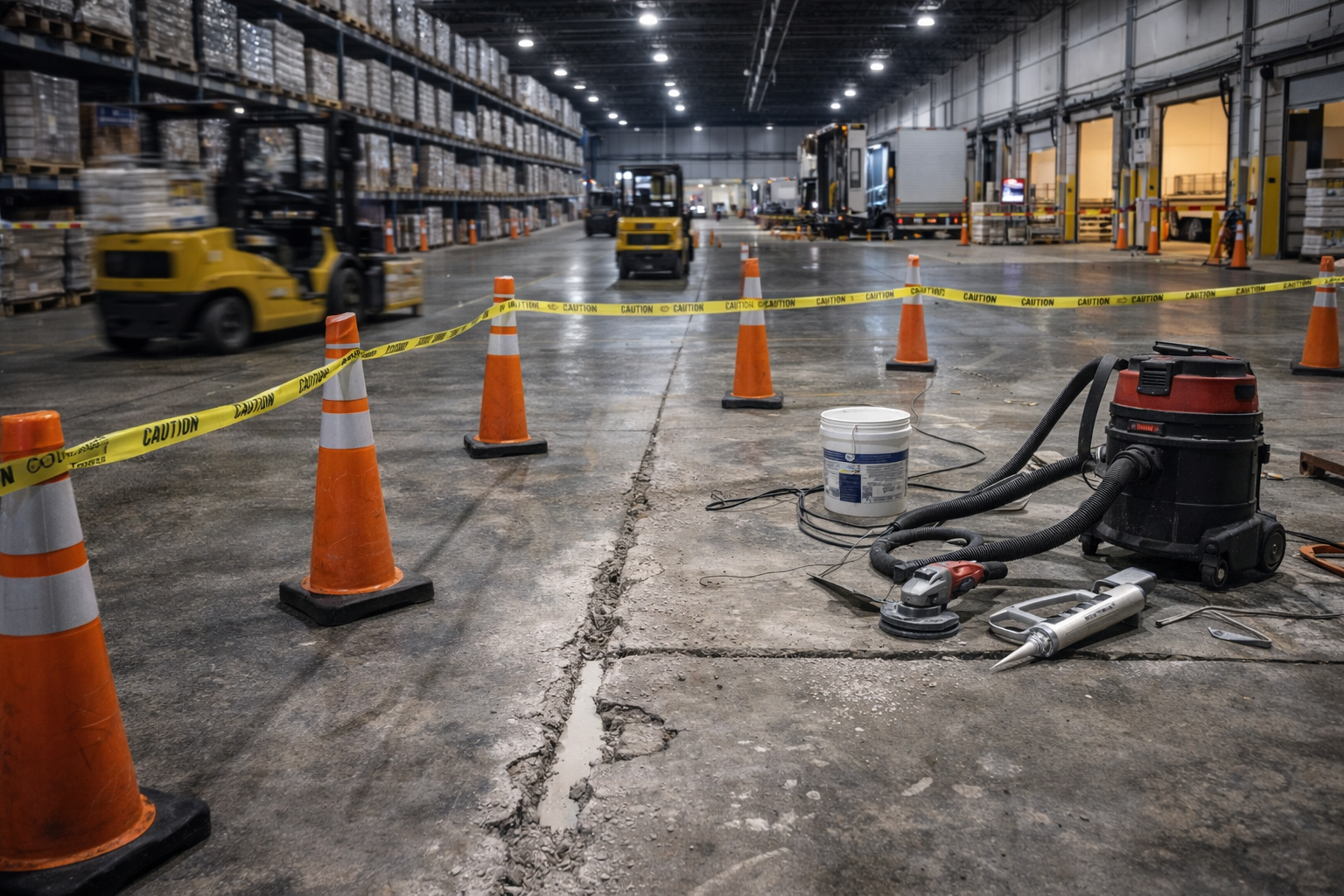
Short answer: a company that specializes in warehouse concrete floor repair. Not a general contractor. Not a handyman. Not someone who mostly does residential driveways and patios. Warehouse floors operate under conditions that demand specific materials, methods, and experience.
If you’re leasing a warehouse in Pennsylvania and the concrete floor is cracked, uneven, or falling apart at the joints, you need a contractor who works in industrial environments every day. That’s exactly what we do at Warehouse Floor Repairs. We repair concrete floors in warehouses, distribution centers, and industrial facilities across Pennsylvania and New Jersey.
But before we get into the repair side, there’s a question that comes up on almost every leased warehouse job we do.
Who Is Responsible for Floor Repairs — Tenant or Landlord?
This is where things get tricky. The answer depends entirely on your lease agreement.
In most commercial and industrial leases in Pennsylvania, the tenant is responsible for maintaining the interior of the space. That includes the floor. This is especially true in triple net (NNN) leases, which are common in the warehouse and logistics sector. Under a triple net lease, the tenant pays rent plus property taxes, insurance, and maintenance costs. Floor repair falls squarely under maintenance.
Modified gross leases split responsibilities differently. The landlord may cover structural issues while the tenant handles day-to-day upkeep. In these cases, the distinction between a structural problem and a maintenance issue matters. A crack caused by a failing subgrade might be the landlord’s responsibility. A crack caused by years of forklift traffic probably falls on the tenant.
Full service leases, where the landlord covers most maintenance, are rare in the industrial space. But they do exist. If you’re on one, floor repairs may be on your landlord.
Here’s the practical advice: read your lease carefully before you call anyone. Look for language around “floor maintenance,” “structural repairs,” “capital improvements,” and “restoration at lease end.” Many leases require the tenant to return the space in the same condition it was received, minus normal wear and tear. If the floor has deteriorated beyond what’s considered normal, you could be on the hook for repairs when you move out — whether you fix it now or later.
We’re not attorneys, and this isn’t legal advice. If your lease language is unclear, talk to a real estate lawyer. But we can tell you from experience that most of the tenants and property managers who call us are either directly responsible for the repair or are coordinating it on behalf of the landlord.
Either way, the floor still needs to get fixed. And that’s where we come in.
Why Leased Warehouses Need Specialized Floor Repair
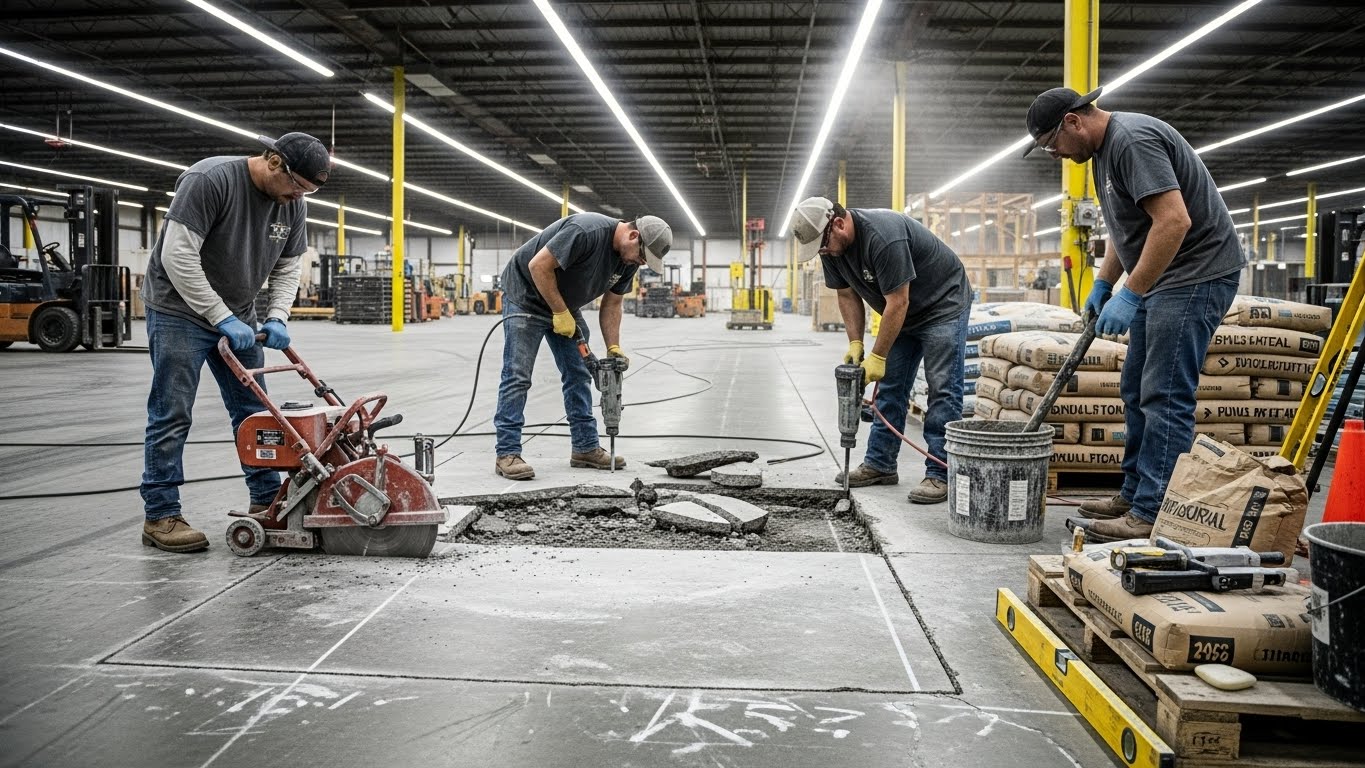
A warehouse floor isn’t like a basement slab or a retail showroom. It’s an industrial surface that supports heavy racking systems, pallet jacks, forklifts, and constant foot traffic. The repair approach has to match that level of demand.
General contractors can do a lot of things. But warehouse concrete floor repair isn’t usually one of them. The materials, equipment, and techniques involved are specific to industrial settings. Using the wrong filler in a crack, for example, might hold up fine in a garage but crumble within weeks under a loaded forklift.
Leased spaces add another layer. You need repairs that are durable, compliant with your lease terms, and done with minimal disruption to your operation. Most tenants can’t afford to shut down a section of the warehouse for days. A specialized contractor understands that and plans the work accordingly.
There’s also the matter of documentation. If you’re repairing the floor in a leased space, it’s smart to have records of the work — what was done, what materials were used, and what condition the floor was in before and after. That protects you at lease end. A specialized warehouse floor repair company can provide that documentation. A handyman with a bucket of patching compound cannot.
Common Concrete Floor Problems in PA Warehouses
Pennsylvania’s climate and geography create a specific set of challenges for warehouse concrete.
Cracking
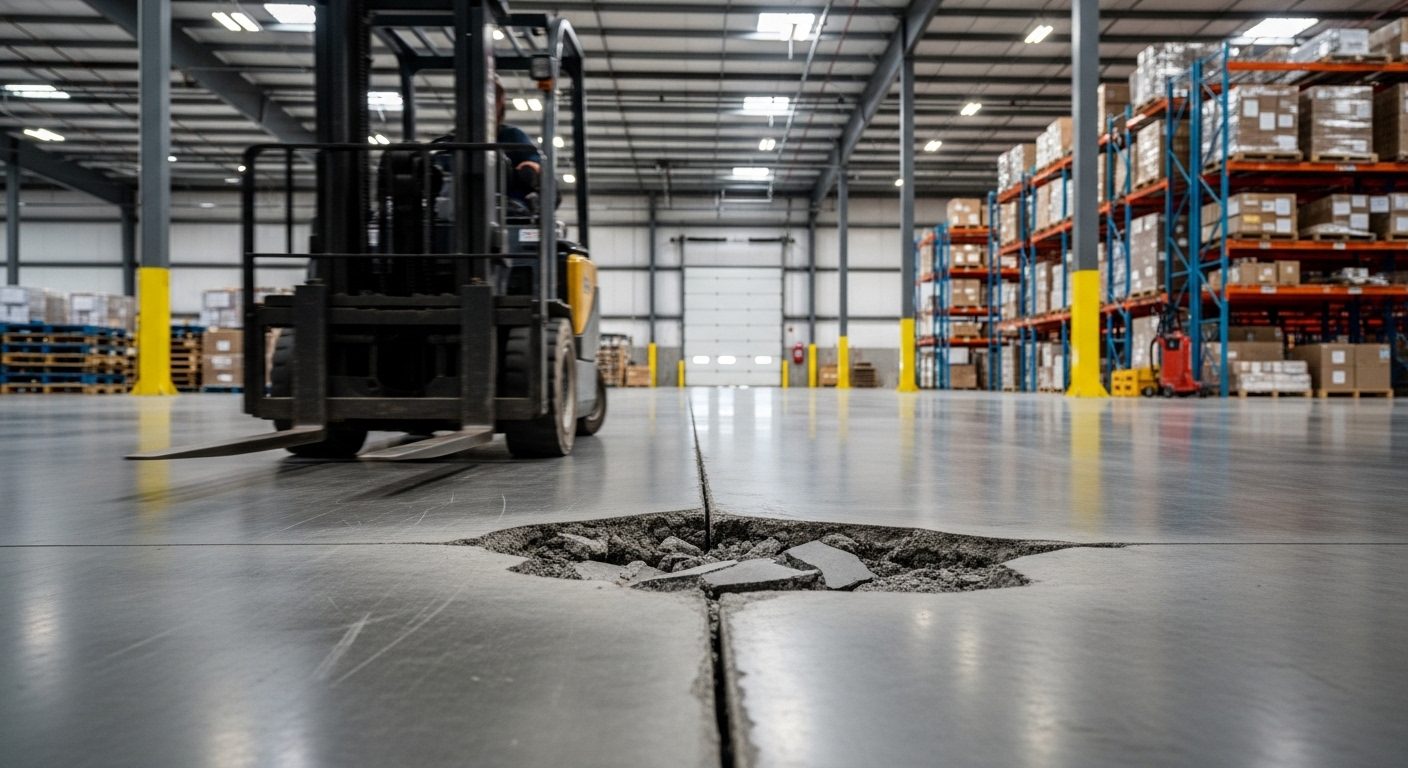
This is the most common issue. Cracks develop from repeated heavy loading, thermal expansion and contraction, and subgrade movement. In PA, the freeze-thaw cycle is relentless. Water enters small pores and cracks in the concrete. It freezes, expands, and breaks the concrete apart from within. Over a few winters, a minor crack becomes a major one.
Forklift traffic accelerates the process. The same routes get driven hundreds of times a day. That repetitive stress concentrates on the same points in the slab, and cracks form along those paths.
Joint Deterioration
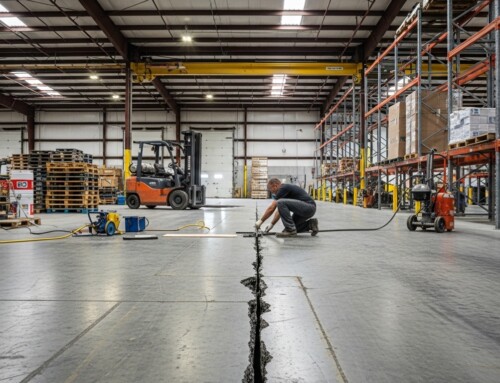
Control joints are designed into warehouse floors to manage cracking in a controlled way. But the joints themselves take a beating. Forklift wheels slam into joint edges repeatedly. The filler material wears out or pulls away. The edges of the joint start to spall and chip. Before long, the joint is wider and rougher than it was designed to be, and it’s damaging equipment and creating safety hazards.
Joint deterioration is one of the most overlooked problems in warehouse floors. By the time most tenants call us, the joints are in rough shape.
Surface Scaling and Spalling
The top layer of the concrete can start to flake and peel, especially in warehouses that aren’t climate-controlled. This is called scaling. It’s often caused by freeze-thaw exposure, deicing chemicals tracked in from outside, or a weak surface layer from the original pour.
Spalling is similar but involves larger chunks of concrete breaking away, usually around cracks and joints. Both conditions create rough, uneven surfaces that are hard on equipment and hazardous for workers.
Uneven Slabs and Trip Hazards
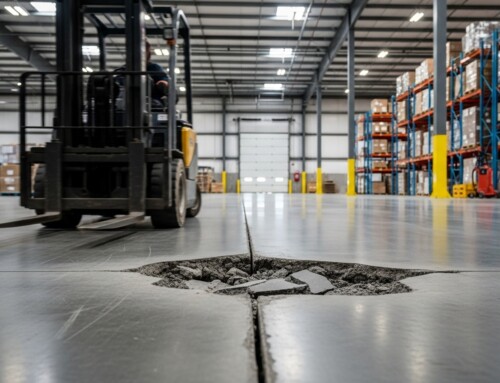
Settlement can cause sections of the floor to sit at different heights. Even a quarter-inch lip between two slabs is enough to catch a foot or jolt a forklift. These trip hazards are a liability issue, especially in a leased facility where OSHA compliance is your responsibility as the tenant.
Drainage and Moisture Issues
Some PA warehouses, particularly older ones, have inadequate vapor barriers beneath the slab. Moisture migrates up through the concrete and can cause surface issues, delamination of coatings, and damage to stored goods. In leased spaces, this can become a dispute between tenant and landlord over who’s responsible. Regardless, the floor needs attention.
How We Repair Concrete Floors in Leased Warehouses
Every floor is different. We don’t apply a one-size-fits-all solution. Here’s what our repair process typically looks like.
Inspection and Assessment
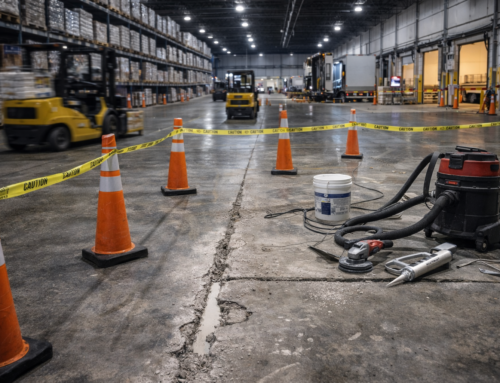
We start with a thorough evaluation of the floor. We look at the type, location, and severity of the damage. We check whether cracks are active or dormant. We assess joint condition, surface quality, and any signs of subgrade failure.
This step drives everything else. The right diagnosis leads to the right repair. The wrong one leads to wasted money and a callback in six months.
Epoxy Crack Injection
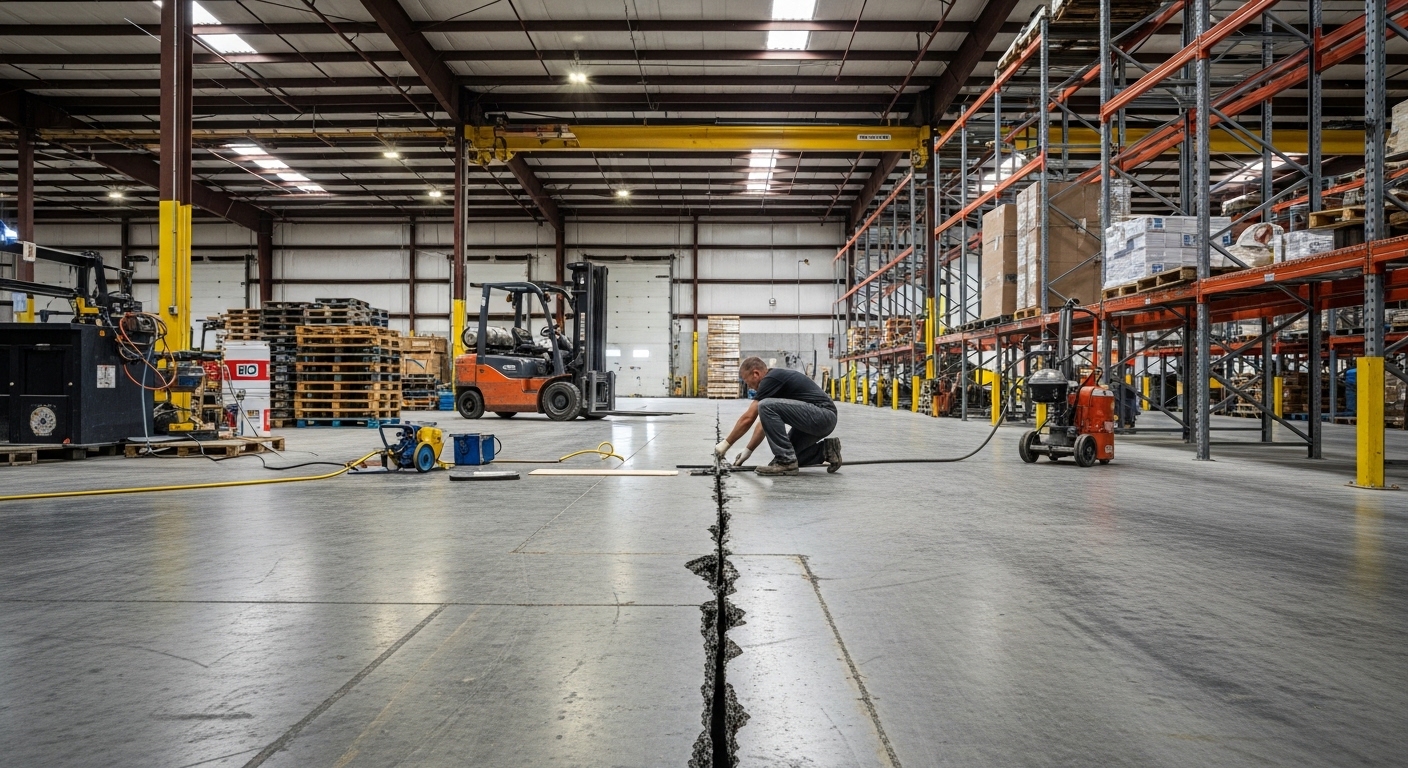
For structural cracks that have stabilized, we use high-strength epoxy injection. The epoxy is pumped into the crack under pressure, filling it from the bottom up. Once it cures, the repaired area has the same or greater strength than the original concrete.
This method works well for cracks caused by one-time events like settlement or overloading. It creates a rigid bond that restores the structural integrity of the slab.
Semi-Rigid Polyurea Crack and Joint Repair
Not every crack should be filled with rigid epoxy. Some cracks still have minor movement — thermal expansion, vibration from equipment, slight seasonal shifts. For those, we use semi-rigid polyurea fillers.
Polyurea has some flex to it. It can absorb slight movement without cracking again. It also cures quickly, often within an hour, which means less downtime for your warehouse.
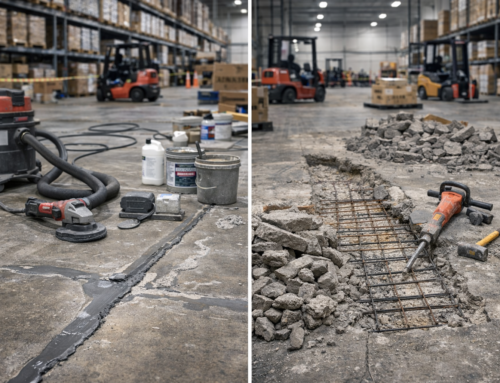
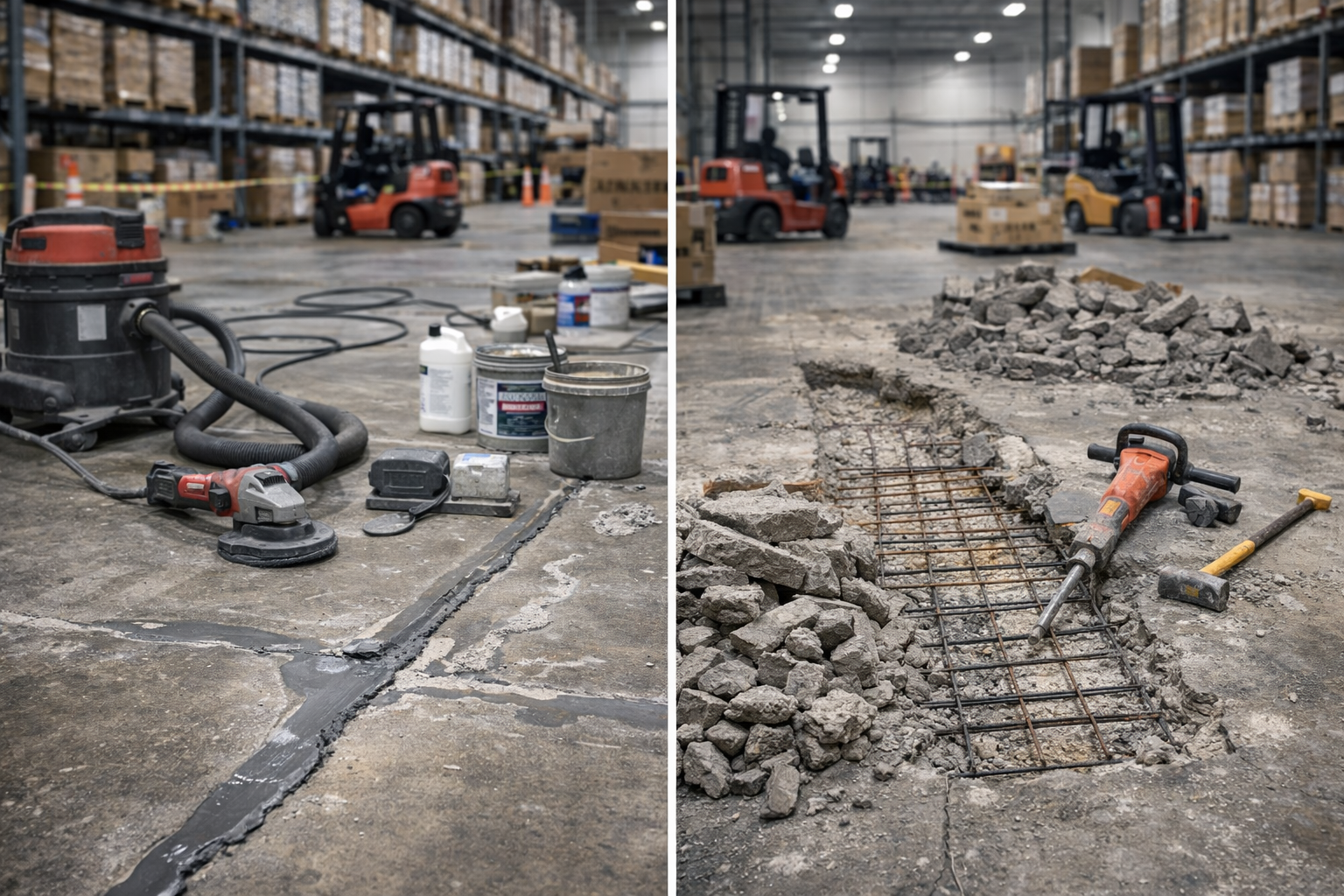
We use the same material for joint repair. Deteriorated control joints get cleaned out, re-profiled, and filled with polyurea that’s rated for heavy wheel traffic. The result is a smooth, durable joint that forklifts can roll over without impact.
Trip Hazard Grinding and Surface Leveling
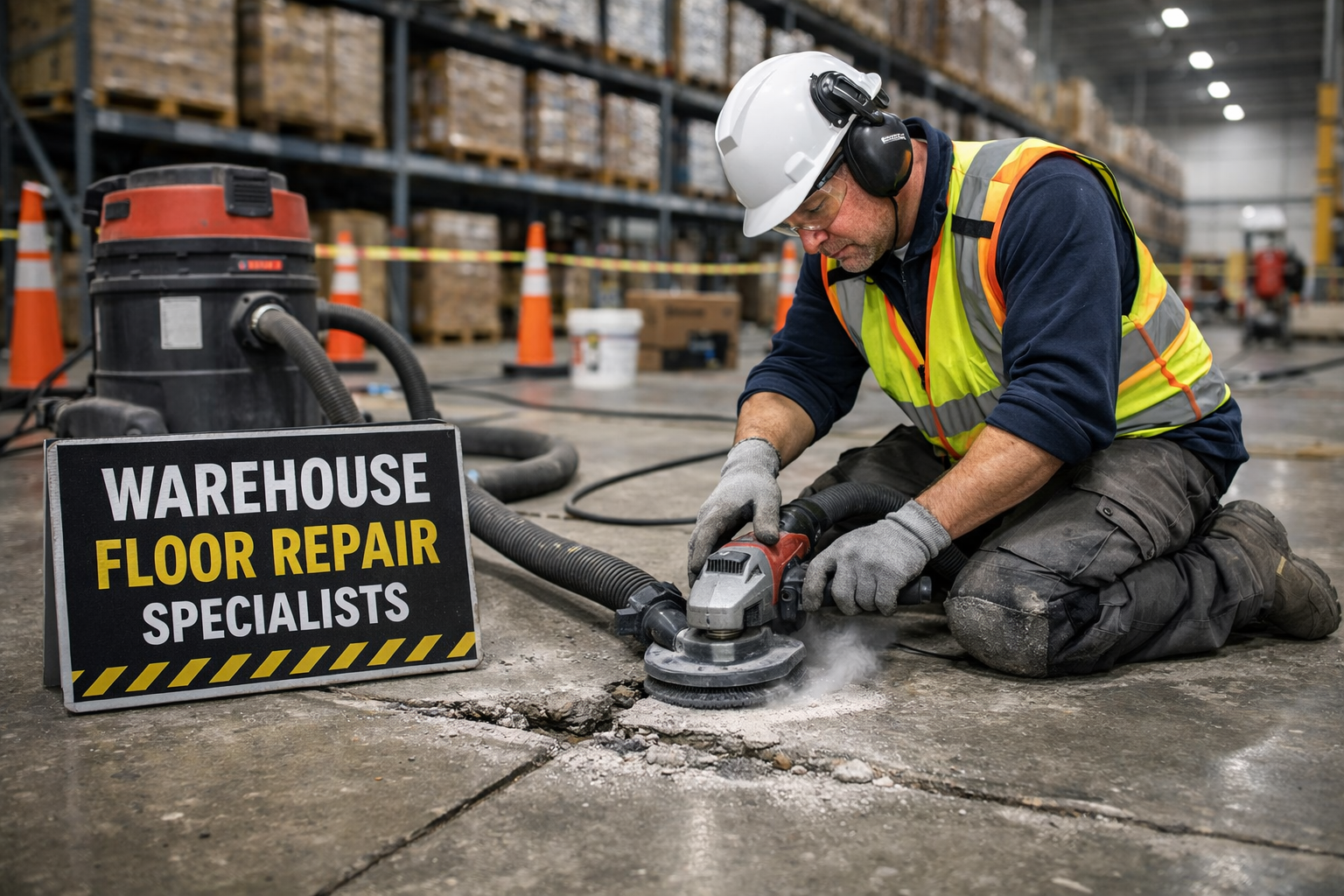
When slab sections have settled unevenly, we grind the high edges down to create a smooth transition. This eliminates trip hazards and makes the surface safe for both foot traffic and wheeled equipment.
It’s a straightforward fix that solves an immediate safety concern. In a leased space, addressing trip hazards quickly protects you from liability claims.
Concrete Resurfacing and Overlays
When the damage is widespread — heavy scaling, extensive spalling, numerous cracks across a large area — individual spot repairs may not be practical. In those cases, we apply industrial concrete resurfacing systems.
These are polymer-modified overlays that bond to the existing slab and create a new wear surface. They’re designed for heavy industrial use and can handle the same loads as the original floor. Resurfacing is significantly less expensive and less disruptive than full slab replacement, which makes it a practical option for tenants who need a good floor but don’t want to invest in a brand-new slab in someone else’s building.
A Note on Foam Jacking
We get asked about foam jacking from time to time. Foam jacking involves injecting expanding polyurethane foam beneath the slab to raise settled sections. While it has its applications, it’s not a surface repair method. It doesn’t fix cracks, restore joints, or address surface deterioration. It also doesn’t give you control over the final floor profile the way precision grinding does.
Our focus is on repairing the concrete floor itself — the surface you and your equipment interact with every day. That’s where the problems are, and that’s where the solutions need to be.
What to Look for in a Warehouse Floor Repair Company in PA
If you’re searching for someone to repair concrete floors in a leased warehouse, here’s what to look for.
Industrial experience. Residential and commercial concrete work is different from warehouse floor repair. Ask whether the company regularly works in industrial facilities. Ask for references from similar projects.
Ability to work around your operations. A good warehouse floor contractor will plan the work in phases so you don’t have to shut down entirely. They’ll use fast-curing materials and schedule work during off-peak hours when possible.
Knowledge of PA conditions. The climate, soil types, and building practices in Pennsylvania affect how concrete behaves and how repairs should be done. A company that understands the local environment will make better decisions about materials and methods.
Proper insurance. This is non-negotiable, especially in a leased facility. The repair company should carry general liability insurance and workers’ compensation coverage. Your landlord will likely require proof of insurance before any work begins.
Areas We Serve in Pennsylvania
We work throughout eastern and central Pennsylvania, including Bucks County, Chester County, Delaware County, Montgomery County, Lehigh County, Northampton County, and other nearby areas.
On the New Jersey side, we cover the entire state, with a strong presence in Burlington County, Mercer County, Middlesex County, and the northern NJ industrial corridor.
Whether your warehouse is a 10,000-square-foot operation in Allentown or a 500,000-square-foot distribution center outside Philadelphia, we have the experience and equipment to handle the job.
Get a Detailed Floor Assessment
If you’re dealing with concrete floor damage in a leased warehouse in Pennsylvania, don’t wait for it to get worse. And don’t guess about whether the repair is your responsibility or your landlord’s — get the floor evaluated first so you know exactly what you’re dealing with.
WarehouseFloorRepair offers on-site assessments for warehouse tenants, property managers, and landlords throughout PA and NJ. We’ll inspect the floor, identify the issues, and give you a clear, honest recommendation on what needs to be done.
No pressure. No inflated quotes. Just a straight assessment from a team that does this work every day.
Contact Warehouse Floor Repair today to schedule your warehouse floor assessment in Pennsylvania.

- Concrete Floor Repair for 24/7 Distribution Centers in New Jersey - March 2, 2026
- Warehouse Floor Repair Cost vs. Replacement in NJ - March 2, 2026
- Heavy-Duty Crack Repair for Warehouses in Burlington County - March 2, 2026