
IN THIS ARTICLE
Repair Options for Forklift-Damaged Warehouse Concrete Floors
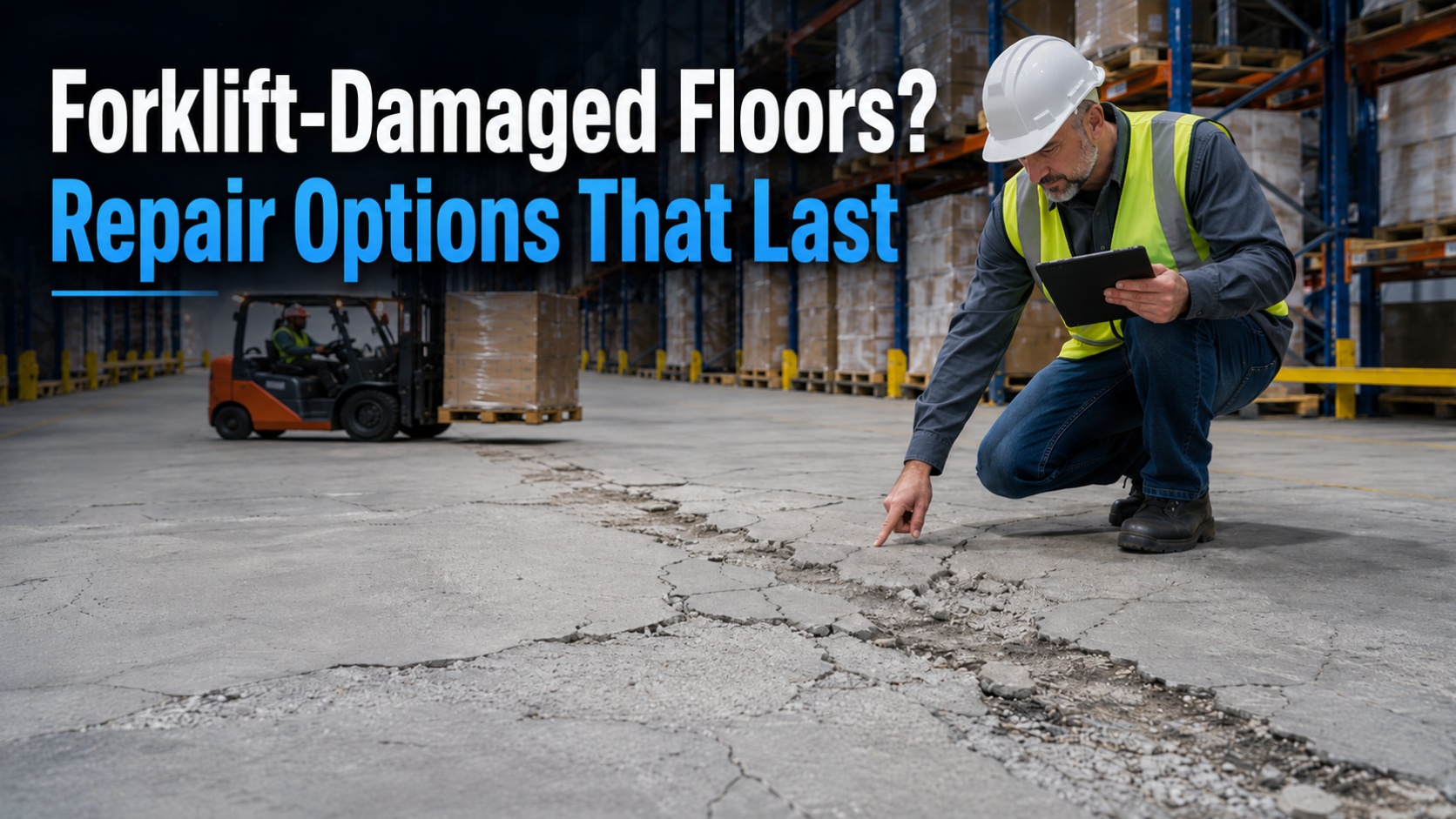
Forklifts are essential to warehouse operations, but they can be brutal on concrete floors.
If your facility has chipped joints, cracked traffic aisles, spalling concrete, rough transitions, or uneven slab sections where forklifts travel every day, the damage is not just cosmetic. It can slow down operations, increase equipment wear, create safety concerns, and turn a small repair into a much larger expense if it is ignored.
For warehouse owners and facility managers in New Jersey, forklift-damaged concrete floor repair starts with understanding what type of damage you have. A cracked aisle, a broken joint, a spalled turning area, and a sinking slab may all look like “floor damage,” but they do not require the same repair method.
The right repair depends on what caused the damage, how much forklift traffic the area receives, whether the slab is still stable, and how quickly the repaired area needs to return to service.
This guide explains the most common types of forklift-related warehouse floor damage, the repair options available, when repair is better than replacement, and when New Jersey facility managers should call a professional warehouse floor repair contractor.
Why Forklifts Damage Warehouse Concrete Floors
Warehouse concrete floors are designed to handle heavy use, but forklifts create repeated stress in the same traffic paths day after day. Over time, that stress can expose weak points in the floor.
Forklift damage is usually caused by a combination of factors, including:
- Heavy concentrated wheel loads
- Repeated traffic through the same aisles
- Sharp turning in tight areas
- Hard braking and acceleration
- Impacts at joints and slab edges
- Dropped pallets or heavy materials
- Worn forklift wheels
- Existing cracks that widen under traffic
- Weak or aging concrete
- Unsupported or settling slabs
- Poorly maintained floor joints
In many cases, the forklift is not the only problem. The floor may already have weak joints, minor cracks, surface wear, or hidden slab support issues. Forklift traffic simply makes the problem worse because the same wheels keep hitting the same damaged spots.
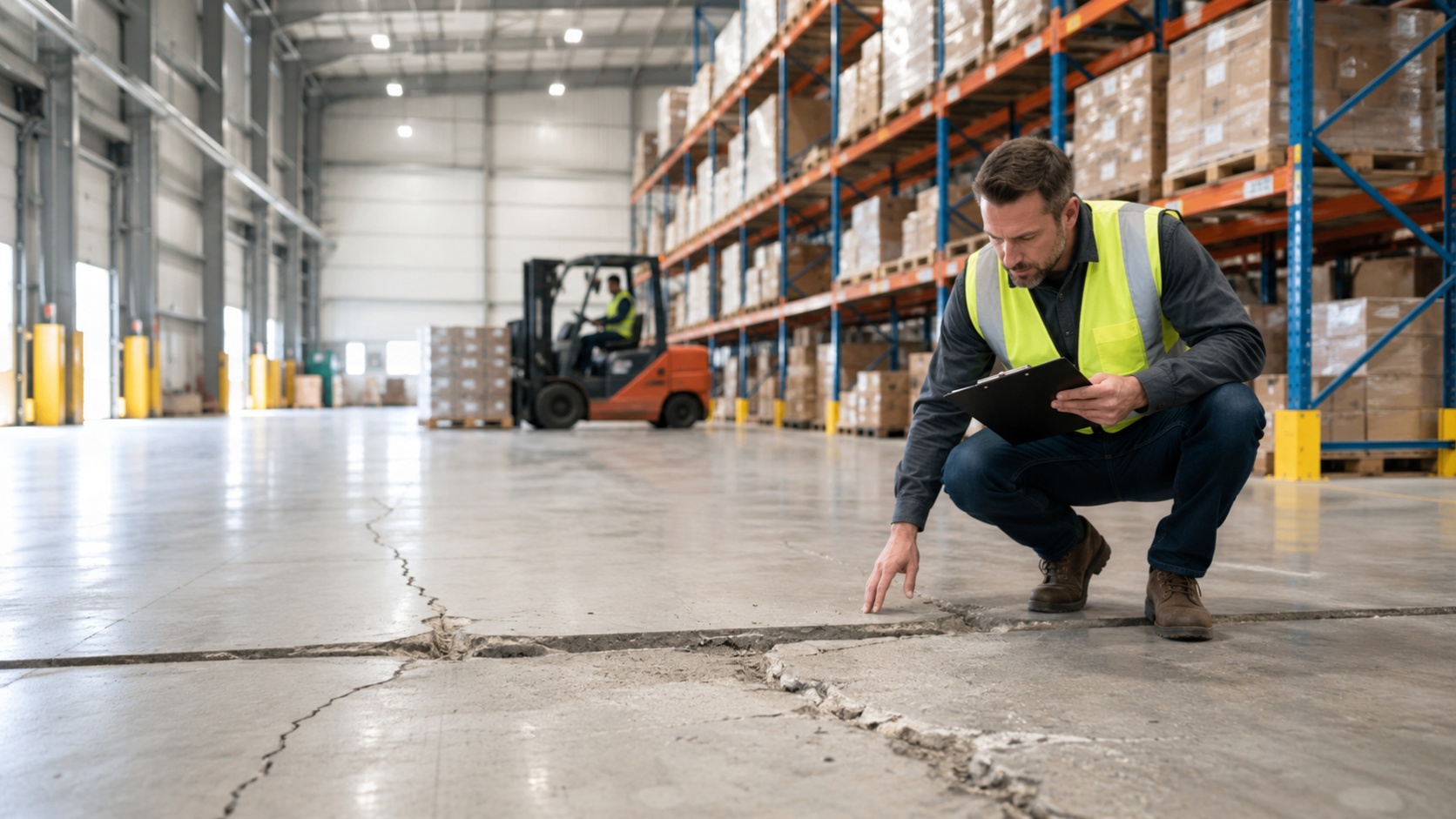
That is why a repair should not begin with guesswork. Before choosing a repair method, the floor should be inspected to determine whether the issue is surface damage, joint failure, slab movement, settlement, or structural deterioration.
For a related prevention guide, read how to protect warehouse concrete floors from forklift damage.
Common Signs of Forklift-Damaged Concrete Floors
Forklift damage often starts small. At first, it may look like minor chipping at a joint or a narrow crack across a traffic aisle. But once forklift wheels repeatedly strike that weak area, the damage can grow quickly.
Common signs include:
- Chipped or broken floor joint edges
- Cracks running across forklift aisles
- Spalling concrete in turning zones
- Pothole-like surface damage
- Uneven transitions between slab sections
- Forklifts bouncing or vibrating over joints
- Loose concrete debris near damaged areas
- Concrete dust collecting around cracks or joints
- Pallet jacks catching on rough surfaces
- Repeated patch failures
- Operators slowing down or avoiding certain aisles
- Rough areas near loading docks, doors, or staging zones
One of the best early warning signs is operator feedback. Forklift operators usually feel floor damage before management fully sees it. If drivers complain about bouncing, vibration, rough transitions, or unsafe travel paths, the floor should be inspected before the damage spreads.
If cracks are forming in forklift lanes, see this related guide on warehouse floor cracks from forklift traffic.
Why You Should Not Ignore Forklift-Damaged Warehouse Floors
A damaged warehouse floor rarely stays the same. Every forklift pass can make the weak area worse.
When a forklift wheel hits a broken joint edge, chipped slab, or raised transition, it creates impact. That impact breaks off more concrete. As more concrete breaks away, the transition becomes rougher. Then the forklift hits it harder the next time. This cycle can turn a small repair into a major operational issue.
Ignoring forklift-damaged concrete can lead to:
- Larger repair areas
- Higher repair costs
- More forklift wheel wear
- More frequent equipment maintenance
- Slower material movement
- Operator discomfort
- Trip hazards for employees
- Loose concrete debris
- Product damage
- Safety complaints
- Emergency repair needs
For a warehouse facility manager, the real cost is not only the concrete repair. It is also downtime, productivity loss, equipment wear, safety exposure, and the risk of patching the same area again because the original repair did not address the cause.
If your forklifts are wearing out wheels too quickly, your floor may be contributing to the problem. Read why your forklift wheels keep failing for more detail.
Forklift-Damaged Concrete Floor Repair Options
The best repair option depends on the type of damage. A crack repair is different from a joint repair. Spalling repair is different from leveling. A surface patch is different from stabilizing a sinking slab.
Below are the most common repair options for forklift-damaged concrete floors in warehouses.
1. Concrete Crack Repair
Concrete cracks are common in warehouses, especially in areas with repeated forklift traffic. Cracks may form from shrinkage, slab movement, poor support, temperature changes, heavy loads, or stress around joints and traffic aisles.
Crack repair may be needed when:
- Cracks are widening across forklift lanes
- Forklift wheels catch on crack edges
- Cracks are collecting dirt, dust, or debris
- Pallet jacks bounce over the cracked area
- The crack keeps returning after patching
- The slab appears to be moving or settling nearby
Depending on the condition of the crack, repair may involve cleaning, routing, filling, sealing, or using stronger repair materials designed for industrial traffic.
However, facility managers should be careful with simple surface filling. If the slab is moving or unsupported, filling the visible crack may not solve the problem. The repair may fail again because the underlying movement is still happening.
For more information, visit the concrete crack repair service page.
2. Concrete Warehouse Floor Joint Repair
Floor joints are one of the most common starting points for forklift damage.
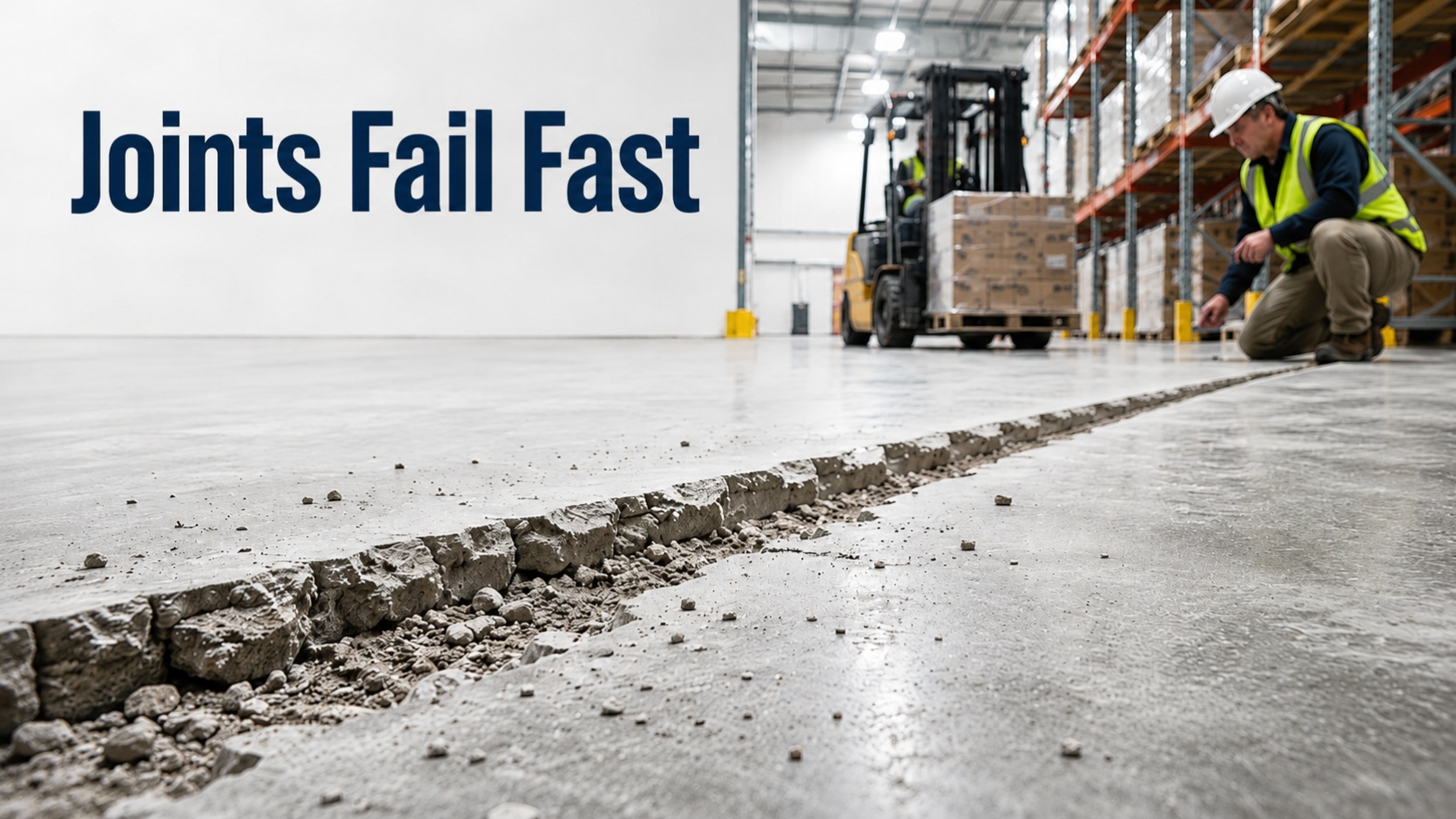
Joints are necessary because concrete expands, contracts, and moves. But in a warehouse, they also become impact points. Forklift wheels cross the same joints thousands of times. Once the joint edge begins to chip, crack, or break down, every forklift pass makes the impact worse.
Joint repair may be needed when:
- Forklifts bounce over joints
- Joint edges are chipped or broken
- Joints have become uneven
- Dust or debris collects around the joint
- Previous joint patches have failed
- Forklift operators slow down at certain joints
- Pallet jacks catch on joint edges
Proper joint repair usually involves more than filling a gap. The damaged concrete may need to be removed, the joint edges rebuilt, the area cleaned and prepared, and the surface ground smooth so forklifts can travel over the repair without repeated impact.
In many warehouses, repairing the joint properly is one of the best ways to reduce future forklift damage.
Learn more about concrete warehouse floor joint repair.
3. Concrete Spalling Repair
Spalling happens when the surface of the concrete flakes, chips, breaks, or separates. In a warehouse, spalling often shows up in forklift turning areas, around joints, near loading docks, beside doors, or in zones where heavy loads are moved repeatedly.
Spalling repair may be needed when:
- Concrete is flaking or breaking apart
- Loose debris keeps returning after cleanup
- The surface feels rough under forklift traffic
- Damage appears around joints or cracks
- Small chipped areas are spreading
- Forklift turning zones are wearing down
The biggest mistake with spalling is patching over weak concrete. If the loose or damaged material is not removed first, the repair may not bond properly. A durable repair usually requires proper surface preparation before applying the repair material.
For industrial warehouse floors, the repair material must also be strong enough to handle forklift traffic. A light-duty patch may look good at first but fail once forklifts start turning, braking, and carrying loads over it again.
Read more about concrete spalling repair.
4. Surface Grinding and Smoothing
Sometimes the main problem is not deep structural damage. It may be a raised edge, rough transition, uneven patch, or surface irregularity that causes forklifts and pallet jacks to bounce.
Grinding may help when:
- There is a minor height difference between slab sections
- Forklift wheels hit a rough transition
- A previous repair left an uneven edge
- Pallet jacks catch on a raised area
- The surface needs to be smoothed after joint or patch repair
Grinding can improve the smoothness of the travel path, but it is not a cure for every problem. If the slab is sinking, hollow, cracked through, or losing support, grinding only treats the surface. The underlying issue may continue to worsen.
In many forklift-damaged areas, grinding is best used as part of a broader repair plan, especially after joint repair, spalling repair, or patching.
5. Concrete Floor Leveling
If forklifts dip, rock, or bounce in a certain section of the warehouse, the issue may be more than surface damage. The slab may be uneven, sinking, or unsupported beneath the concrete.
Concrete floor leveling may be needed when:
- Slabs are sinking or settling
- Forklifts dip in certain areas
- There are uneven transitions between slab sections
- Cracks keep returning after repairs
- The floor feels hollow or unstable
- Damage appears near loading docks, doors, or heavy traffic paths
In this case, patching the top of the slab may not solve the problem. If the slab has lost support beneath it, the floor may continue to move. Leveling or stabilizing the slab may be necessary before surface repairs can last.
For more information, visit the concrete floor leveling page.
6. Partial Slab Repair or Replacement
Not every forklift-damaged floor can be fixed with crack filling, joint repair, or spalling repair. Sometimes the concrete is too broken, unstable, or deteriorated to repair reliably.
Partial slab repair or replacement may be needed when:
- The slab is severely broken
- Damage extends deep into the concrete
- Previous repairs keep failing
- The floor cannot support normal warehouse traffic
- The subbase is poor or unstable
- The damaged area creates a serious safety risk
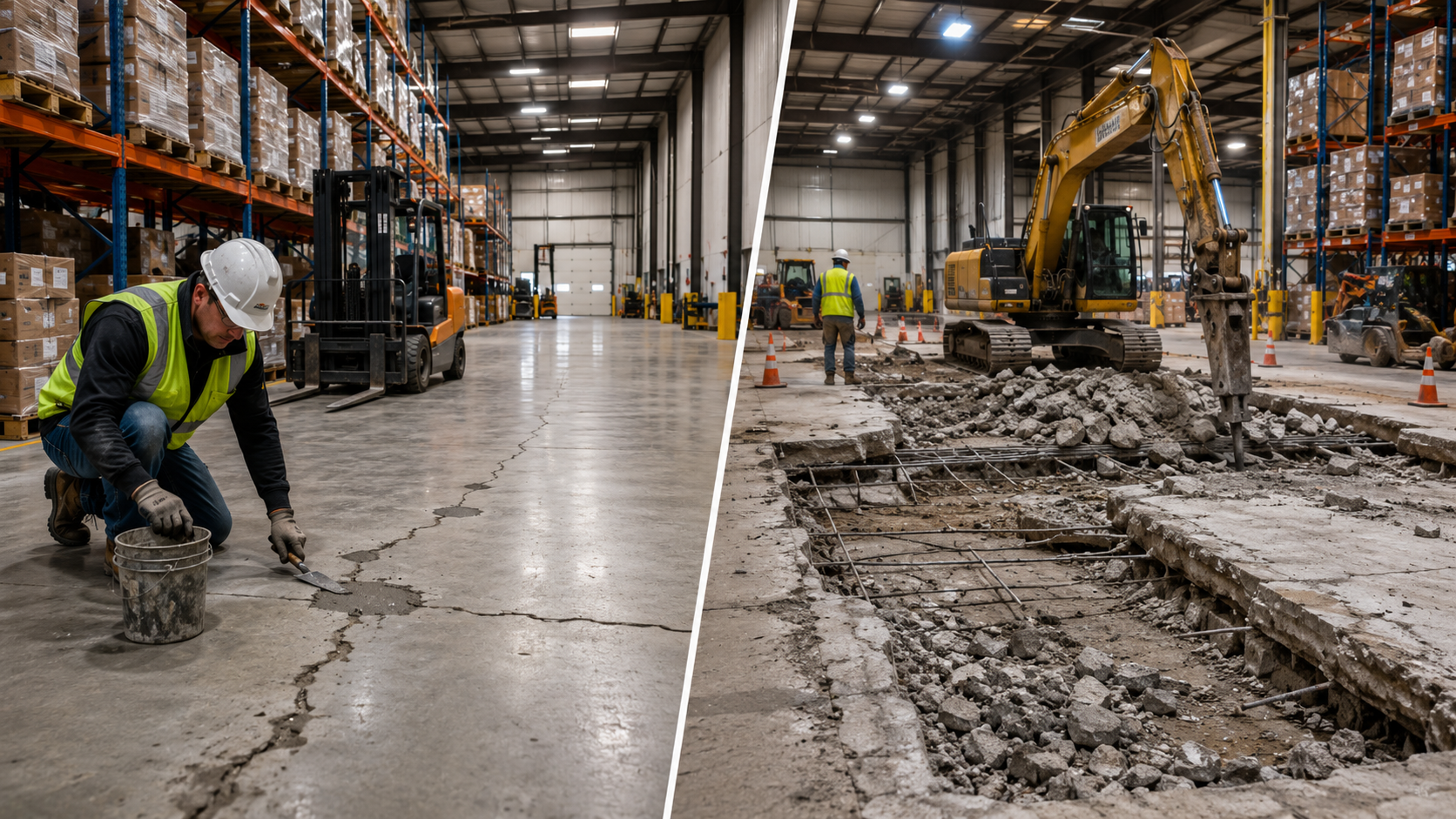
That said, full replacement should not be the first assumption. Replacement can involve demolition, disposal, new concrete, curing time, and more disruption to warehouse operations. In many cases, a targeted repair may restore the floor at a lower cost and with less downtime.
If you are weighing both options, read warehouse floor repair cost vs. replacement in NJ.
How to Choose the Right Repair Method
The right repair method depends on the condition of the floor and how your warehouse uses that area.
A contractor should evaluate:
- The type of damage
- The depth of the damage
- Whether the slab is stable or moving
- The amount of forklift traffic
- The weight of loads being moved
- The location of the damage
- Whether the repair area is near racks, docks, doors, freezers, or staging zones
- How quickly the area must return to service
- Whether repairs can be phased around operations
- Whether the problem has been repaired before
Here is a simple guide:
| Floor Problem | Possible Repair Option |
|---|---|
| Narrow cracks | Crack cleaning, filling, or sealing |
| Wide or moving cracks | Crack repair plus deeper inspection |
| Chipped joint edges | Joint rebuilding and filling |
| Spalling surface damage | Surface preparation and spalling repair |
| Rough transitions | Grinding, smoothing, or joint repair |
| Sinking slab sections | Concrete floor leveling or stabilization |
| Severely broken slab | Partial slab repair or replacement |
The main takeaway is simple: do not choose a repair based only on what the surface looks like. A visible crack may be a symptom of slab movement. A broken joint may be a sign of repeated forklift impact. A rough patch may be failing because the floor was never prepared properly.
If you are unsure which method fits your floor, read what is the best repair method for warehouse concrete floors.
Can Forklift-Damaged Concrete Floors Be Repaired Without Shutting Down the Warehouse?
For most facility managers, downtime is one of the biggest concerns.
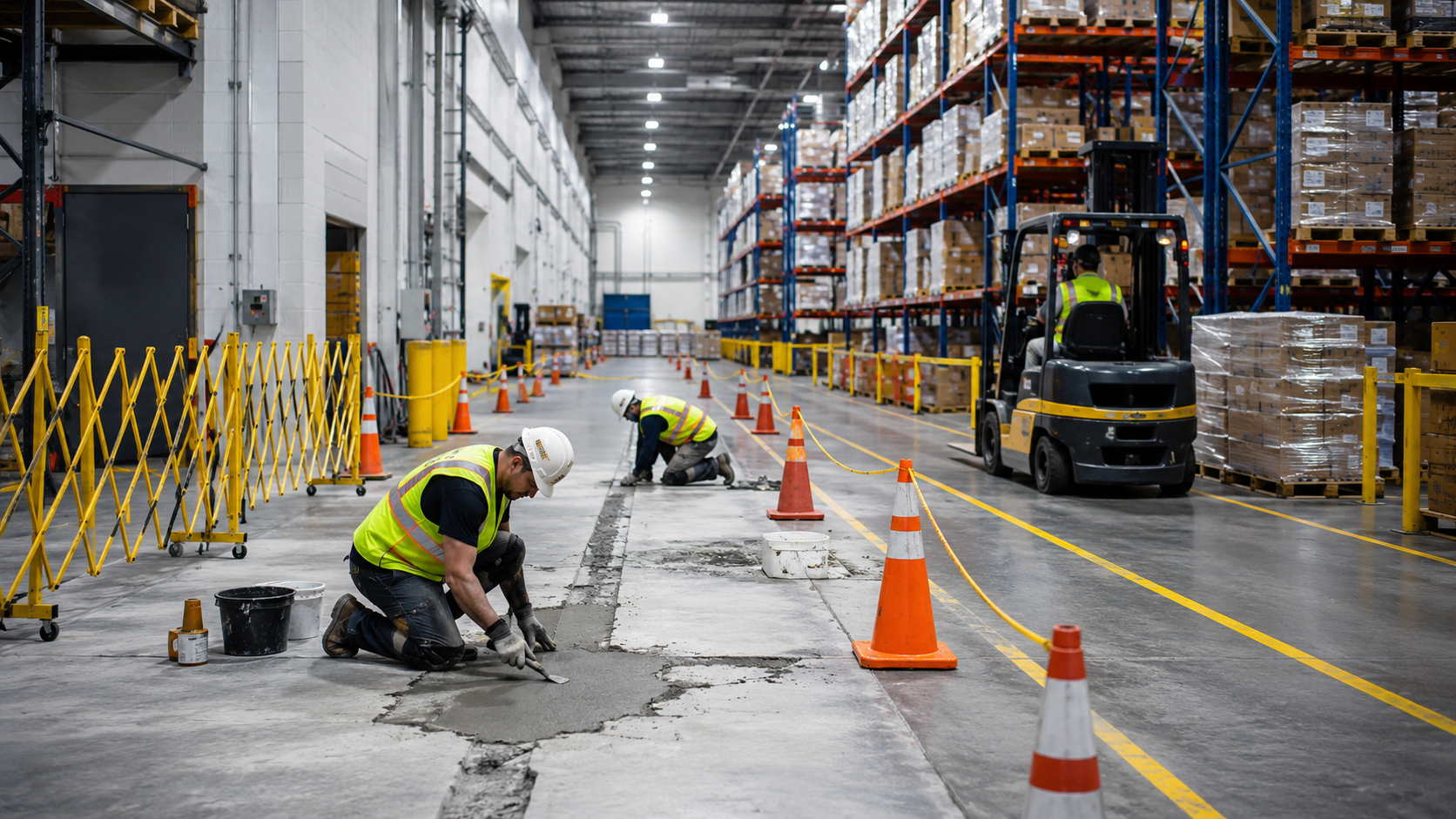
The good news is that many forklift-damaged concrete floor repairs can be planned around operations, depending on the repair type, cure time, traffic level, and location of the damage.
Possible scheduling options may include:
- Repairing one aisle at a time
- Working around dock schedules
- Using temporary traffic reroutes
- Scheduling repairs during off-hours
- Phasing repairs by work zone
- Prioritizing the most hazardous areas first
- Using repair methods that reduce return-to-service time
However, not every repair can be rushed. A floor repair in a high-traffic forklift aisle must be strong enough to handle the abuse after reopening. If the repair material is not ready for traffic, the new repair can fail early.
For warehouses that run multiple shifts or operate around the clock, planning is critical. A contractor should understand material cure times, traffic routing, equipment access, and how to keep the facility moving while repairs are completed.
For more guidance, read concrete floor repair for 24/7 distribution centers in New Jersey.
Repair vs. Replacement: What Makes Sense for Forklift-Damaged Floors?
Forklift-damaged floors do not always need full replacement. In fact, many warehouse floor problems can be repaired if the damage is localized and the slab is still stable.
Repair may make sense when:
- The damage is limited to specific aisles or traffic zones
- Cracks can be properly repaired
- Joint edges can be rebuilt
- Spalling is not too deep or widespread
- The floor can be leveled or stabilized
- The facility needs to limit downtime
- The existing slab still has useful life left
Replacement may be needed when:
- The slab is severely broken across large areas
- The floor has widespread settlement
- The concrete has lost structural integrity
- Previous repairs have failed repeatedly
- The floor cannot support current warehouse loads
- The damage is too extensive for targeted repair
The best decision comes from inspection. Do not replace a floor that could be repaired, but do not keep patching a slab that has clearly failed. Both mistakes can be expensive.
How to Prevent Forklift Damage After Repair
A good repair should not be the end of the conversation. Once the damaged floor is fixed, facility managers should take steps to prevent the same issue from coming back.
Here are practical ways to reduce future forklift damage:
Maintain Floor Joints
Joints are a major impact point for forklifts. Inspect them regularly and repair damaged edges before they spread.
Repair Cracks Early
Small cracks are usually easier to repair than wide cracks with broken edges. Once forklift wheels start striking the crack, the damage can accelerate.
Watch Forklift Wheels
Worn or damaged wheels can increase impact on the floor. If wheels are failing quickly, inspect both the forklift and the floor.
Reduce Sharp Turning Where Possible
Sharp turns create additional surface stress, especially in tight aisles, staging zones, and dock areas.
Keep Aisles Clean
Loose debris can worsen surface abrasion and interfere with forklift travel.
Address Water Problems
Water near doors, docks, or exterior transitions can worsen cracking, settlement, and surface deterioration.
Schedule Regular Floor Inspections
High-traffic forklift routes should be inspected more often than low-use storage areas.
Preventive maintenance will usually cost less than waiting for major floor failure.
When to Call a Forklift-Damaged Concrete Floor Repair Contractor in NJ
You should call a professional repair contractor when floor damage begins affecting safety, equipment movement, or productivity.
Warning signs include:
- Forklifts bounce at joints
- Operators avoid certain aisles
- Cracks are spreading
- Floor patches keep failing
- Joint edges are breaking apart
- Concrete dust or debris keeps returning
- Slabs are uneven or sinking
- Pallet jacks catch on broken concrete
- Loading dock areas are damaged
- There are safety complaints or trip hazards
This is especially important for New Jersey warehouses, distribution centers, food storage facilities, cold storage buildings, manufacturing facilities, logistics hubs, and loading dock-heavy properties where forklift traffic is constant.
Warehouse Floor Repairs provides warehouse concrete floor repair for facilities dealing with forklift damage, cracked floors, damaged joints, spalling, settlement, and uneven concrete surfaces.
Service Areas for Forklift-Damaged Warehouse Floor Repair in New Jersey
Forklift-related floor damage is common in industrial and logistics-heavy areas across New Jersey. Facility managers dealing with damaged warehouse floors can find local service information for several NJ markets, including:
- warehouse floor repairs in Jersey City, NJ
- warehouse floor repairs in Elizabeth, NJ
- warehouse floor repairs in Kearny, NJ
- warehouse floor repairs in Carlstadt, NJ
- warehouse floor repairs in Secaucus, NJ
- warehouse floor repairs in North Bergen, NJ
- warehouse floor repairs in Moonachie, NJ
- warehouse floor repairs in Union, NJ
These local pages are useful for warehouse owners and facility managers who want location-specific service information before requesting an inspection.
Frequently Asked Questions About Forklift-Damaged Concrete Floor Repair
What is the best repair for forklift-damaged concrete floors?
The best repair depends on the type of damage. Cracks may need crack repair. Chipped joints may need joint rebuilding. Spalling may need surface preparation and patching. Uneven slabs may need leveling or stabilization. Severe damage may require partial slab repair or replacement.
Can damaged warehouse floor joints be repaired?
Yes. Damaged warehouse floor joints can often be repaired if the surrounding slab is still stable. Proper repair may involve removing weak concrete, rebuilding the joint edge, filling the joint, and grinding the surface smooth for forklift traffic.
Why do forklifts cause concrete floors to crack?
Forklifts create repeated heavy loads, especially in traffic aisles, turning areas, and at floor joints. If the concrete is already weak, unsupported, cracked, or poorly maintained, forklift traffic can make the damage worse.
Can forklift-damaged floors be repaired while the warehouse stays open?
Often, yes. Many repairs can be phased by aisle, dock, or work zone. Some may be scheduled during off-hours. The exact plan depends on the repair method, cure time, traffic flow, and how quickly the area needs to return to service.
Is it better to repair or replace forklift-damaged concrete?
Repair is often better for localized damage, especially when the slab is still stable. Replacement may be needed when the slab is severely broken, structurally unsound, or failing across large areas.
How do I stop forklift damage from coming back?
Use the correct repair method, maintain floor joints, repair cracks early, inspect forklift wheels, reduce sharp turning where possible, keep aisles clean, and address slab support or water issues before they create more damage.
Get Forklift-Damaged Concrete Floor Repair in NJ
Forklift-damaged concrete floors should not be ignored. Small cracks, chipped joints, spalling, and uneven areas can quickly become larger safety and productivity problems in a busy warehouse.
If your forklifts are bouncing over joints, operators are avoiding certain aisles, concrete patches keep failing, or damaged floor sections are affecting daily operations, it is time to schedule a professional inspection.
Warehouse Floor Repairs helps New Jersey warehouses repair damaged concrete floors, including forklift-damaged aisles, cracked slabs, broken joints, spalling surfaces, uneven floors, and loading dock concrete problems.
To discuss your facility, contact Warehouse Floor Repairs or call (908) 369-3110 to request an evaluation.

- Low-Downtime Concrete Floor Repair for Active Warehouses in NJ - June 30, 2026
- Repair vs Replacement:What to Do With a Damaged Warehouse Concrete Floor - June 30, 2026
- Warehouse Floor Joint Repair: Why Damaged Joints Get Worse Fast - June 30, 2026