
IN THIS ARTICLE
What Facility Managers Should Know about Warehouse Floor Repair vs Replacement
When a warehouse concrete floor starts failing, one question comes up fast: should you repair it or replace it?
It is not a small decision. A damaged warehouse floor can affect forklift movement, pallet jack traffic, worker safety, loading dock productivity, equipment wear, and daily operations. But replacing concrete too early can waste money. On the other hand, patching a floor that has already failed can lead to repeated repairs, more downtime, and higher costs later.
If you are comparing warehouse floor repair vs replacement, the right choice depends on the type of damage, the stability of the slab, the amount of forklift traffic, the depth of the concrete failure, and how much downtime your facility can afford.
For many New Jersey warehouse owners and facility managers, targeted repair is often the smarter first option when the damage is localized. Cracks, damaged joints, spalling, uneven slab sections, and forklift-damaged traffic aisles can often be repaired without removing and replacing the entire concrete floor.
But repair is not always the answer. If the slab is severely broken, structurally unstable, deeply deteriorated, or failing across large areas, replacement may be the better long-term decision.
This guide explains how to think through the repair-or-replace decision before you spend money on the wrong solution.
Why the Repair vs Replacement Decision Matters
A damaged warehouse floor is not just an appearance issue.
In a busy warehouse, the floor is part of the operation. Forklifts run across it all day. Pallet jacks move through the aisles. Employees walk across it. Products are staged, loaded, stored, and moved over it. When the floor begins to fail, the damage can show up in places you may not immediately connect to the concrete.
A failing warehouse floor can lead to:
- Forklifts bouncing over cracks and joints
- Pallet jacks catching on uneven areas
- Operators slowing down or avoiding certain aisles
- Higher forklift wheel and tire wear
- Loose concrete debris in traffic lanes
- Trip hazards for employees
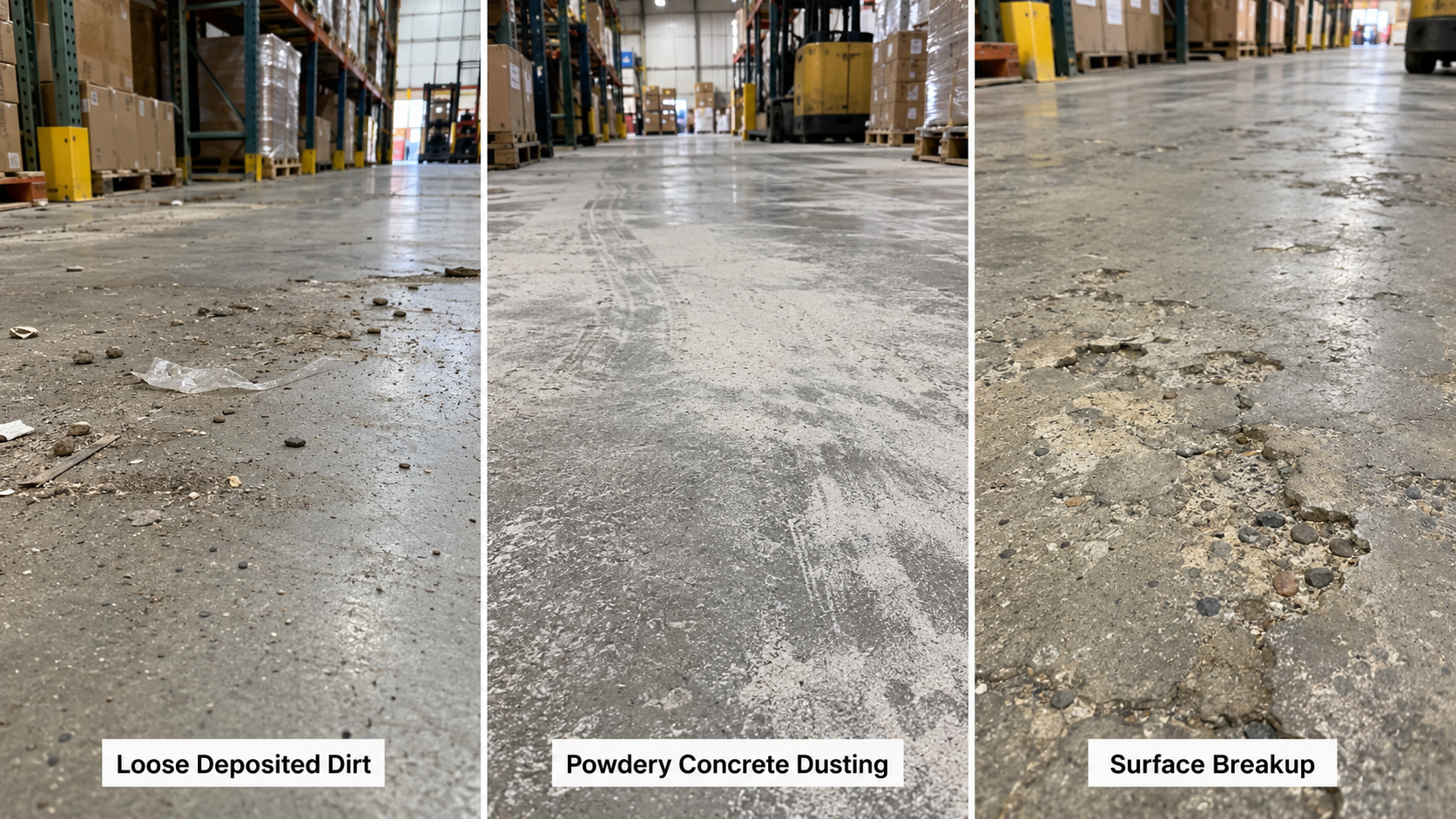
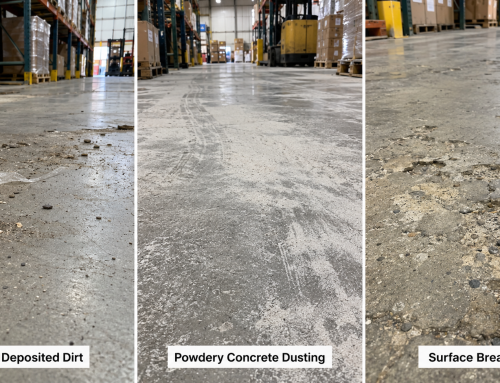
- Dust and surface breakdown
- Loading dock delays
- More frequent maintenance calls
- Safety complaints
- Product movement delays
That is why the decision should not be based only on how the floor looks. A floor that looks ugly may still be repairable. A floor that looks like a simple crack may have deeper movement or support problems underneath.
The goal is not to choose repair because it sounds cheaper or replacement because it sounds more permanent. The goal is to choose the option that matches the actual condition of the concrete and the way the facility uses the floor.
If your facility has multiple types of concrete damage, start with the broader warehouse concrete floor repair service page. It covers common warehouse floor problems such as forklift damage, settlement, joint chipping, uneven floor joints, cracked floors, and spalling.
Warehouse Floor Repair vs Replacement: The Main Difference
Before deciding, it helps to clearly understand what each option involves.
What Warehouse Floor Repair Usually Means
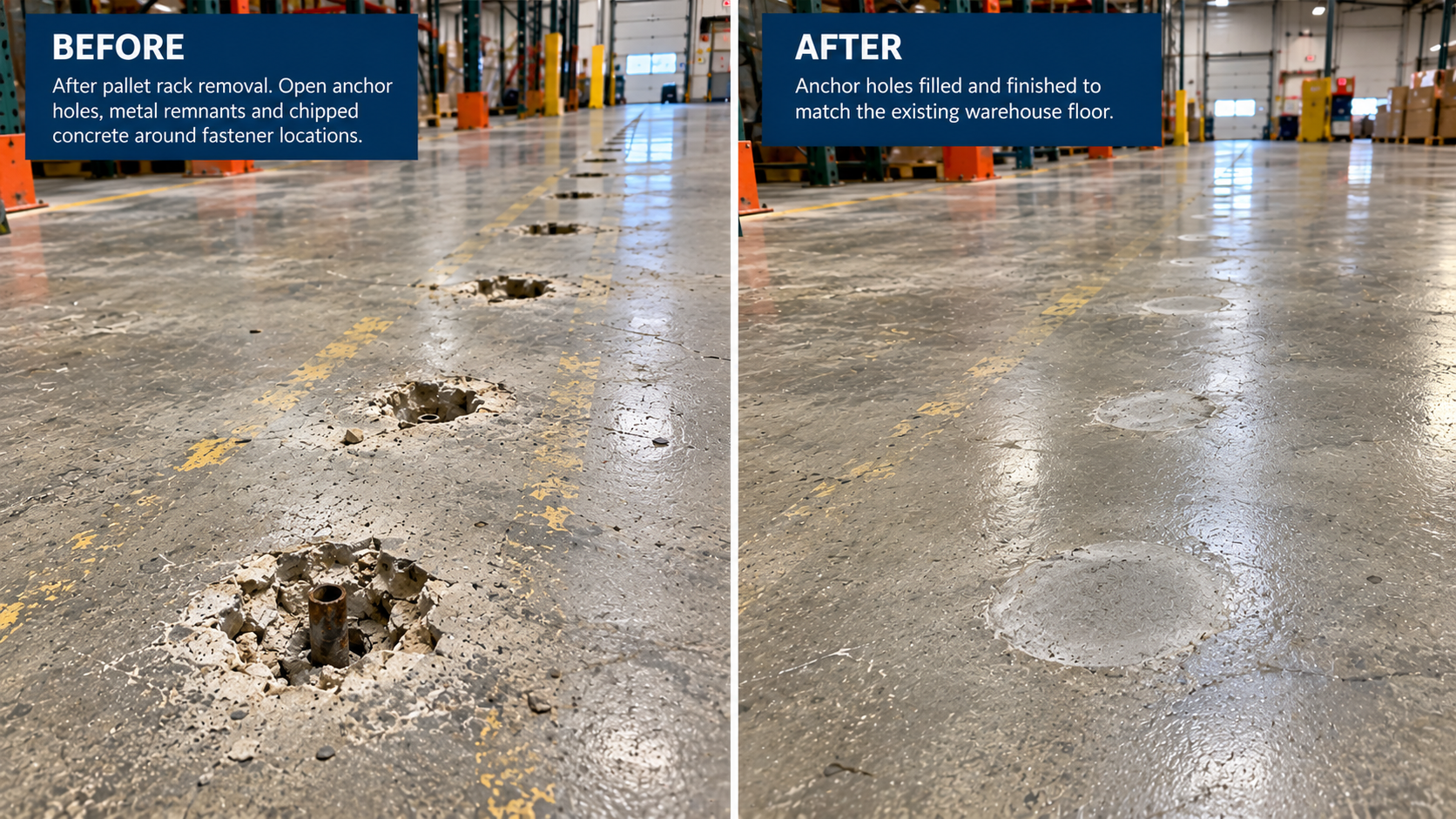
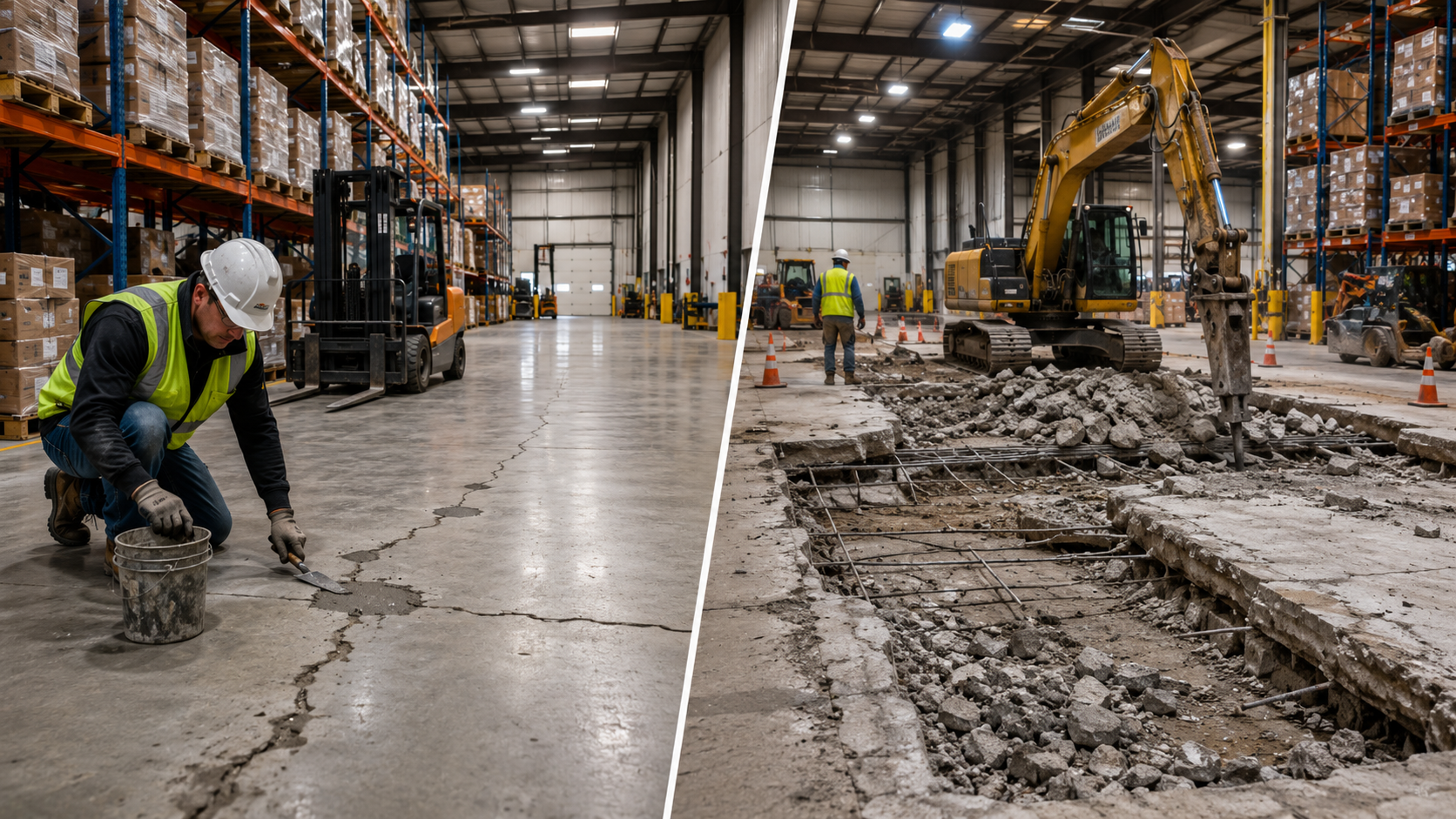
Warehouse floor repair focuses on restoring the existing concrete where possible. Instead of removing the entire slab, a contractor repairs the damaged areas based on the type and severity of the problem.
Common warehouse floor repair methods include:
- Concrete crack repair
- Warehouse floor joint repair
- Spalling repair
- Surface patching
- Grinding and smoothing rough transitions
- Concrete floor leveling
- Slab stabilization
- Repair mortar installation
- Joint rebuilding and sealing
Repair is usually targeted. That means the contractor addresses specific problem areas such as a forklift aisle, loading dock approach, damaged joint line, sunken slab panel, or cracked traffic zone.
This can reduce downtime and avoid unnecessary demolition when the slab still has useful life left.
What Warehouse Floor Replacement Usually Means
Warehouse floor replacement is more invasive. It usually involves removing the damaged concrete section and rebuilding it.
Replacement may include:
- Saw cutting the damaged slab
- Breaking and removing concrete
- Hauling away debris
- Preparing or rebuilding the base
- Installing new reinforcement if needed
- Pouring new concrete
- Finishing the slab surface
- Waiting for the new concrete to cure
- Keeping the work zone closed until it can handle traffic
Replacement may be the right choice when the concrete is too damaged to repair reliably. But it usually comes with more downtime, more disruption, and more operational planning.
When Warehouse Floor Repair Usually Makes Sense
Repair often makes sense when the damage is localized and the slab is still mostly stable.
In many warehouses, the entire floor is not failing. Instead, the damage is concentrated in high-stress areas: forklift lanes, loading dock approaches, turning zones, joints, freezer areas, doorways, and staging zones.
Repair may be the better first option when:
- The damage is limited to specific sections
- The surrounding slab is still sound
- Cracks can be cleaned, filled, or sealed properly
- Joint edges can be rebuilt
- Spalling is surface-level or moderate
- Uneven areas can be leveled or stabilized
- The facility needs to limit downtime
- The floor has not failed across large areas
- Previous damage has not spread deeply through the slab
Below are some common examples of warehouse floor problems that may be repairable.
Cracks in the Warehouse Floor
Cracks do not automatically mean the slab needs replacement.
Some cracks are caused by shrinkage, temperature movement, heavy loads, stress from forklift traffic, or normal slab movement. Others may suggest settlement or deeper support issues. The important question is whether the crack is stable, widening, moving, or affecting forklift traffic.
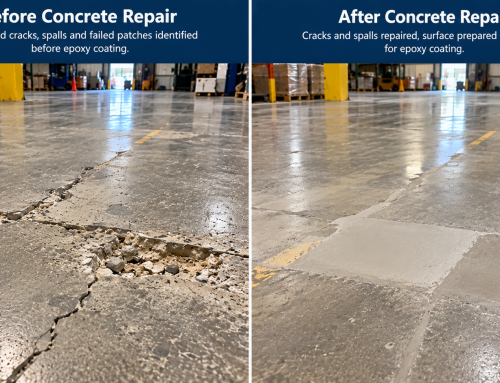
Crack repair may be appropriate when:
- The crack is localized
- The slab is not severely broken
- The crack is not creating major height differences
- The damaged area can be properly cleaned and repaired
- The surrounding concrete is still strong
If cracks are appearing across your floor, review the concrete floor crack repair service page. You can also read this guide on how to identify and repair cracks in warehouse concrete floors, which discusses checking cracks, uneven areas, and signs that may point to deeper settlement concerns.
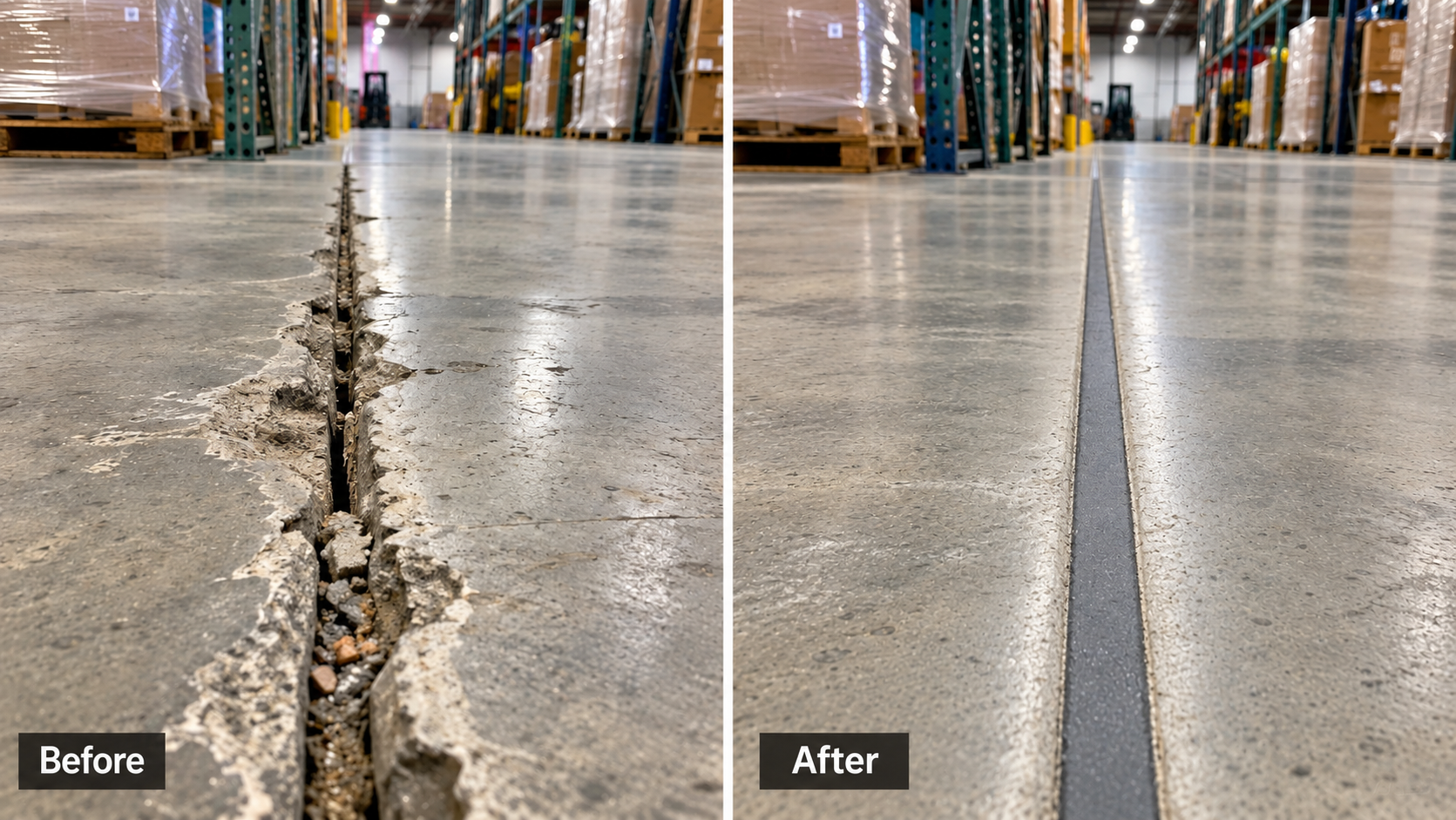
Damaged Warehouse Floor Joints
Joint damage is one of the most common reasons facility managers consider major floor work.
Forklifts and pallet jacks repeatedly cross the same floor joints. Once a joint edge chips or breaks, every wheel impact can make it worse. The damaged joint becomes rougher, wider, and more expensive to fix if it is ignored.
But many damaged joints can be repaired without replacing the slab.
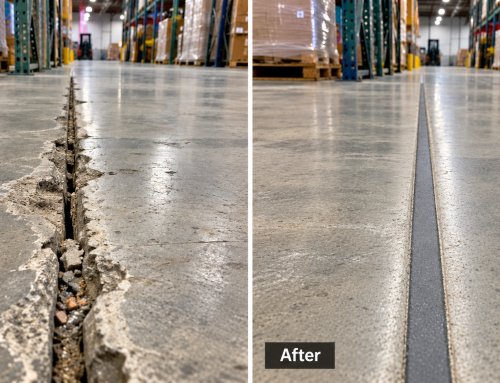
Warehouse floor joint repair may involve removing weak concrete, rebuilding broken joint edges, filling or sealing the joint, and grinding the repair smooth for forklift traffic. The goal is to restore a safer, smoother transition through the traffic path.
If the main issue is chipped or broken joints, visit our concrete warehouse floor joint repair page. We understand that joint rebuilds are important for maintaining warehouse functionality, safety, operational efficiency, and long-term cost savings.
You may also find this related article useful: causes of floor joint damage in warehouse concrete floors.
Concrete Spalling and Surface Breakdown
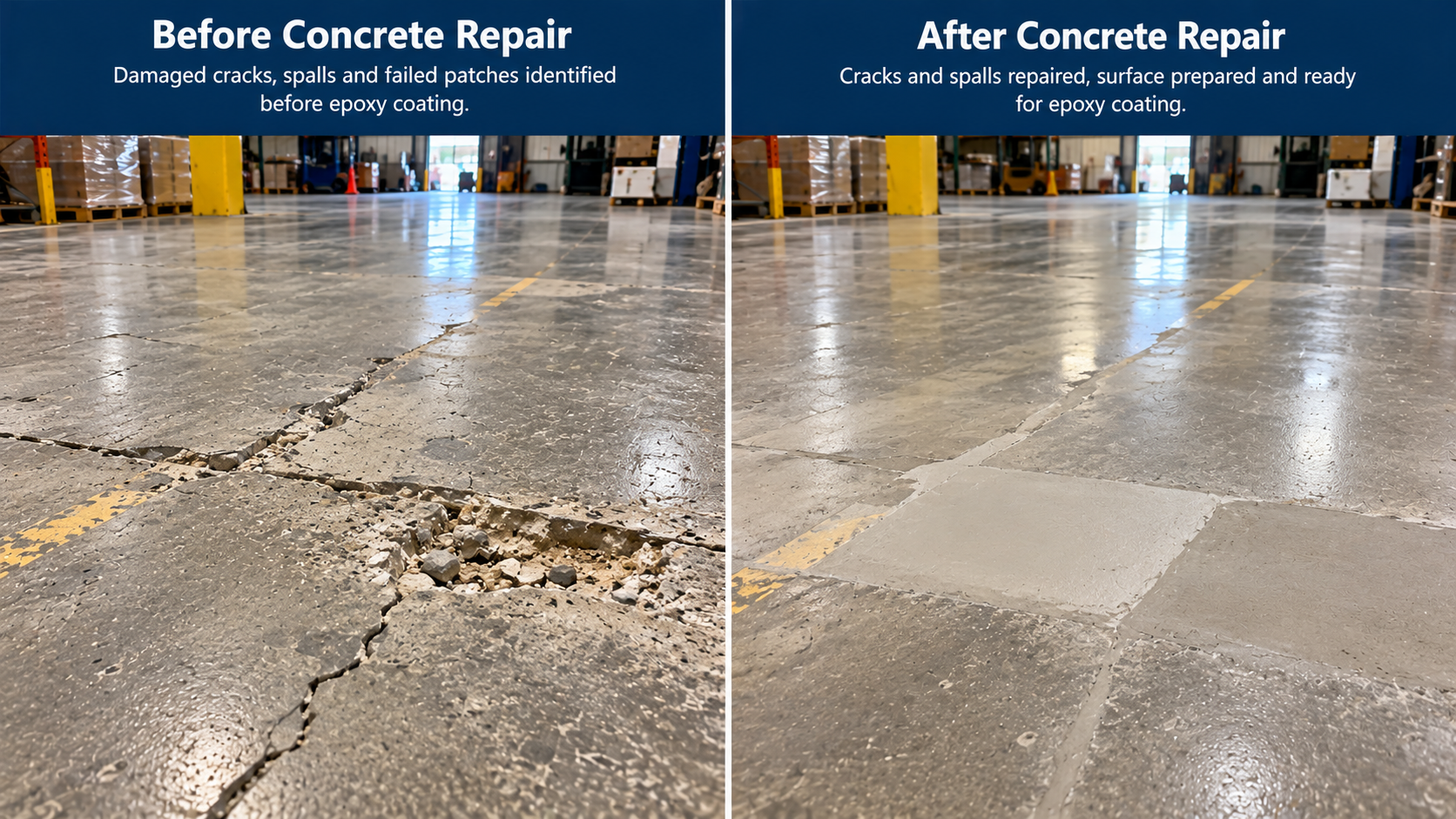
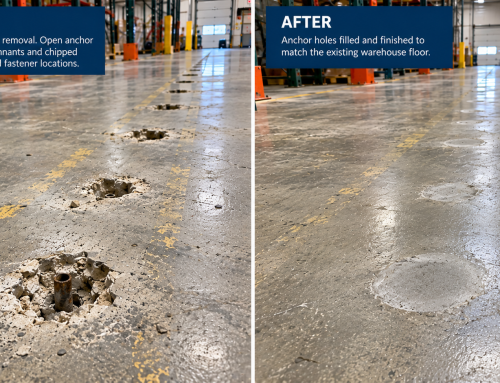
Spalling happens when the concrete surface flakes, chips, breaks, or separates. In warehouses, spalling often appears around joints, loading docks, forklift turning zones, freezer areas, and high-traffic aisles.
Spalling does not always require replacement. If the damage is not too serious or widespread, it may be repairable with proper surface preparation and industrial-grade repair materials.
Spalling repair may make sense when:
- The damage is mostly at the surface
- The surrounding concrete is stable
- Loose material can be removed
- The repair area can be prepared properly
- The repaired surface can handle forklift traffic
Do not make the mistake of patching over weak concrete. If loose or damaged material is not removed first, the repair can fail quickly. The concrete spalling repair service page explains that spalling repair can include surface preparation such as grinding or shot blasting and the use of epoxy mortar compounds for surface repairs.
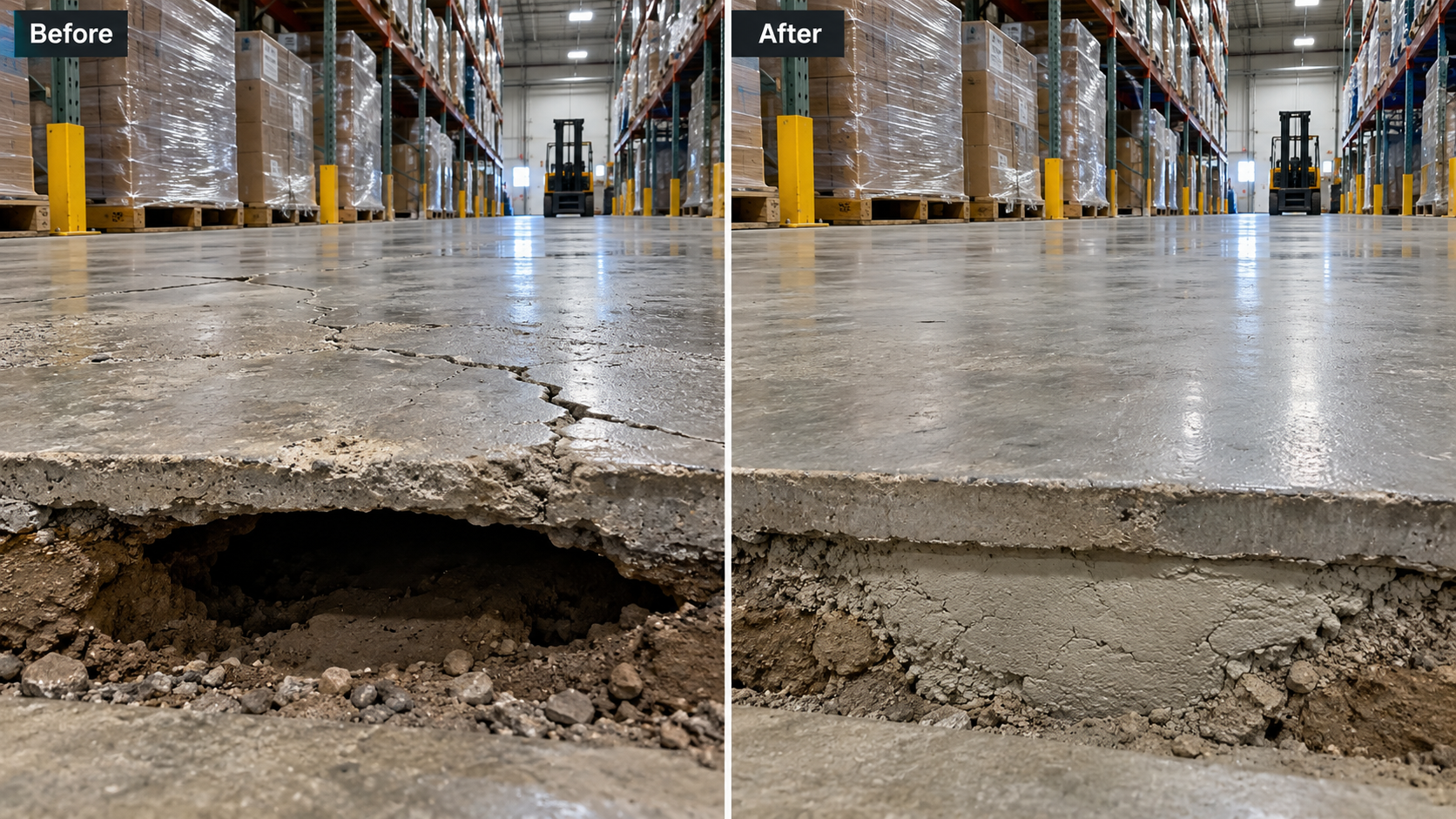
Uneven or Sinking Warehouse Slabs
An uneven slab does not always mean replacement is required.
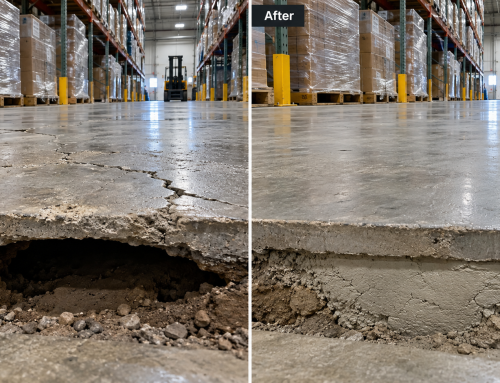
In some cases, the concrete can be lifted, leveled, or stabilized. This is especially important when the slab has settled but is still mostly intact. Instead of removing and replacing the concrete, the repair may focus on restoring support and improving the floor’s levelness.
Leveling may be considered when:
- Forklifts dip or rock in certain areas
- Pallet jacks catch on uneven transitions
- One slab panel has settled lower than another
- Cracks keep forming around uneven areas
- The slab is not completely broken apart
The concrete floor leveling service page is a good internal resource for this type of issue. Some site pages also describe concrete leveling as a way to correct settled commercial floors with less downtime compared with full concrete replacement, which can involve breaking, removal, disposal, prep work, and extended curing time.
When Warehouse Floor Replacement May Be Necessary
Repair is not always the right answer.
There are cases where replacement is the smarter long-term option, especially when the slab is too damaged to perform safely under warehouse traffic.
Replacement may be necessary when:
- The slab is severely broken through
- Concrete is crumbling deeply across a large area
- The subbase has failed badly
- Multiple slab panels are unstable
- The floor can no longer support equipment loads
- Previous repairs keep failing because the slab is moving
- There is major settlement across a wide area
- The damaged section creates an immediate safety hazard
- The concrete is too deteriorated for repair materials to bond properly
- The floor has widespread structural failure
Replacement is not the enemy. Sometimes it is the responsible decision.
The mistake is replacing a floor that could have been repaired, or repeatedly patching a floor that has clearly failed.
That is why inspection matters. A contractor should evaluate whether the visible damage is isolated or whether it points to a deeper slab, base, drainage, or load-support problem.
How Forklift Damage Affects the Repair-or-Replace Decision
Forklift traffic changes everything.
A floor repair that might work in a low-traffic storage corner may fail quickly in a main forklift aisle. Forklifts concentrate heavy loads through small wheels. When they cross cracks, joints, spalled areas, or uneven transitions repeatedly, the damage can spread fast.
Forklift-damaged floors may still be repairable if the damage is localized and the slab is stable.
Repair may work when:
- Joint edges can be rebuilt
- Cracks can be repaired
- Spalling is limited to the surface
- The slab has not broken deeply
- The floor can be leveled or stabilized
- The repaired area can be finished smooth enough for traffic
Replacement may be more likely when:
- Forklift traffic has broken the slab deeply
- Multiple panels have failed
- The floor is unstable under load
- Previous patches fail repeatedly
- Settlement affects a wide area
- The concrete cannot support normal warehouse operations
If your damage is clearly tied to forklift traffic, read how to protect warehouse concrete floors from forklift damage. That article discusses heavy forklift traffic, sharp turns, repeated use, and heavy loads as contributors to floor damage. For crack-specific forklift issues, read warehouse floor cracks from forklift traffic.
Cost Factors: Why Repair Often Costs Less Upfront
In general, repair often costs less upfront because it is targeted. Replacement usually costs more because it involves demolition, disposal, new concrete, curing time, and more disruption.
But the cheapest upfront option is not always the cheapest long-term option.
A repair may cost less today, but if the slab is unstable and the repair fails, the facility may pay for the same problem again. Replacement may cost more today, but it may make sense if the concrete is deeply failed and no targeted repair can hold up.
Cost depends on:
- The size of the damaged area
- The type of damage
- The depth of the failure
- Whether the slab is moving
- The amount of forklift traffic
- The material required
- Surface preparation needs
- Access restrictions
- Downtime limits
- Whether repairs can be phased
- Demolition and disposal requirements
- Cure time before reopening
Some localized repair projects may be far more practical than replacement. But if you are dealing with widespread slab failure, replacement may be the more realistic long-term investment.
| Floor Condition | Repair Consideration | Replacement Consideration |
|---|---|---|
| Localized cracks | Often repairable if slab is stable | Usually not necessary |
| Damaged joints | Often repairable with joint rebuilding | May be needed if slab panels are badly failed |
| Surface spalling | Often repairable with preparation and patching | Consider if damage is deep and widespread |
| Uneven slab section | May be leveled or stabilized | Consider if base failure is severe |
| Repeated patch failures | Needs deeper diagnosis | May be needed if slab is unstable |
| Widespread slab failure | Repair may not be enough | Replacement may be best |
| High downtime sensitivity | Phased repair may reduce disruption | Replacement may require longer shutdown |
Downtime: The Factor Many Facility Managers Underestimate
Downtime can change the entire repair-or-replace decision.
A replacement project may look reasonable on paper until you calculate what it means for operations. Will a loading dock close? Will a forklift aisle be unavailable? Will racks need to be cleared? Will trucks need rerouting? Will production slow down? Will the area need to cure before traffic returns?
Repair may allow more flexibility:
- Work can sometimes be phased by aisle.
- Repairs may be scheduled during off-hours.
- Only the damaged zone may need to be closed.
- Traffic may be rerouted temporarily.
- Some repair methods may allow faster return to service.
Replacement usually involves more disruption:
- Concrete must be broken and removed.
- Debris must be hauled out.
- The base may need preparation.
- New concrete must be placed and finished.
- The slab needs time before it can handle traffic.
- The work zone may stay closed longer.
The cheapest option on the estimate may not be the cheapest option for the business if it shuts down a dock, aisle, or production zone for too long.
This is especially important for facilities that operate around the clock. If your warehouse cannot easily stop operations, read concrete floor repair for 24/7 distribution centers in New Jersey.
How to Inspect a Damaged Warehouse Floor Before Deciding
Facility managers do not need to diagnose the floor like engineers. But you can do a practical walk-through before calling a contractor.
Look for these signs:
- Are cracks narrow, wide, or spreading?
- Are floor joints chipped, uneven, or breaking apart?
- Is concrete spalling or flaking?
- Are slab panels uneven?
- Do forklifts bounce, dip, or vibrate in certain areas?
- Does concrete dust or debris keep returning?
- Have previous patches failed?
- Is the damage localized or widespread?
- Is water entering the area?
- Are loading docks affected?
- Are operators avoiding certain zones?
- Are forklift wheels wearing faster than expected?
- Does the floor sound hollow in some areas?
- Does the damage affect safety or traffic flow?
The answers can help determine whether you are looking at a localized repair, a leveling issue, a joint failure, a spalling problem, or a possible replacement situation.
For a broader overview of floor problems, visit common issues with warehouse concrete floors and how to fix them. That resource covers cracks, joint damage, and other early signs of warehouse floor deterioration.
Decision Guide: Should You Repair or Replace?
Use this as a practical starting point, not a final diagnosis.
| Floor Condition | Best Starting Point |
|---|---|
| Minor cracks in a stable slab | Repair |
| Chipped joints in forklift aisles | Joint repair |
| Surface spalling in a localized area | Spalling repair |
| Uneven but intact slab | Leveling or stabilization inspection |
| Repeated patch failures | Professional diagnosis |
| Deep broken concrete across a large area | Replacement evaluation |
| Major settlement across multiple panels | Stabilization or replacement review |
| Immediate safety hazard | Urgent inspection |
| Damage near loading docks | Repair, leveling, or replacement evaluation |
| Widespread slab failure | Replacement may be necessary |
The most important takeaway is this: do not guess.
Guessing can lead to two expensive mistakes. You may replace a floor that could have been repaired, or you may keep patching a floor that needs a more serious solution.
Why Repeated Patching Can Become More Expensive Than Proper Repair
Repeated patching is one of the most common problems in warehouse floor maintenance.
The same area gets patched. Forklifts run over it. The patch breaks down. Maintenance patches it again. A few months later, it fails again.
This usually happens because the patch does not fix the cause.
Patches fail when:
- Loose concrete was not removed
- The wrong material was used
- Joint edges were not rebuilt
- The slab continued moving
- The floor reopened to traffic too soon
- Forklift traffic was too heavy for the material
- The surrounding concrete was already weak
- Settlement or voids below the slab were ignored
A cheap patch can become expensive when you pay for it again and again.
If joint edges are failing, repair the joint properly. If cracks are widening, investigate the cause. If a slab is sinking, consider leveling or stabilization. If the concrete has failed deeply, replacement may need to be discussed.
The right repair should be based on the floor’s actual condition, not just the visible surface damage.
Repair vs Replacement for Loading Dock Areas
Loading dock concrete deserves special attention because it takes a beating.
Trucks back in. Forklifts move in and out. Pallets are staged. Water, salt, and temperature changes can affect the slab near exterior doors. If concrete near the dock is sinking, cracking, spalling, or breaking apart, the repair-or-replace decision becomes more serious.
Repair may be enough if the damage is localized and the slab can be stabilized. Replacement may be needed if the concrete is badly broken, unsafe, or no longer supports normal dock activity.
If your problem is near a dock, read loading dock concrete sinking in NJ before deciding. Dock problems often involve more than surface wear.
Repair vs Replacement for New Jersey Warehouse Facilities
New Jersey warehouses often operate in high-demand industrial environments. Many facilities deal with constant forklift traffic, dock activity, leased-space maintenance questions, cold storage needs, manufacturing traffic, logistics deadlines, and limited downtime windows.
That means the repair-or-replace decision should consider more than concrete condition alone.
Facility managers should also think about:
- How the damaged area affects operations
- Whether the facility can close that section
- Whether the damage creates safety exposure
- Whether the building owner or tenant is responsible
- Whether repairs can be phased
- Whether forklift traffic can be rerouted
- Whether the same problem has been patched before
- Whether the floor damage is affecting equipment maintenance costs
A New Jersey warehouse with one damaged aisle may need targeted repair. A facility with multiple unstable slab panels may need deeper evaluation. A loading dock with sinking concrete may need leveling or stabilization. A severely broken slab section may need replacement.
The key is to match the fix to the facility, not force the same solution onto every floor.
Frequently Asked Questions About Warehouse Floor Repair vs Replacement
How do I know whether to repair or replace my warehouse floor?
Start by looking at the type of damage, the condition of the slab, the amount of forklift traffic, and whether the problem is localized or widespread. Repair may make sense for cracks, joints, spalling, and uneven areas when the slab is still stable. Replacement may be needed if the slab is severely broken, unstable, or failing across large areas.
Is warehouse floor repair usually cheaper than replacement?
Repair is often cheaper upfront because it targets specific damaged areas. Replacement usually costs more because it involves demolition, disposal, new concrete, curing time, and longer downtime. However, if the slab has failed badly, repeated repair attempts may cost more over time.
When is warehouse concrete floor replacement necessary?
Replacement may be necessary when the slab is deeply broken, structurally unstable, severely settled, crumbling across a large area, or unable to support normal warehouse loads. It may also be needed when previous repairs keep failing because the base or slab has failed.
Can forklift-damaged warehouse floors be repaired?
Yes, many forklift-damaged floors can be repaired if the damage is localized and the slab is stable. Forklift-related cracks, joint damage, spalling, and uneven areas can often be repaired with the right method and materials.
Can repairs be done without shutting down the whole warehouse?
Often, yes. Repairs can sometimes be phased by aisle, dock, traffic lane, or work zone. The exact plan depends on the repair method, cure time, access, and how quickly the area must return to forklift traffic.
Why do warehouse floor patches keep failing?
Patches often fail because the cause was not fixed. Common reasons include slab movement, poor preparation, weak repair material, heavy forklift traffic, loose surrounding concrete, or reopening the area before the repair is ready.
Get Help Deciding Between Warehouse Floor Repair and Replacement in NJ
If your warehouse concrete floor is cracked, spalling, uneven, forklift-damaged, breaking at the joints, or sinking near loading docks, do not guess whether repair or replacement is the right move.
A professional inspection can help you avoid wasting money on unnecessary replacement or repeated patching that fails again.
Warehouse Floor Repairs helps New Jersey facility managers evaluate damaged concrete floors and recommend the right repair path. Depending on the condition of your floor, that may include crack repair, joint repair, spalling repair, concrete floor leveling, slab stabilization, or replacement evaluation when necessary.
To discuss your facility, contact Warehouse Floor Repairs or call (908) 369-3110 to request an evaluation.