
IN THIS ARTICLE
Discover When to Refill Your Warehouse Concrete Floor Joint and When to Rebuild It
If the material between your warehouse slabs is coming loose, sweeping it away only clears the aisle.
The next question is more important:
Has the joint filler failed on its own, or is the concrete beside the joint breaking down too?
That distinction matters when you arrange a warehouse joint filler replacement for your New Jersey or Eastern Pennsylvania facility.
If the concrete edges are still solid, removing the failed material and replacing the joint filler may be enough. But if forklifts have already chipped and broken the edges, simply putting new material into the gap will not restore a smooth, durable crossing.
We see this concern in busy warehouse environments where the same joints are crossed again and again throughout the day.
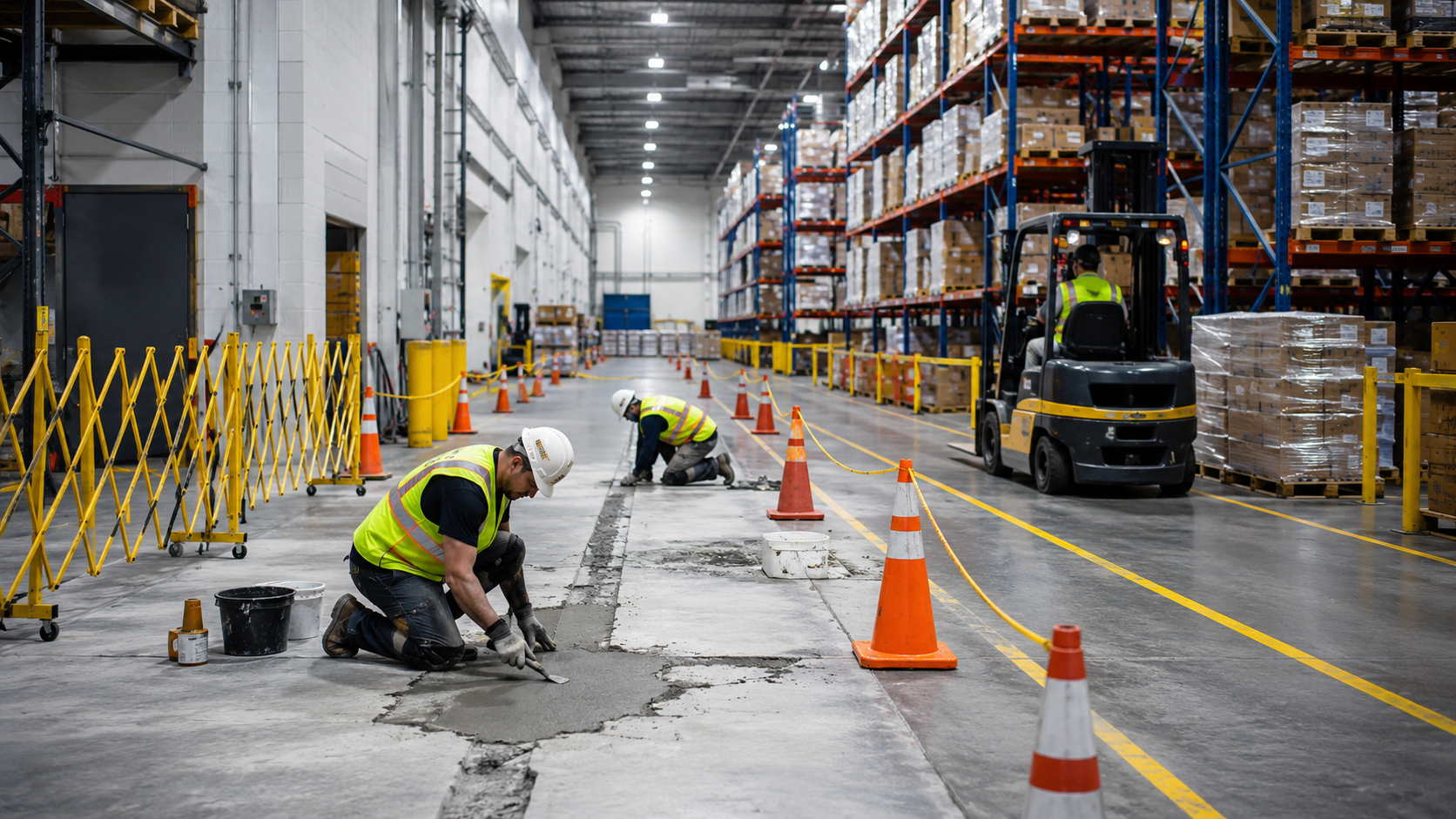
Imagine a main forklift aisle in a Woodbridge, NJ warehouse. A section of joint filler starts pulling loose. Forklift wheels cross that joint every few minutes, and there is not much room to reroute traffic because storage racks line both sides of the aisle.
What begins as loose filler soon feels like a rough bump to the operator.
The facility manager now needs to know whether this is still a straightforward filler replacement or whether the damaged concrete around the joint also needs repair.
The same situation can happen in a busy Lehigh Valley distribution center.
The answer starts with looking at more than the material inside the joint.
Is the Joint Filler Missing, or Are the Concrete Edges Breaking Away?
A failed warehouse floor joint does not always look the same.
Sometimes the filler simply separates from one side of the joint, pulls out in strips or disappears from sections of the gap.
Other times, what looks like failed filler is actually part of a bigger concrete problem.
Look closely at the edges on both sides.
Failed filler with solid concrete edges
If the existing filler is loose or missing but the concrete edges remain straight, hard and intact, the problem may be concentrated within the joint itself.
You might notice:
- Filler pulling away from one side
- Sections of material lifting out
- Gaps where filler is completely missing
- Debris collecting inside the open joint
- A rougher forklift crossing even though the concrete edges are still sound
This is the type of condition where removal and replacement of the failed filler may be considered after the joint is properly evaluated and prepared.
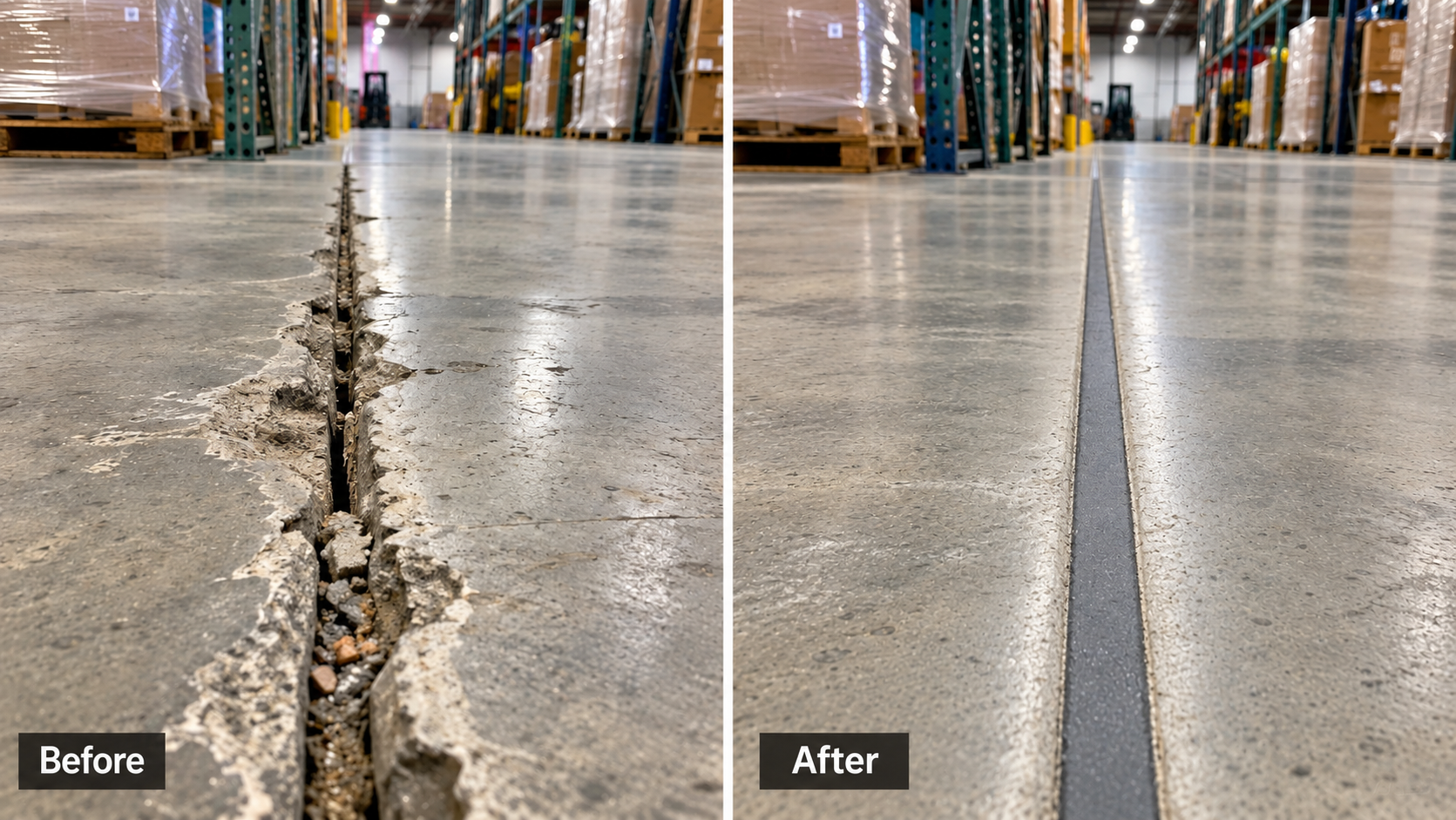
Broken or chipped concrete edges
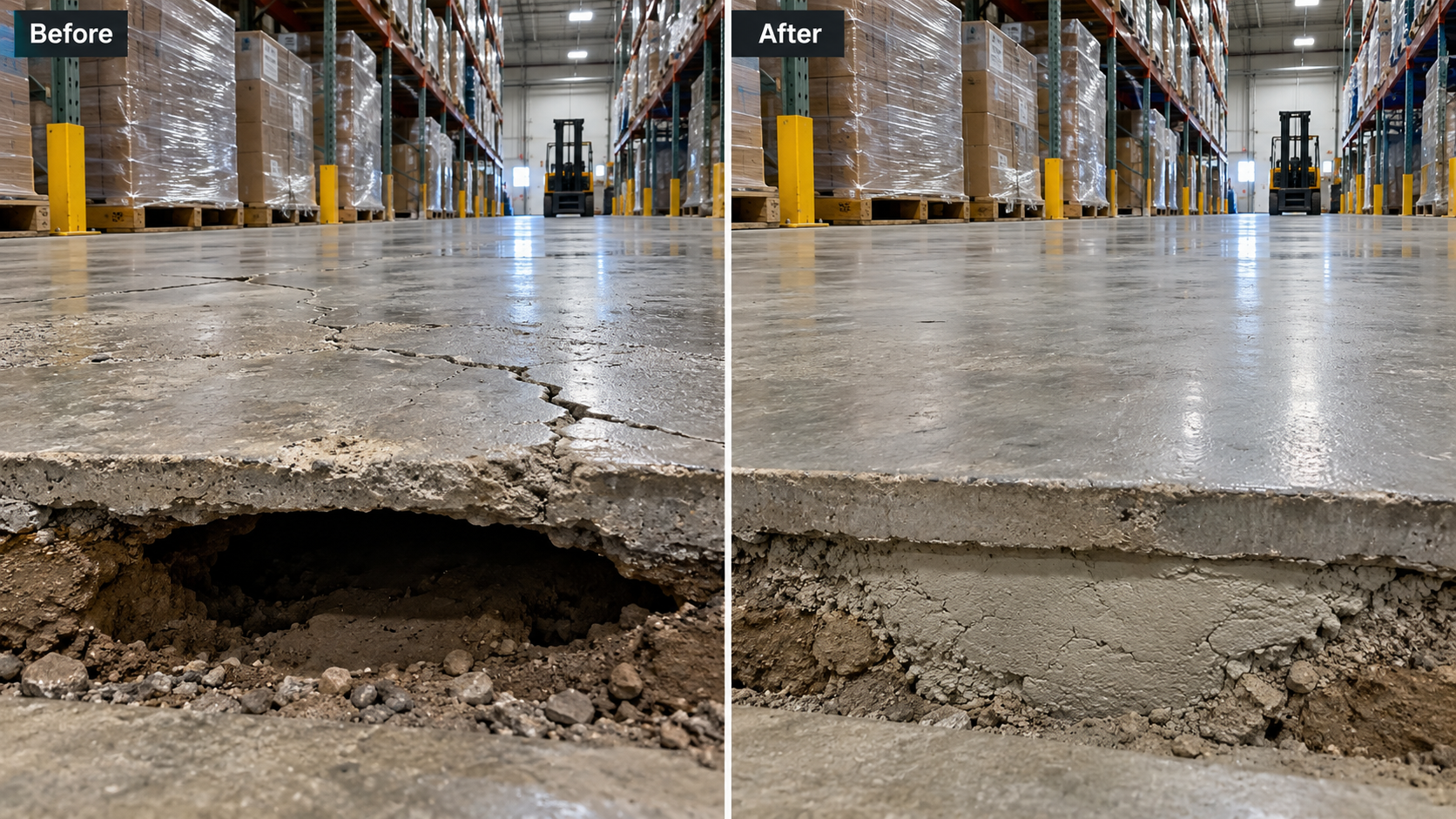
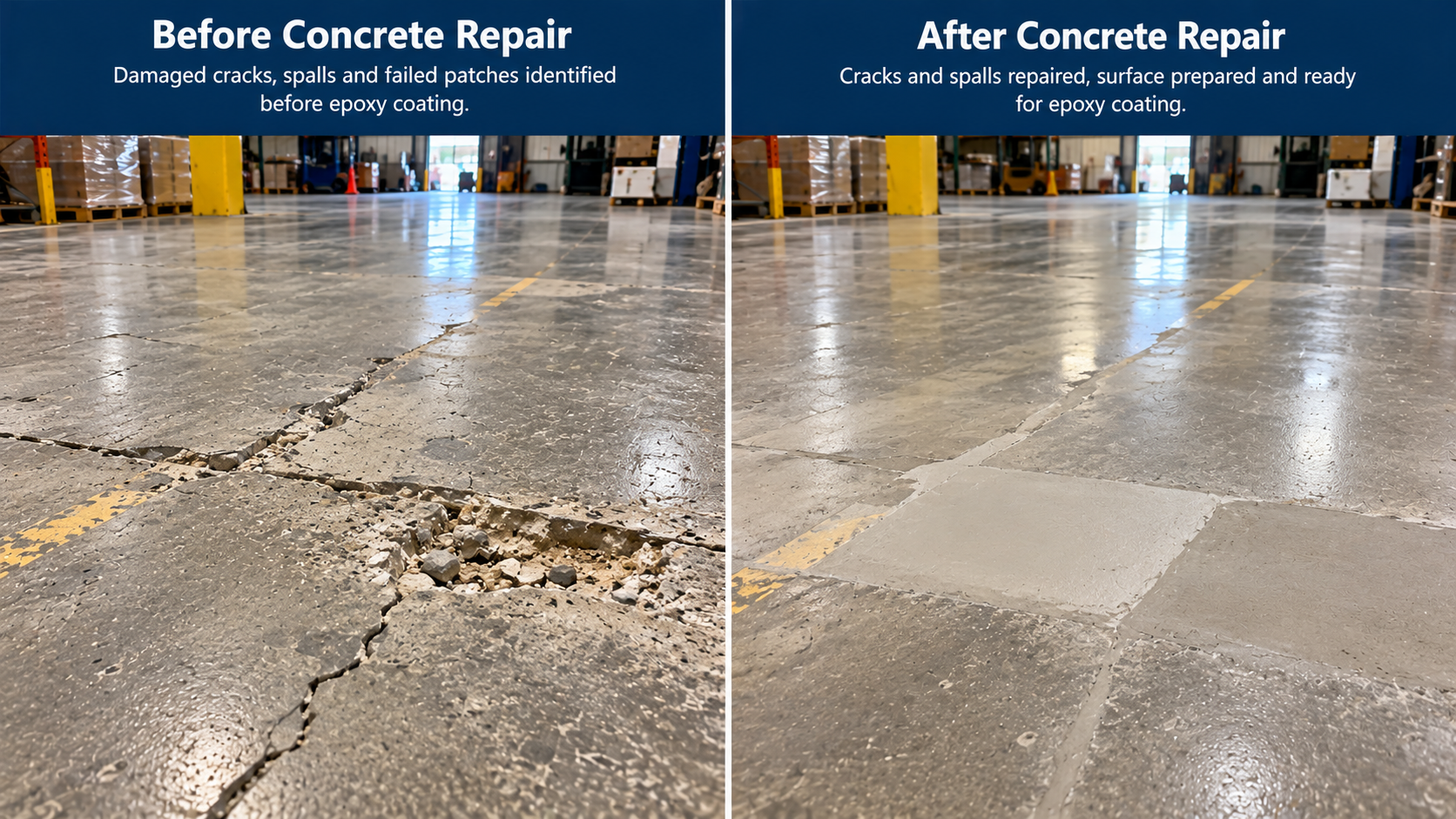
The scope changes when concrete beside the joint has started breaking away.
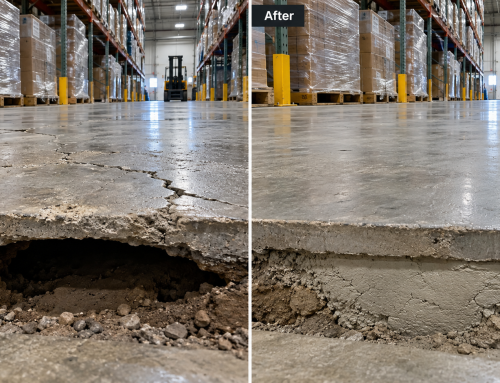
A forklift wheel crossing an unsupported or damaged joint edge can strike that concrete repeatedly. Once a small chip develops, each crossing can make the opening wider and rougher.
You may see:
- Rounded or chipped joint edges
- Loose pieces of concrete
- Widening damage beside the original joint
- Pitting around the joint
- Exposed aggregate
- A noticeable bump or drop when forklifts cross
At that point, simply replacing the filler may leave the real problem untouched.
The damaged edges may first need to be reconstructed.
If you want a broader explanation of why this type of deterioration tends to accelerate, our guide to warehouse floor joint damage and why it gets worse fast explains what repeated forklift impact can do once the joint starts breaking down.
Why the Type of Warehouse Joint Matters Before Replacing the Filler
One reason we do not recommend choosing joint filler based only on what was there before is that not every concrete joint performs the same job.
Before replacing failed material, we want to understand what kind of joint we are dealing with and how much movement is taking place.
Warehouses can contain contraction joints, construction joints and other joints intended to accommodate different kinds of slab movement.
Some locations may also contain isolation or movement joints that should not automatically be treated the same way as a typical saw-cut warehouse floor joint.
That matters because the repair material has to match the function of the joint.
A product that works well in one type of warehouse joint may not be appropriate everywhere.
We also pay attention to what the joint is doing under actual warehouse conditions.
Is it staying relatively stable?
Are the slab panels opening and closing?
Is one side sitting higher than the other?
Is there movement beneath the slab?
Has the filler failed because of age and traffic, or is continued slab movement pushing the repair beyond what it can handle?
Those are very different situations.
For example, imagine replacing the filler in a joint where one slab panel is moving vertically every time a loaded forklift passes.
The new filler may make the joint look better temporarily, but it does not correct the support problem underneath the concrete.
This is why inspection comes before material selection.
If you are interested in the broader reasons joints deteriorate, we have also covered the common causes of warehouse concrete floor joint damage.
The important point here is simpler:
Do not treat every empty joint as a hole that just needs to be filled.
First determine why the previous material came out and whether the surrounding concrete is still doing its job.
When Does the Job Change From Refilling to Rebuilding?
For a facility manager, this is usually the main decision.
There are three different repair situations that can look similar from across the aisle.
1. The filler has failed, but the joint edges are sound
When the surrounding concrete remains solid and reasonably straight, the work may primarily involve removing failed material, cleaning and preparing the joint, and installing an appropriate replacement system.
The key word is appropriate.
The joint type, traffic, temperature and expected movement still need to be considered before deciding what belongs back in the joint.
2. The filler has failed and the concrete edges are damaged
This is no longer just a filler problem.
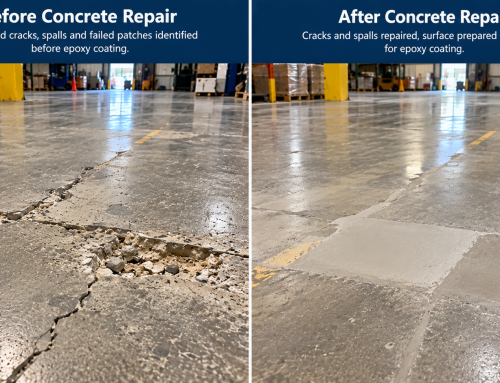
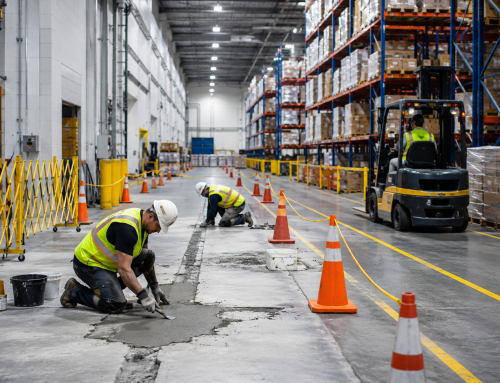
If forklift traffic has chipped, crushed or spalled the concrete beside the joint, those damaged sections may need to be removed back to sound concrete and rebuilt.
Our warehouse floor joint repair service addresses damaged concrete joints where repair may involve preparation, joint-edge rebuilding and treatment of the joint based on its actual condition.
The goal is not simply to make the gap disappear.
For a warehouse, the practical goal is to restore a smoother, more durable traffic transition so forklifts and material-handling equipment are not continually striking a broken edge.
3. The slabs themselves are moving or uneven
This needs to be separated from both filler failure and edge damage.
If one slab panel has settled, become unsupported or is moving independently, rebuilding the joint edges alone may not solve the underlying problem.
The support or stabilization issue has to be identified separately.
This is something we pay close attention to because a beautiful joint repair can fail again if the concrete on either side continues moving.
For a facility manager, that means the repair proposal should clearly tell you what is being addressed.
Is it:
joint filler replacement, concrete edge rebuilding, slab stabilization — or a combination of them?
Those should not be bundled together as though they are the same problem.
What Should You Gather Before a Warehouse Joint Repair Evaluation?
You do not need to diagnose the joint yourself before calling us.
But a few details can make the initial conversation much more useful.
Start with the approximate length of joint affected.
For example:
- 20 feet across one aisle
- Several short sections near loading docks
- Approximately 100 feet through a main forklift route
- Multiple intersections throughout the warehouse
Then look at the joint width and depth as best you can.
You do not need precise engineering measurements. Photos with a ruler, tape measure or another common object for scale can be very helpful.
We also want to know about the condition of the concrete edges.
Are they:
- Straight and intact?
- Slightly chipped?
- Breaking away?
- Deeply spalled?
- Uneven from one slab to another?
The operating environment matters too.
Tell us whether the area is:
- A normal ambient-temperature warehouse
- A refrigerated or cold-storage facility
- Subject to regular washdowns
- Near exterior doors
- Exposed to significant temperature changes
Finally, describe the traffic.
A lightly used storage aisle is very different from a main distribution-center route carrying loaded forklifts around the clock.
If rerouting traffic is difficult, tell us that too.
That is common in New Jersey and Eastern Pennsylvania warehouse facilities where racking, loading areas and production layouts leave only a few practical travel paths.
Before requesting an evaluation, it helps to collect:
- Facility location
- Approximate joint length affected
- Approximate joint width
- Photos of the failed filler
- Photos of both concrete edges
- Whether the slabs feel uneven
- Type and frequency of forklift traffic
- Normal operating temperature
- Any previous repairs you know about
- How much downtime or aisle closure is practical
The more clearly we understand how your floor operates, the better we can evaluate what the joint actually needs.
How We Can Help With Failed Warehouse Joint Filler
At Warehouse Floor Repairs, we repair warehouse and industrial concrete floors throughout New Jersey and Eastern Pennsylvania.
When a warehouse joint filler is coming out, our goal is not to walk in, refill the gap and leave without determining why it failed.
We want to separate the problem into the right repair categories.
If the joint filler has failed but the concrete edges remain sound, the proposed work should reflect that.
If the edges have broken away, the scope should identify the concrete reconstruction that is needed.
And if we find a separate slab-support or movement issue, that should be identified separately rather than hidden inside a generic “joint repair” recommendation.
That distinction matters because your real goal is not simply to put material between two pieces of concrete.
You need a warehouse floor that forklifts, pallet jacks and employees can cross without repeatedly striking a broken joint.
A good repair plan should therefore answer three questions:
What failed?
What needs to be rebuilt?
Is anything underneath the slabs contributing to the problem?
Once those questions are answered, it becomes much easier to decide whether you are dealing with straightforward warehouse joint filler replacement or a more complete joint reconstruction.
If the filler in your warehouse floor is pulling out, missing or surrounded by broken concrete, contact us to arrange a warehouse joint evaluation.
Call (908) 369-3110 and tell us your New Jersey or Eastern Pennsylvania location, the approximate length affected, and whether the concrete edges are breaking away.
We can help you determine whether the joint needs to be refilled, rebuilt or evaluated for a separate slab-support problem before more forklift traffic makes the crossing worse.