
IN THIS ARTICLE
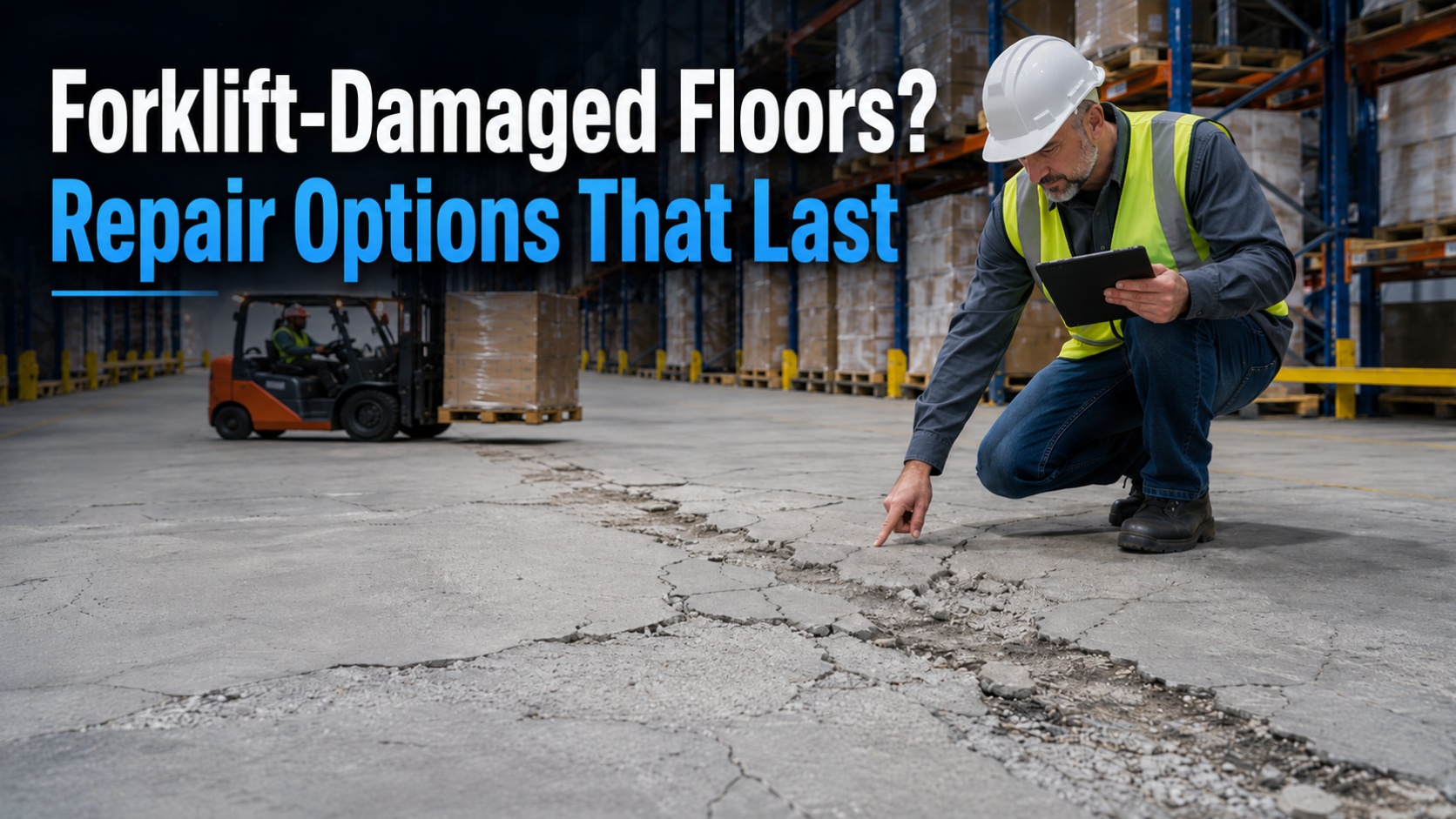
Discover How Warehouse Floor Cracks from Forklift Traffic Happen and Real Solutions That Actually Last For NJ & Eastern PA Warehouse Facilities
If you manage a warehouse in New Jersey or Eastern Pennsylvania, there’s a good chance you’ve seen this problem develop over time.
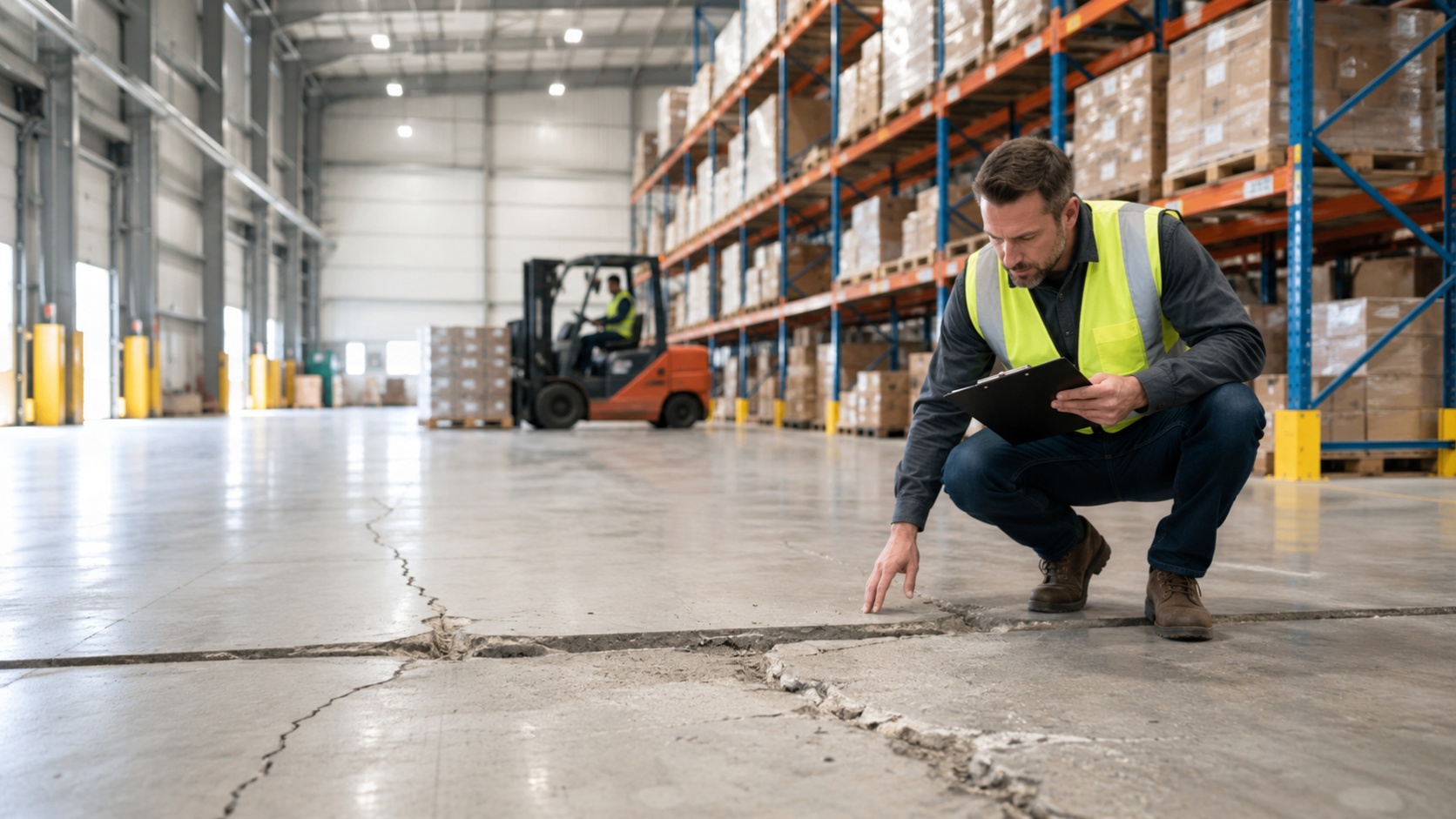
It usually doesn’t start as anything serious. A small crack appears along a joint or in a forklift lane. At first, it’s easy to ignore. Operations continue, forklifts move over it, and nothing seems immediately wrong.
Then, gradually, things begin to change.
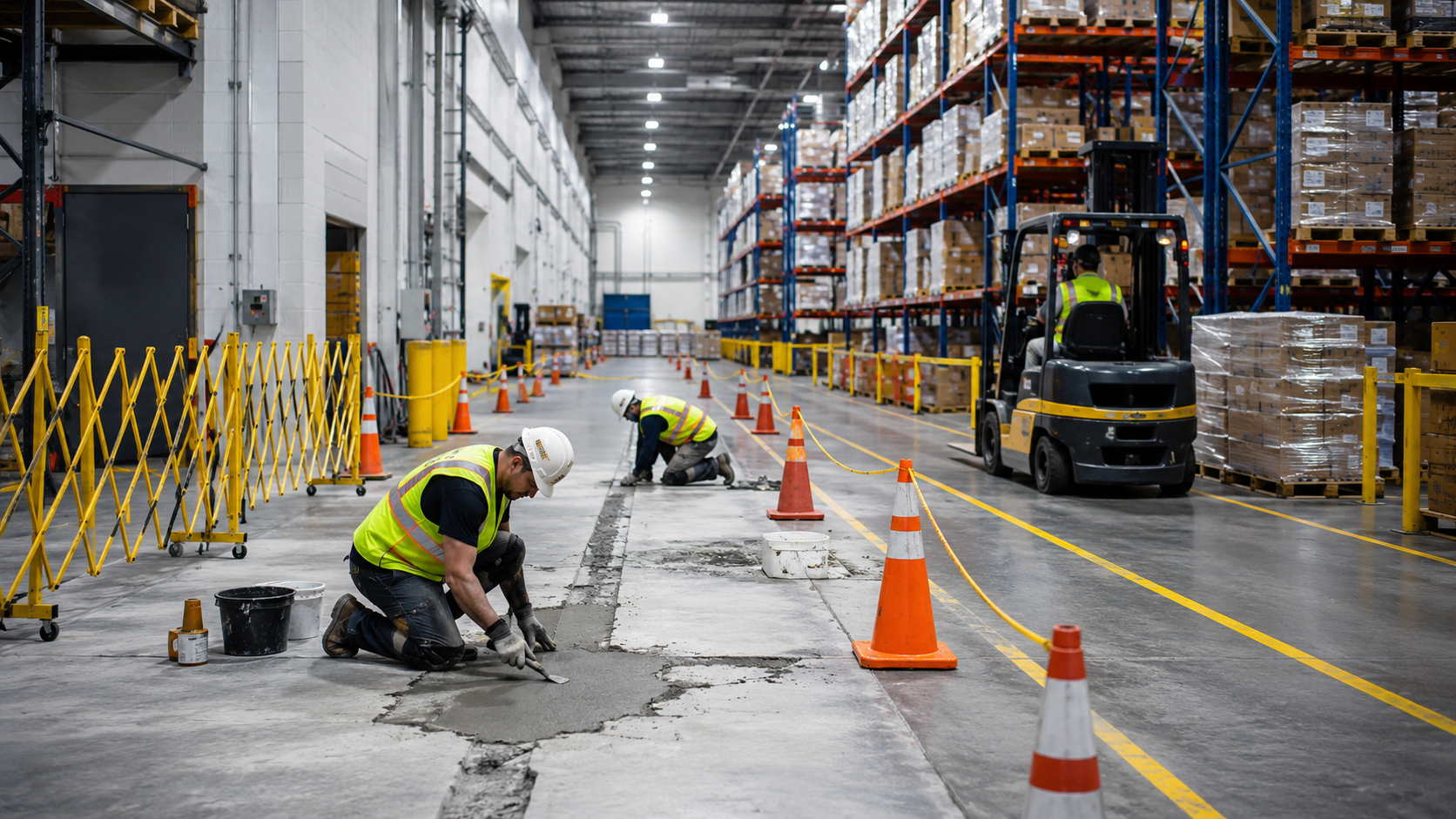
Operators start to feel a slight bump when driving over certain areas. Pallets shift more than they should. Maintenance teams step in and apply a patch, expecting it to hold. For a while, it does.
But then the same crack comes back. Sometimes wider. Sometimes longer. And often in the exact same location.
This is where frustration sets in.
Because at that point, it’s clear the issue isn’t just surface-level damage. It’s something deeper — something that isn’t being addressed by routine repairs.
For warehouse managers and facility owners, this isn’t just about appearance. Floor conditions directly affect:
- Equipment performance and wear
- Operator comfort and safety
- Efficiency of daily operations
A rough or unstable floor slows things down. It increases maintenance costs. And over time, it can create larger structural concerns if left unchecked.
What makes this issue challenging is that many commonly used repair methods focus on what’s visible — the crack itself — without addressing why it keeps coming back.
If you’re searching for a real solution to warehouse floor cracks caused by forklift traffic, the first step is understanding what’s actually happening beneath the surface — and why these problems tend to repeat in active warehouse environments.
Warehouse Floor Cracks Are Rarely Just Surface Problems
One of the most common assumptions in warehouse maintenance is that a crack in the floor is simply a surface issue — something that can be cleaned, filled, and moved on from.
In light-duty environments, that approach might be enough.
But in warehouses, especially those with constant forklift traffic, cracks usually tell a much bigger story.
Concrete floors in industrial settings are exposed to a unique combination of forces. Unlike residential slabs or lightly used commercial floors, warehouse slabs deal with:
- Continuous traffic across the same paths
- Heavy, concentrated loads from forklifts
- Repeated stopping, turning, and reversing
- Daily operational stress with little downtime
Over time, these conditions create internal strain within the concrete. This strain doesn’t always show up immediately. In many cases, the slab can appear fine on the surface while stress is building internally.
Eventually, that stress needs to be released — and when it does, it often appears as cracking.
What’s important to understand is that these cracks are not random. They tend to follow patterns based on how the warehouse operates.
For example:
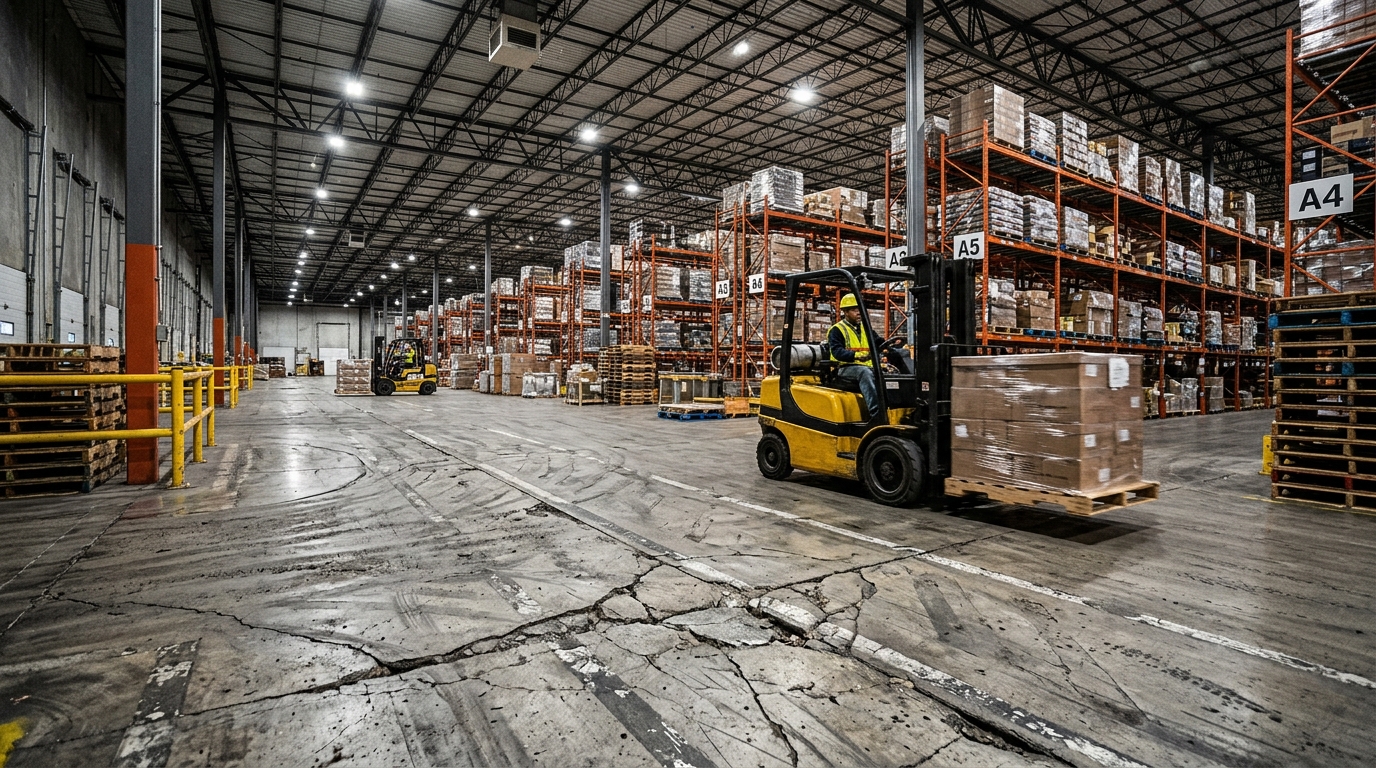
- Cracks often form along forklift travel lanes
- Damage appears near turning points where stress is highest
- Joints begin to deteriorate where slabs repeatedly transfer load
These patterns are a clear sign that the issue goes beyond surface wear.
In many cases, the crack is simply the first visible indicator that the slab is no longer behaving as it was originally designed to.
Treating the crack alone, without understanding the forces behind it, is similar to repainting over a stain without fixing the leak causing it.
It may look better temporarily, but the underlying issue remains — and it will show up again.
The Real Trigger: Loss of Support Beneath the Slab
If cracks in warehouse floors were caused only by surface wear, most repairs would last much longer than they do.
But in reality, one of the most common — and most overlooked — causes of recurring cracks is loss of support beneath the slab.
Concrete is incredibly strong when it is fully supported. It performs well under heavy loads as long as the pressure is evenly distributed across a stable base.
The problem begins when that support becomes inconsistent.
In warehouse environments across New Jersey and Eastern Pennsylvania, this can happen for several reasons over time:
- Sub-base materials may settle unevenly under repeated loading
- Small voids can develop beneath the slab due to compaction issues or minor washout
- Moisture changes can affect soil stability beneath the floor
- Older fill materials may gradually break down or shift
These changes are often subtle and happen gradually, which is why they go unnoticed at first.
However, once a section of the slab loses full contact with the ground beneath it, it begins to behave differently under load.
Instead of distributing weight evenly, that area experiences slight movement when forklifts pass over it. This movement may only be a fraction of an inch, but that’s enough to create stress within the concrete.
And concrete does not tolerate movement well.
Unlike flexible materials, it cannot bend or absorb that stress over time. Instead, it relieves the stress by cracking.
This is why certain areas in a warehouse seem to fail repeatedly:
- The same joints break down
- The same cracks reopen after repair
- The same sections feel uneven under equipment
Until the underlying support is restored or stabilized, the slab will continue to respond to load in the same way — and the cracking will continue.
Understanding this is key, because it shifts the focus from simply repairing damage to addressing the condition that’s causing it.
Why Forklift Traffic Accelerates the Problem
Once a warehouse floor begins to lose support in certain areas, forklift traffic doesn’t just expose the issue — it makes it worse, faster.
Forklifts operate differently from most other vehicles found in industrial environments. They are compact, carry heavy loads, and rely on hard wheels that transfer force directly into the concrete. This creates a combination of pressure and movement that continuously stresses the same areas of the floor.
In a typical warehouse, traffic patterns are highly repetitive. Forklifts follow the same routes throughout the day, especially along main aisles, picking zones, and loading dock approaches. This means that any weak point in the floor is not stressed occasionally — it is stressed constantly.
Over time, this repeated loading creates a fatigue effect within the slab.
When a forklift passes over a fully supported section of concrete, the load is distributed evenly and the slab performs as expected. But when it passes over an area with reduced support — even slightly — the behavior changes.
That section of the slab begins to deflect under load. It may not be visible to the eye, but the repeated flexing introduces internal stress. Each pass of a forklift adds to that stress, gradually weakening the concrete until cracking becomes inevitable.
Turning zones make this even worse.
When forklifts turn, they introduce lateral forces in addition to vertical load. These forces place extra strain on slab edges and joints, which are already vulnerable areas. This is why you’ll often see cracking, chipping, and surface breakdown concentrated in these locations.
Braking and acceleration also play a role. Sudden stops create impact forces that travel through the slab, especially when loads are heavy or uneven.
The result is a cycle:
- Weak support leads to slight movement
- Forklift traffic amplifies that movement
- Stress builds within the slab
- Cracks form and expand
Without addressing the underlying instability, forklift traffic will continue to accelerate the problem — no matter how many times the surface is repaired.
Why Most Repairs Don’t Hold Up in Warehouse Environments
Many warehouse managers have already invested time and money into floor repairs, only to find that the results don’t last.
This isn’t usually due to poor workmanship. In most cases, it comes down to a mismatch between the repair method and the actual problem.
One of the most common approaches is surface patching. It’s quick, relatively inexpensive, and easy to apply. On the surface, it seems like a practical solution.
But patching only addresses what’s visible.
If the slab is still experiencing movement underneath, the patched area becomes a point of stress concentration. Forklift traffic repeatedly loads that same spot, and over time, the repair begins to fail — often in the exact same pattern as before.
This is why many facilities experience a cycle of repeated maintenance in the same locations.
Another common approach is treating cracks as isolated defects rather than part of a larger system.
In warehouse floors, cracks are often connected to joint performance and load transfer between slabs. When joints begin to deteriorate, the way loads move across the floor changes. Instead of being distributed evenly, stress becomes concentrated at specific points.
If repairs don’t restore that load transfer or stabilize the surrounding area, the problem doesn’t go away — it shifts or expands.
There’s also the issue of timing.
Repairs are often made after visible damage appears, but by that point, the underlying issue has usually been developing for some time. Fixing only the surface at that stage is unlikely to produce long-term results.
The key takeaway is this:
Most repairs fail not because they are poorly executed, but because they are focused on the symptom rather than the condition causing it.
Until that condition — usually related to movement or loss of support — is addressed, the floor will continue to behave the same way under load.
What Actually Works: A Targeted, In-Place Repair Approach
In active warehouse environments, the most effective repair strategies are not the most aggressive or the most extensive.
They are the most precise.
Rather than treating the entire floor as a problem, a more practical approach is to identify where the floor is actually failing and address those areas directly.
This is especially important in warehouses, where large-scale repairs can be difficult to execute due to operational constraints. Racking systems, equipment, and daily workflows limit access and make it impractical to shut down large sections of the facility.
Because of this, repair strategies need to work within the environment, not against it.
A targeted, in-place approach focuses on three key principles:
- Identify Movement, Not Just Damage
Instead of focusing only on visible cracks, attention is placed on areas where the slab is moving or losing support. These are often the same locations where cracks keep reappearing.
- Stabilize the Affected Areas
Once these zones are identified, the goal is to restore support beneath the slab in those specific locations. This helps reduce movement and allows the slab to perform as intended under load.
- Repair After Stability Is Restored
Surface repairs become much more effective when the slab is stable. Cracks can be properly addressed, and joints can be restored in a way that improves load transfer and durability.
This approach avoids unnecessary work while delivering better long-term performance.
It also aligns with how warehouse floors actually fail — in localized areas, not all at once.
By focusing on the root cause in those areas, rather than applying broad fixes across the entire floor, facility managers can achieve more reliable results without disrupting operations.
In practice, this often means doing less — but doing it more strategically.
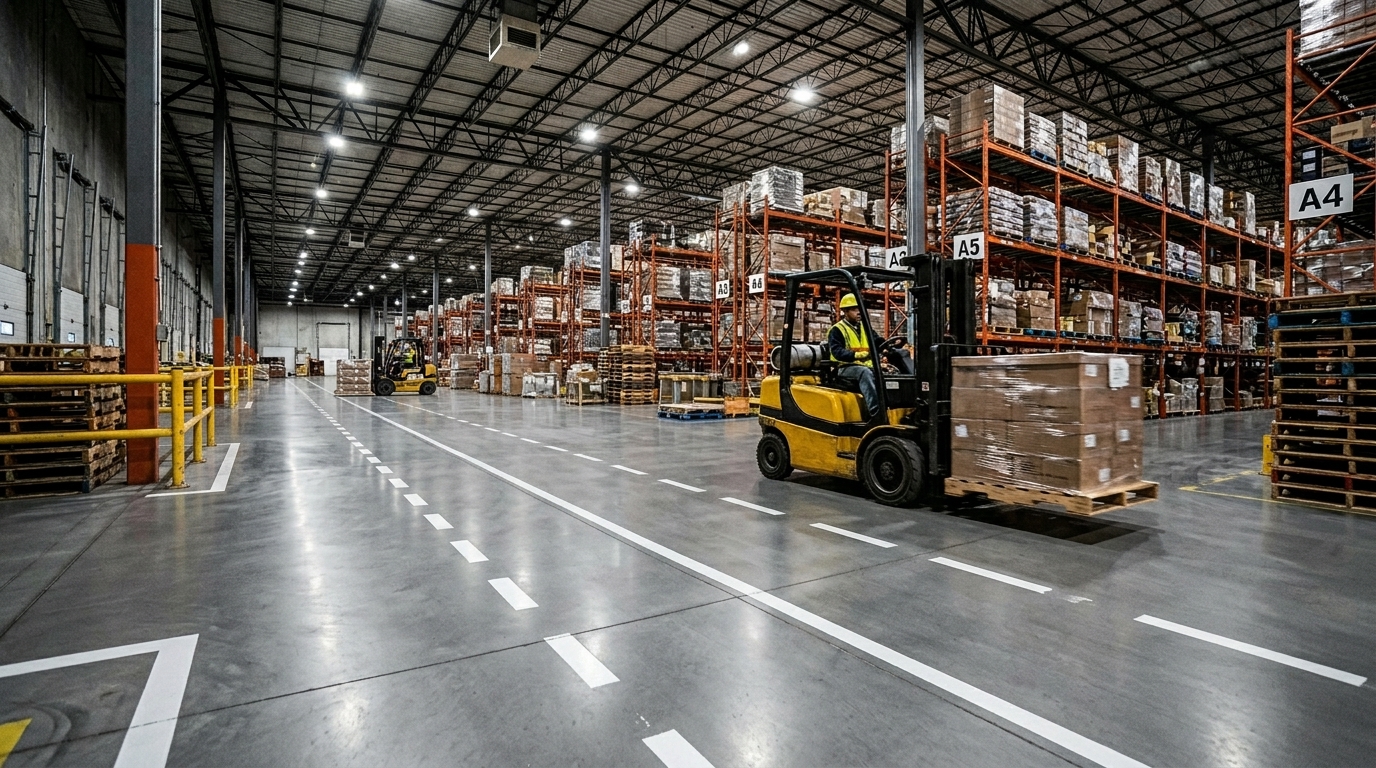
How Undersealing Is Used in Active Warehouse Environments
One of the biggest challenges in warehouse floor repair isn’t just identifying the problem — it’s accessing the area to fix it.
Unlike open residential slabs, warehouses are filled with racking systems, inventory, machinery, and active workflows that can’t simply be moved or paused for large-scale repairs. In many cases, shutting down operations to perform invasive work isn’t a realistic option.
This is where more controlled, localized repair methods become valuable.
Undersealing is one of those methods, and it’s typically used in situations where:
- Access is limited
- The issue is confined to specific areas
- Movement needs to be reduced without large-scale intervention
Rather than attempting to lift or overhaul entire sections of the slab, undersealing focuses on reinforcing support exactly where it has been compromised.
The process involves introducing a high-density material beneath the slab in small, targeted quantities. This is usually done along joints or slab edges — the areas most vulnerable to loss of support and repeated forklift stress.
The goal is not to dramatically change the elevation of the slab, but to:
- Fill small voids that have developed beneath the surface
- Improve contact between the slab and its base
- Reduce deflection under load
Because the application is controlled and localized, it allows technicians to work within tight or active areas without major disruption.
This is especially important in facilities where downtime carries a significant operational cost.
It’s also worth noting that undersealing is not used everywhere — it’s applied selectively, based on where instability is present. When used correctly, it becomes part of a broader strategy focused on stabilization rather than surface-level repair.
In environments where access is limited and precision matters, this type of approach often provides a practical balance between effectiveness and minimal disruption.
Why Joint Performance Plays a Bigger Role Than Most People Realize
In warehouse floors, joints are often the first areas to show signs of failure — and one of the most important to get right.
At a glance, joints may seem like simple gaps between slabs. In reality, they play a critical role in how the floor handles load, movement, and stress.
Every time a forklift crosses a joint, weight is transferred from one slab to the next. When the joint is in good condition, that transfer happens smoothly and evenly.
But when joints begin to deteriorate, that process breaks down.
Forklift traffic places repeated impact on joint edges, especially in high-use areas. Over time, this leads to:
- Chipping or spalling along the edges
- Widening of the joint gap
- Uneven transitions between slabs
Once this happens, forklifts no longer move smoothly across the surface. Instead, they create additional impact with every pass, which accelerates damage not only at the joint but in the surrounding concrete as well.
This creates a ripple effect.
As joint performance declines:
- Load transfer becomes inconsistent
- Stress concentrates in specific areas
- Adjacent slabs begin to experience more movement
This is often when cracks start to form or expand nearby.
What makes joint issues particularly challenging is that they are both a cause and a result of floor problems. Weak support beneath the slab can lead to joint failure, and failing joints can further contribute to slab movement.
Because of this, effective warehouse floor repair must include proper attention to joint condition — not just crack repair.
Restoring joints isn’t just about filling gaps. It’s about ensuring that the floor can once again handle the demands of forklift traffic without creating additional stress points.
When joints are functioning properly, the entire floor system performs better.
What This Looks Like in NJ & Eastern PA Warehouses
While the principles behind warehouse floor cracking are consistent, the way these issues show up can vary depending on the age of the facility, the type of operations, and the conditions beneath the slab.
Across warehouses in New Jersey and Eastern Pennsylvania, several patterns tend to appear repeatedly.
One of the most common is localized damage in high-traffic areas.
Rather than seeing uniform wear across the entire floor, problems usually concentrate in:
- Main forklift travel lanes
- Turning points at the end of aisles
- Loading dock approaches
- Areas with frequent stopping and starting
Another frequent observation is repeated failure in the same locations.
Facility managers often report that:
- The same cracks are repaired multiple times
- Joint damage keeps returning despite maintenance
- Certain sections feel uneven no matter what is done at the surface
This repetition is a strong indicator that the issue is not isolated to the surface.
In older facilities, sub-base changes over time also play a role. Materials that were stable when the building was constructed may shift, compact, or degrade under years of use and environmental exposure.
Seasonal factors in the region can contribute as well. Changes in moisture levels and temperature can affect the stability of the soil beneath the slab, especially in areas where drainage is not ideal.
What’s important to recognize is that most of these problems start small.
A minor loss of support or slight joint deterioration may not seem urgent at first. But under constant forklift traffic, these small issues tend to grow — and once they reach a certain point, repairs become more complex and disruptive.
Addressing them early, and in the right way, makes a significant difference in long-term performance.
Final Thought
When cracks begin to appear in a warehouse floor, it’s natural to focus on the visible damage.
After all, that’s what you can see, measure, and repair.
But in most cases, the crack itself is only part of the story.
What really matters is why it formed in the first place.
In warehouse environments, cracks tend to follow patterns. They show up in high-traffic areas, along joints, and in locations where the slab is under the most stress. When those same cracks return after repair, it’s usually a sign that something hasn’t been addressed beneath the surface.
That “something” is often movement.
Movement caused by:
- Loss of support under the slab
- Weak or deteriorating joints
- Repeated stress from forklift traffic
Surface repairs can improve the condition temporarily, but if the underlying movement continues, the floor will respond the same way again.
That’s why long-term performance depends on shifting the focus.
Instead of asking, “How do we fix this crack?”
The better question is, “What is causing this area to move?”
Once that question is answered, the repair approach becomes clearer.
Stabilizing the slab, reinforcing key areas, and restoring how the floor handles load are what ultimately determine whether a repair will last.
For facility managers, this understanding helps move away from reactive maintenance and toward more controlled, predictable outcomes.
Need a Practical Assessment of Your Warehouse Floor?
If you’re seeing cracks that keep returning, joints that are breaking down, or areas where forklifts don’t move as smoothly as they should, it’s usually a sign that something beneath the surface needs attention.
The challenge is that not every issue requires the same solution.
Some areas may need stabilization.
Others may require joint repair or reinforcement.
And in many cases, the problem is limited to specific zones rather than the entire floor.
That’s why a focused assessment is important.
Rather than applying a broad repair method across the entire slab, a proper evaluation helps identify:
- Where movement is actually occurring
- Which areas are most affected by traffic
- What type of repair approach fits the situation
WarehouseFloorRepairs.com works with facilities across New Jersey and Eastern Pennsylvania to evaluate and address these types of issues in active environments.
The goal is not to over-repair or disrupt operations unnecessarily, but to focus on practical solutions that align with how the space is used day to day.
If you’re dealing with recurring floor problems, getting a clear understanding of what’s happening beneath the surface is the first step toward resolving them in a way that holds up over time.

- Low-Downtime Concrete Floor Repair for Active Warehouses in NJ - June 30, 2026
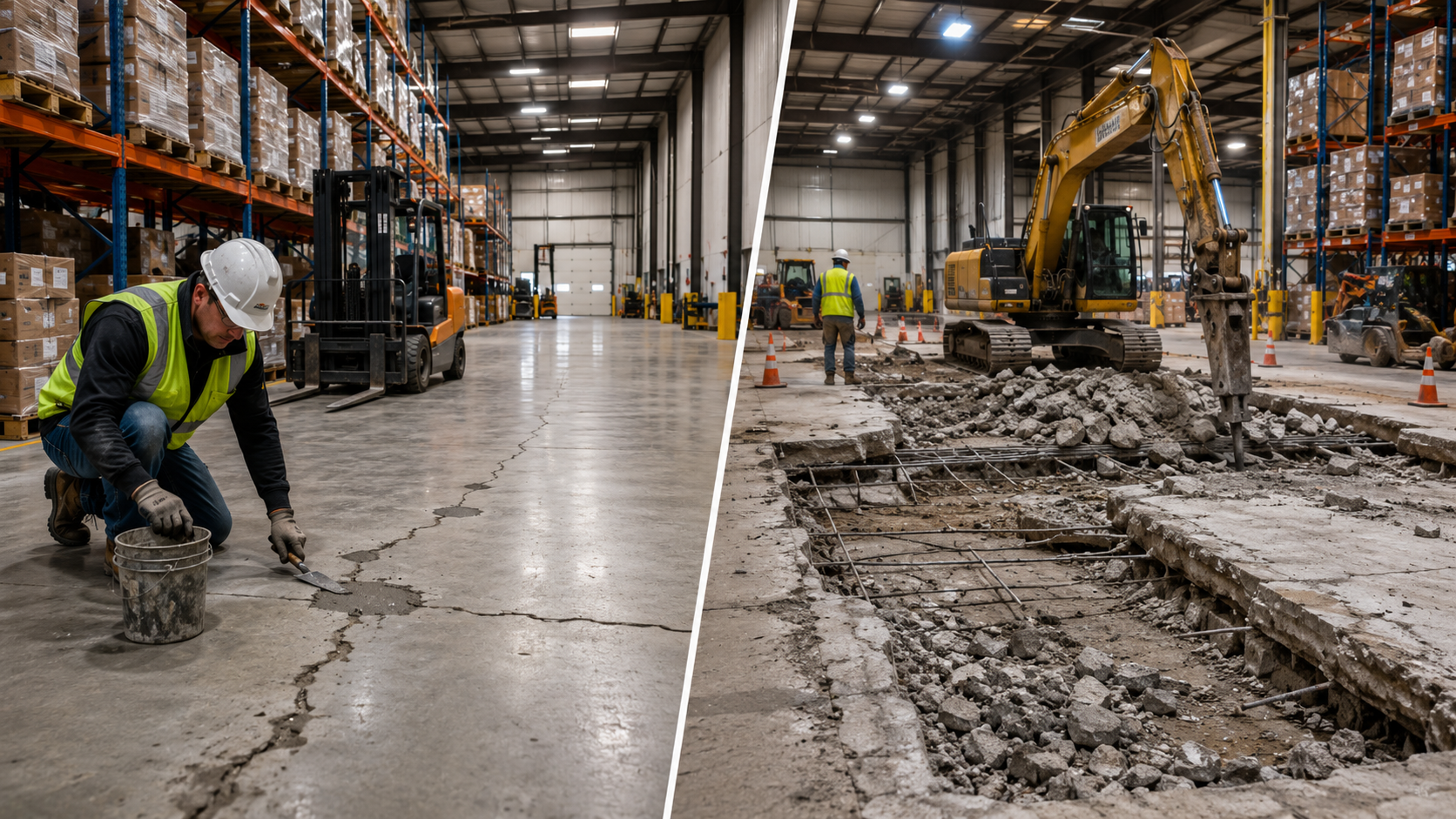
- Repair vs Replacement:What to Do With a Damaged Warehouse Concrete Floor - June 30, 2026
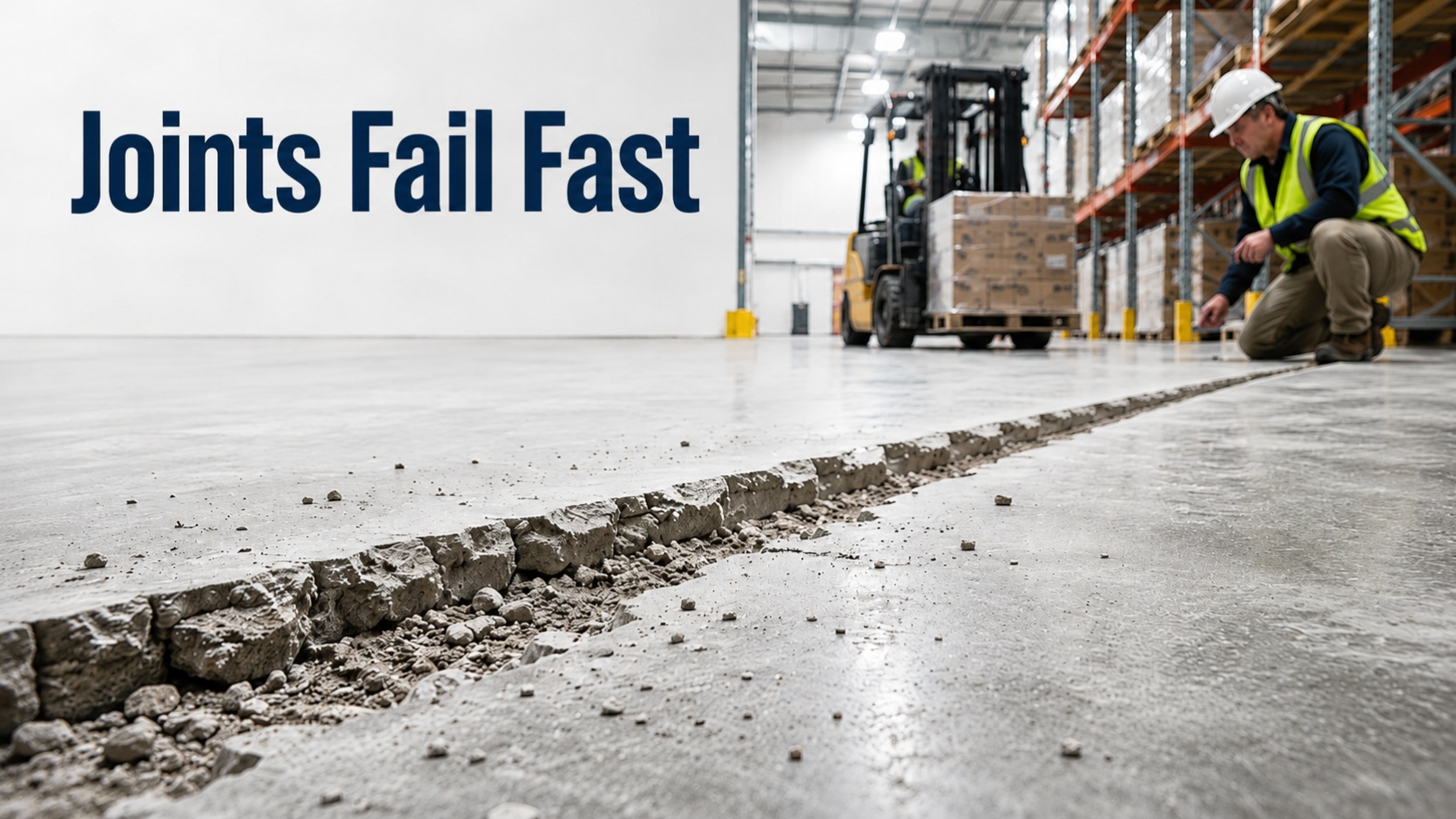
- Warehouse Floor Joint Repair: Why Damaged Joints Get Worse Fast - June 30, 2026