
IN THIS ARTICLE
As a Warehouse manager in New Jersey, is your Loading Dock Concrete Sinking? Here’s When You Need a Repair Contractor
Your loading dock takes a beating every single day. Trucks back in hard. Forklifts run the same lines back and forth, thousands of cycles a year. And through all of it, the concrete underneath is slowly losing the fight — not always visibly, but steadily.
For facility managers across New Jersey and Eastern Pennsylvania, a deteriorating loading dock is more than an eyesore. It’s a liability.
Uneven slabs cause forklift operators to lose control of loads. Spilled product. Worker injuries. Shipments that can’t go out because a dock position is out of commission. And an OSHA citation you didn’t see coming.
The problem is, most contractors who show up to a damaged loading dock reach for the same short-term fix — pour a patch, call it done. That works fine for surface spalls. It does nothing for a slab with failed joints, edge deterioration, or sub-base movement that’s been getting worse for years.
This post will help you tell the difference. And if what you’re dealing with is a structurally compromised loading dock, we’ll walk you through what a proper industrial-grade repair actually looks like.
At Warehouse Floor Repairs, we work exclusively with commercial and industrial facilities across New Jersey and Eastern Pennsylvania. Loading docks, warehouse floors, distribution centers — that’s all we do. We’re not a general contractor who takes concrete jobs on the side.
Why Loading Dock Concrete Fails Faster Than the Rest of Your Floor
Not all concrete ages the same way. Interior warehouse floors take heavy traffic, but the conditions are relatively controlled. Loading docks are a different environment entirely — and the concrete out there fails for reasons that go well beyond surface wear.
Repetitive heavy impact.
Every time a truck backs into your dock, that impact transfers through the bumpers and into the concrete at the pit perimeter. Over the years, that repeated stress fractures the slab from the edges inward, breaks down joint filler, and gradually loosens the material beneath it.
Freeze-thaw cycles.
New Jersey winters are hard on concrete. Water infiltrates through cracks and open joints, freezes, expands, and forces those gaps wider. The ground below the slab heaves, then settles as temperatures shift. Do that enough seasons, and you’ve got compromised slab edges and joints that no longer function as they should.
Drainage problems at the dock apron.
Water that doesn’t drain away from the dock area finds somewhere to go — and that’s usually straight down through any open joint or gap in the slab. Once moisture gets under the slab consistently, you end up with edge erosion and loss of support along the slab perimeter. This is one of the most common and least-diagnosed problems at NJ loading docks.
Age of the building stock.
A large percentage of industrial and warehouse facilities across New Jersey were built in the 1960s through the 1980s. Many of those loading docks have never had structural concrete work done — just the occasional surface patch. After 40 or 50 years, joint systems have broken down completely and slab edges have lost the support they were designed to have.
Warning Signs Your Loading Dock Slab Needs More Than a Surface Patch
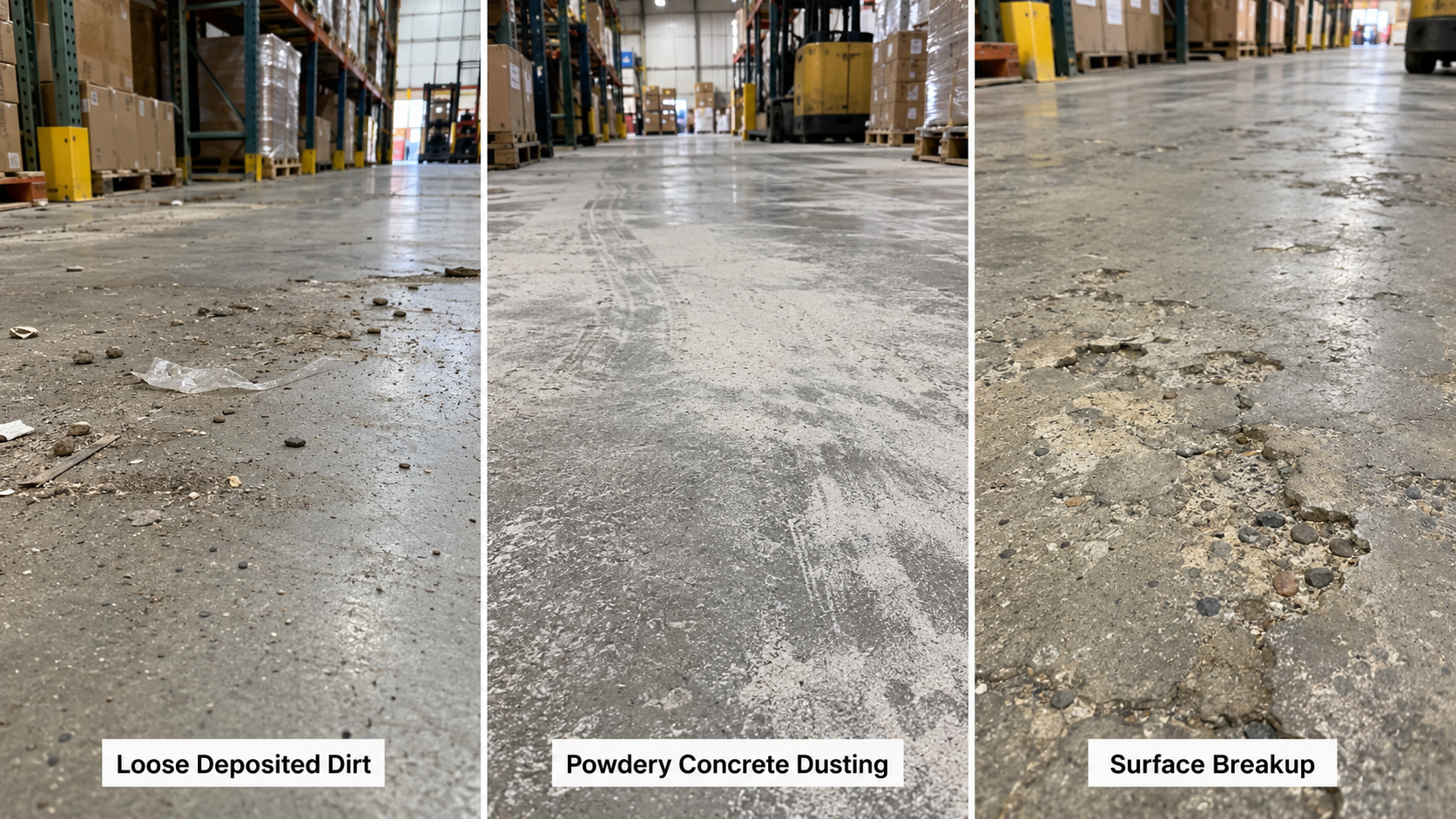
Surface patching has a place. If you’ve got localized spalling around a drain grate or a small chip at the curb angle, a quality repair mortar can handle that. But there are warning signs that tell you the problem is structural — and that patching will only buy you weeks before it comes back.
A visible lip or step between slabs.
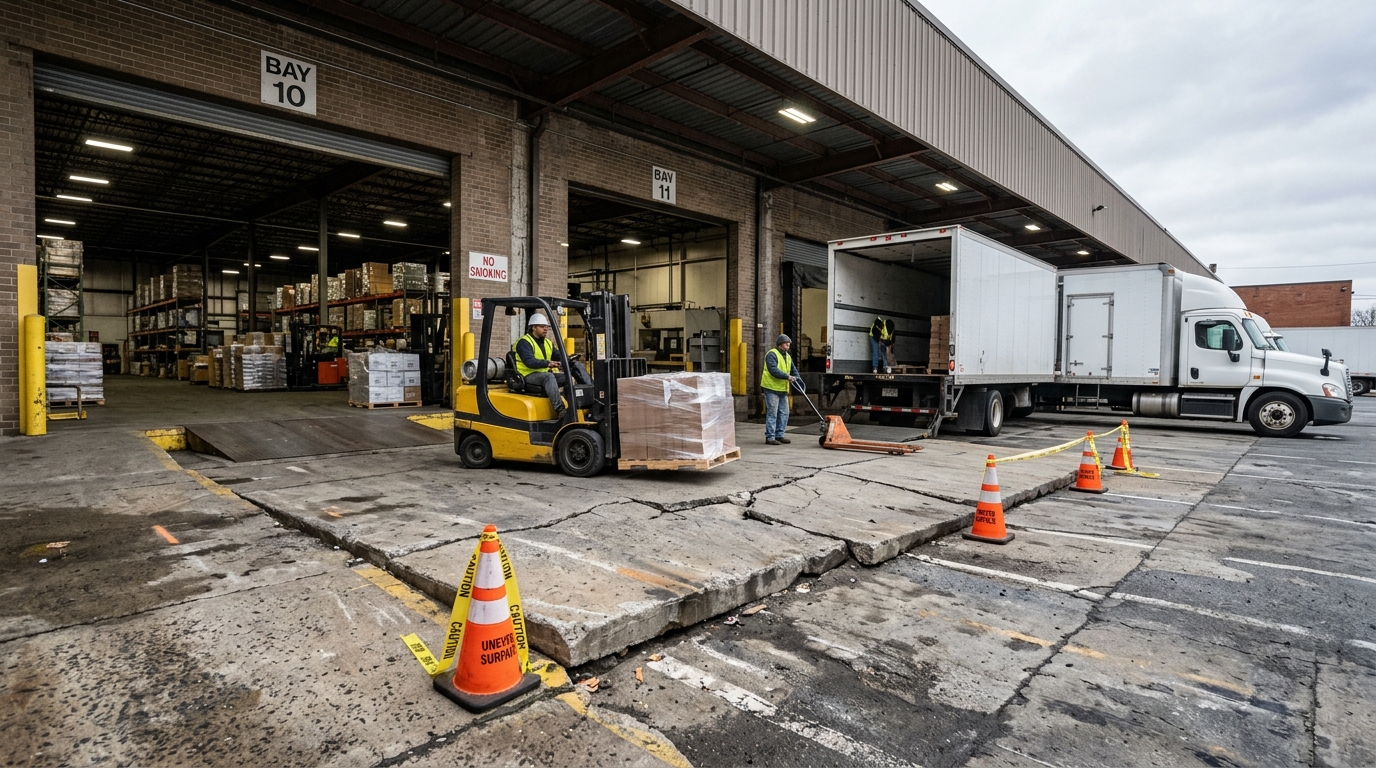
If there’s a height difference between the dock slab and an adjacent slab — even half an inch — that’s differential movement. One slab has shifted relative to the other. Patching over that edge does nothing for the underlying cause. Forklift tires hit that lip on every pass.
Cracks that follow joint lines.
Random surface cracks are one thing. Cracks that run along expansion joints or show up in the same pattern as the slab sections below tell you the concrete is moving as a unit. That’s not a surface problem.
Dock leveler misalignment.
If your dock levelers are no longer sitting flush, or if the rear curb angle is starting to pull away, the slab has shifted. The dock leveler is attached to the building structure. When the concrete moves, the alignment goes with it — and the gap that opens up is a serious hazard for any fork truck operator at that position.
Bumper anchors pulling loose.
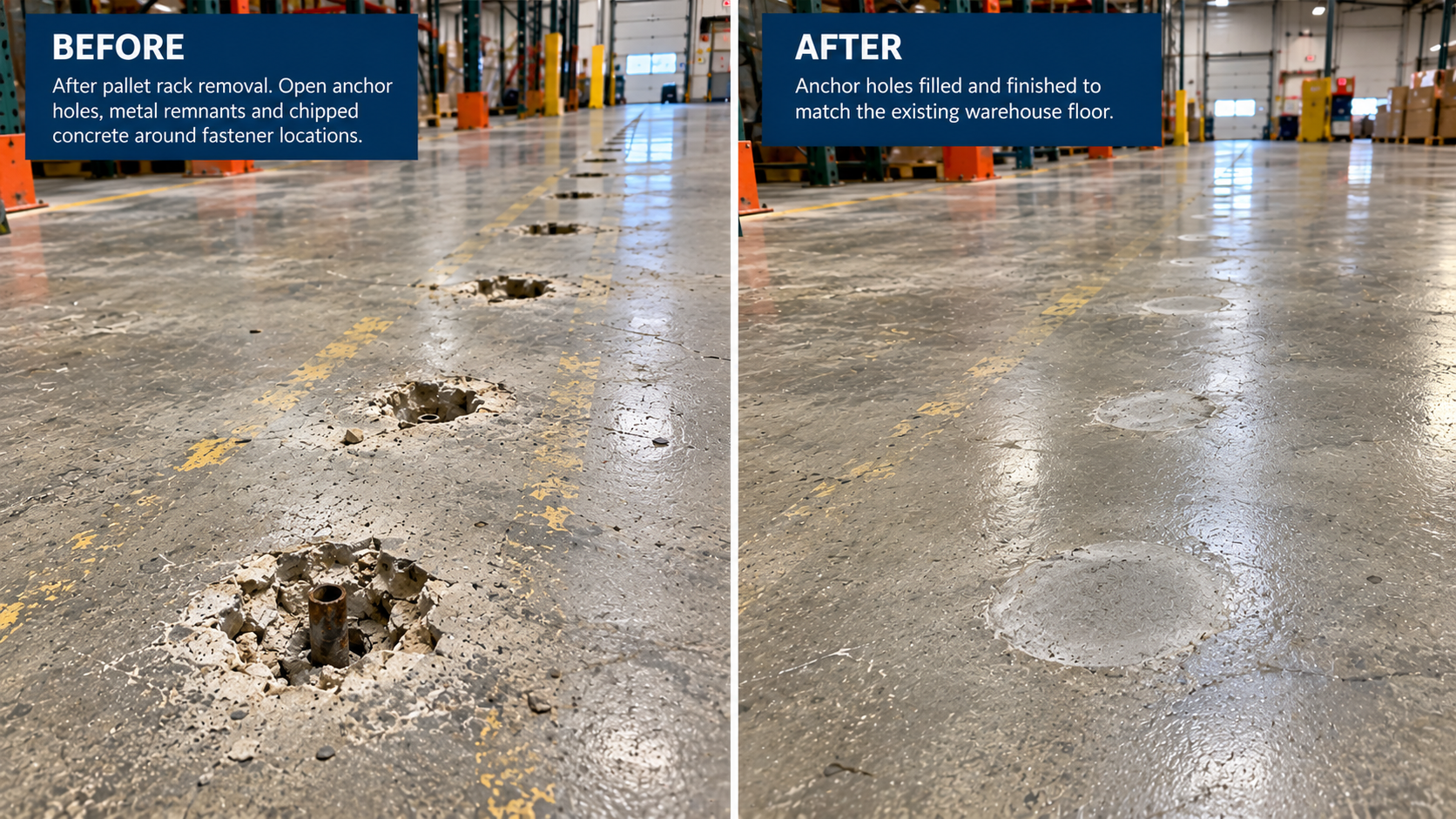
Dock bumpers are anchored into the concrete at the dock face. When those anchors start backing out or the concrete around them crumbles, the concrete around the anchor points has lost density and integrity.
Deteriorated or open joints.
Joint filler that has cracked out, shrunk, or gone missing entirely is an entry point for water, debris, and forklift wheels. Open joints at the dock pit perimeter are especially damaging because that’s exactly where impact and moisture are most concentrated.
Water pooling at the apron.
Standing water after rain at the dock apron tells you two things: the grade has changed, and water is finding a path under the slab. Left alone, it accelerates everything else on this list.
A hollow sound when you walk the slab.
Tap the concrete or pay attention when the forklift runs over it. A hollow sound means there’s a void or loss of support underneath. You’re working against a clock at that point.
If you’re seeing two or more of these, you’re past the surface patch stage. You need a contractor who understands what’s happening at and below the slab — and knows how to fix it properly in an operating facility.
Repair vs. Replace: What NJ Facility Managers Actually Need to Know
The question every facility manager asks when they see a bad dock slab is: Do I repair it or tear it out and start over? The honest answer depends on a few things, and a contractor who jumps straight to “replace it” without a thorough assessment is likely selling you the bigger job.
Repair makes sense when:
The slab itself is structurally intact — the concrete hasn’t shattered, the rebar isn’t corroded through, and the slab geometry is still defined. The problems are at the joints, the edges, and the surface. In these cases, targeted repair work restores function faster, with far less disruption to your operation, and at a fraction of replacement cost.
Replacement makes sense when:
The slab has broken into pieces, the pit walls have failed, the rebar is heavily corroded and no longer providing tensile support, or the dock has deteriorated to the point where repair can’t restore a safe, functional surface. Full replacement is sometimes the right answer — but it should never be the default recommendation before a proper on-site assessment.
The downtime math matters.
A full dock slab replacement means demolition, formwork, a new pour, and a curing period. You’re typically looking at two to three weeks before that dock position is back in service.
A properly scoped repair job, by contrast, can often return a dock position to service the same day or the following morning. For a facility running multiple dock positions, that’s a real operational difference.
The liability angle.
OSHA 1910.22 requires that walking and working surfaces be maintained in a clean, dry condition and free of hazards. An uneven dock slab with a lip that a forklift has to navigate every pass isn’t a minor inconvenience — it’s a documented hazard. If someone gets hurt and maintenance records show the condition was known and left unrepaired, you’re exposed in ways that go well beyond the cost of fixing the concrete.
What Industrial Loading Dock Concrete Repair Actually Involves
Loading dock repair is not one thing. A good contractor looks at the full picture — the surface condition, the joint system, the slab edges, and how the dock is performing structurally — and proposes a scope that addresses the actual problem, not just what’s visible from ten feet away.
Here’s what that typically looks like in practice for NJ warehouse and distribution facilities.
Joint restoration.
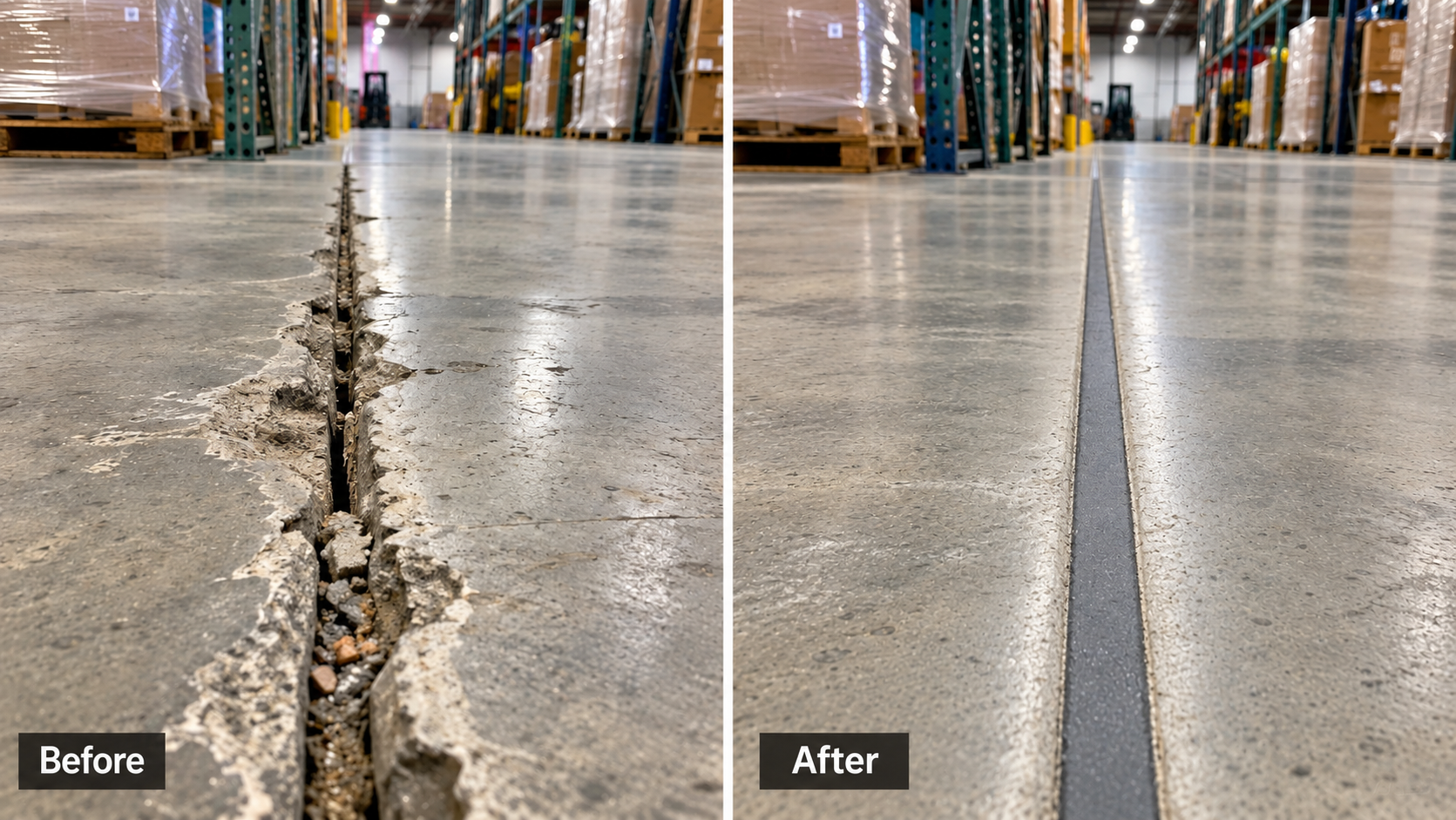
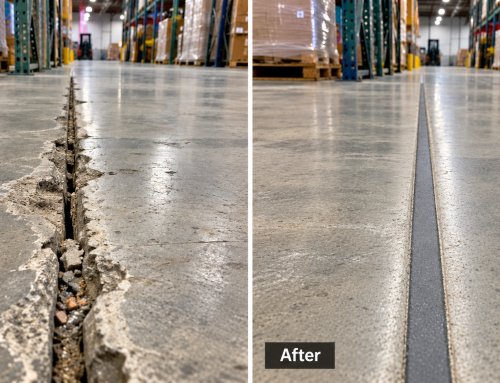
Expansion joints and control joints at loading docks take the hardest beating of any joint in the facility. When the filler material breaks down, the joint opens up, water gets in, and the edges of the adjacent slabs start to chip and crack. Proper joint repair means removing deteriorated filler completely, repairing spalled edges with high-strength cementitious mortar, and installing a joint filler system suited to the traffic and movement at that specific dock.
Slab edge and pit perimeter repair.
The pit perimeter — the concrete immediately around the dock leveler opening — concentrates more load, impact, and moisture than almost anywhere else on the floor. Spalling, cracking, and edge breakdown here are extremely common in facilities over 15 years old.
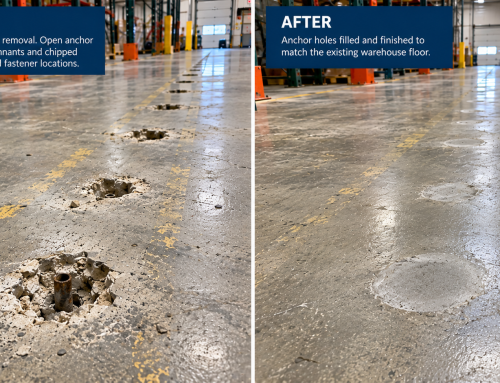
This area requires proper surface preparation, high-strength repair mortar, and in many cases, mechanical anchoring to ensure the repair bonds under the ongoing load and impact.
Surface spall and crack repair.
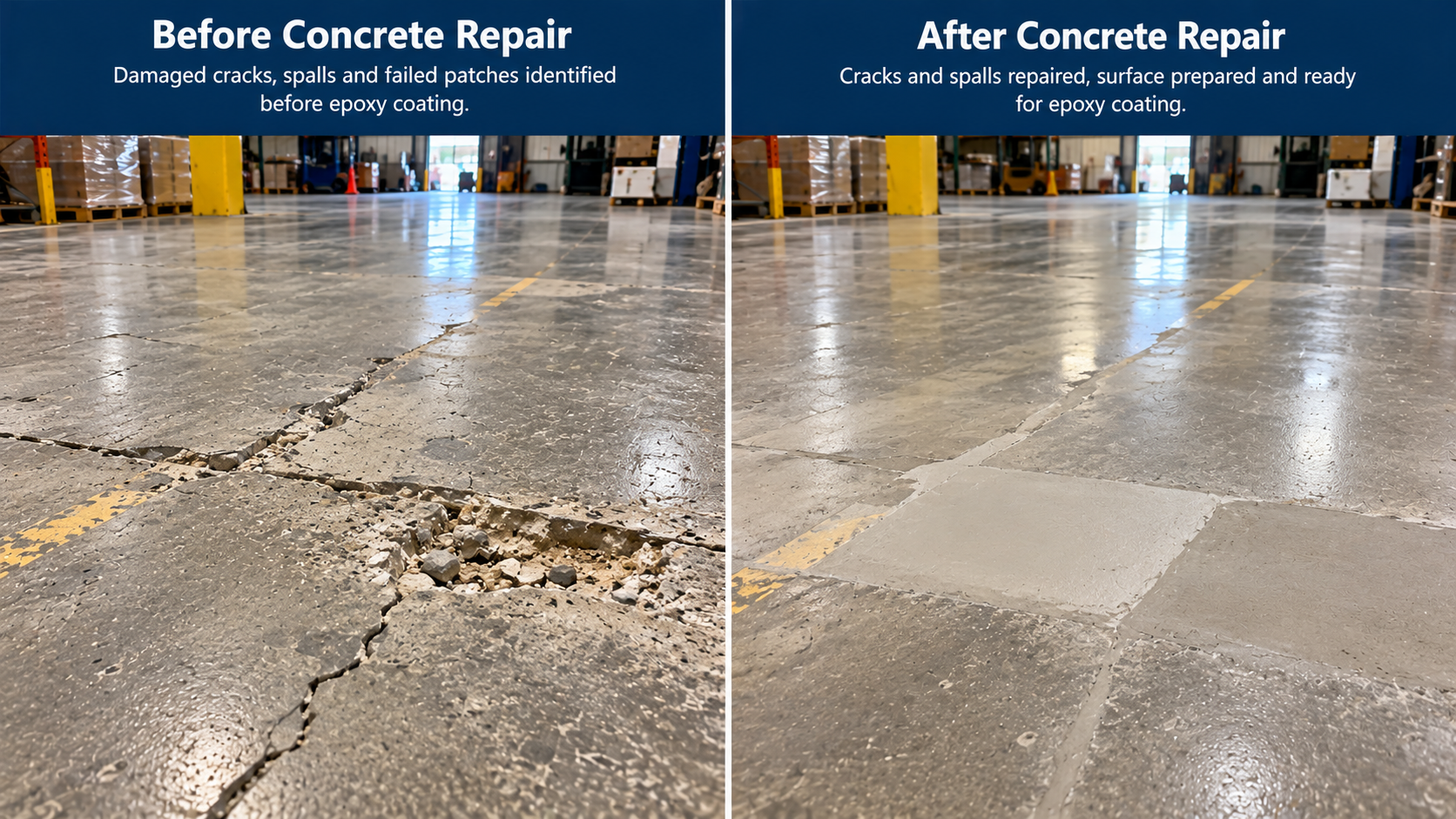
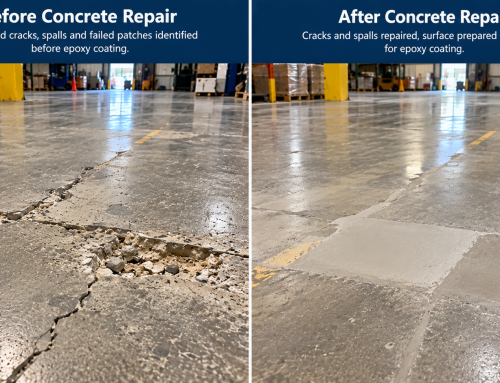
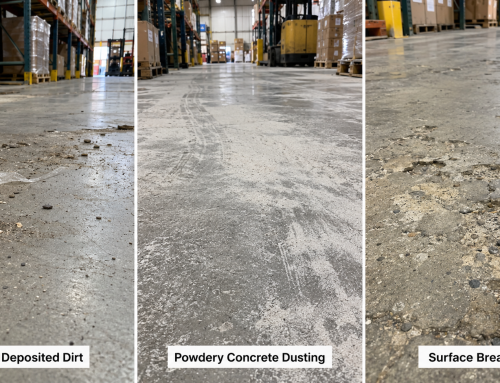
Not all surface damage points to a structural problem, but surface spalls left open become structural problems over time as water infiltrates and loading breaks the edges down further. Proper spall repair uses a bonding agent and repair mortar matched to the base concrete’s strength — not whatever’s on the truck.
Slab edge stabilization.
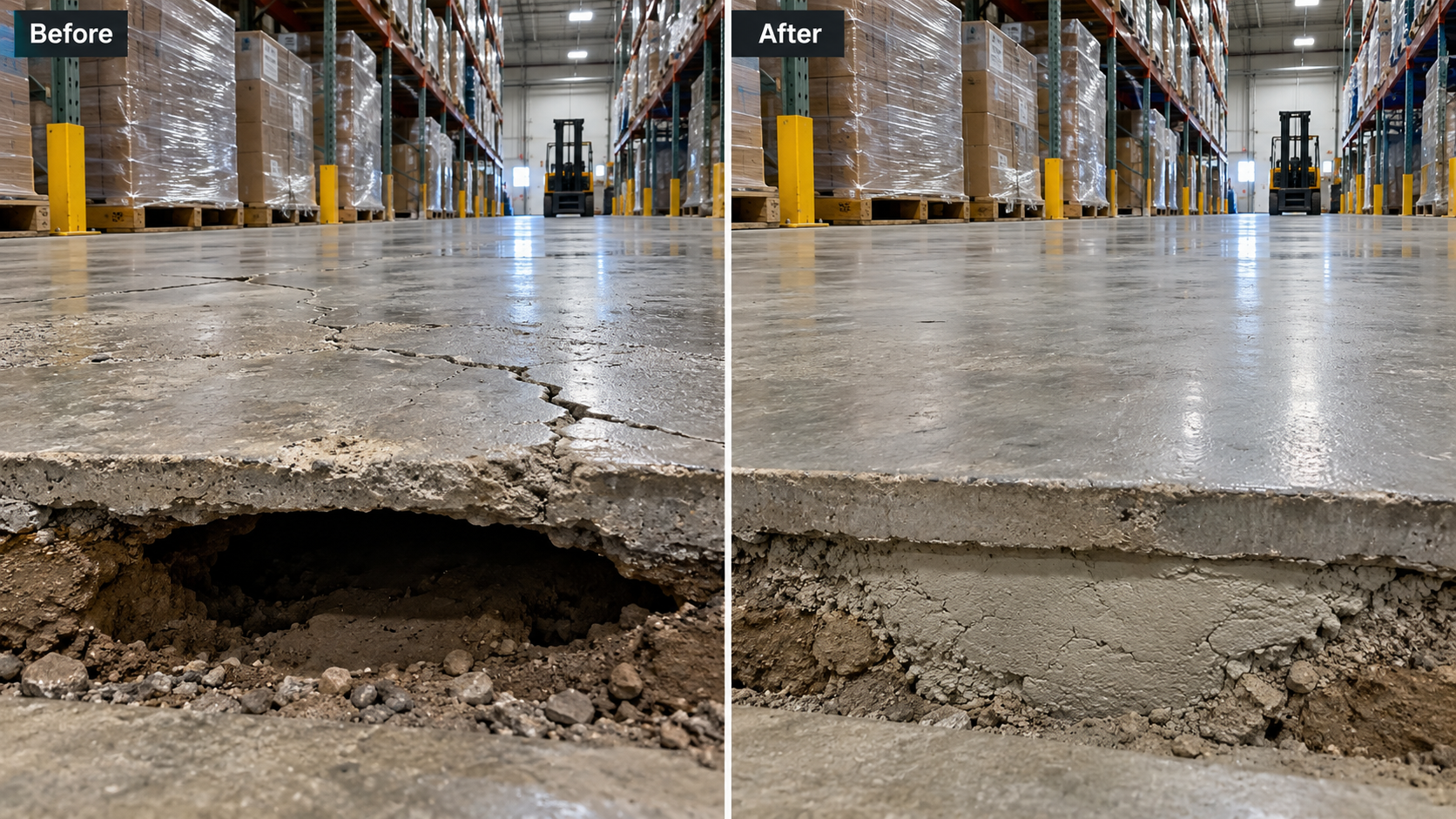
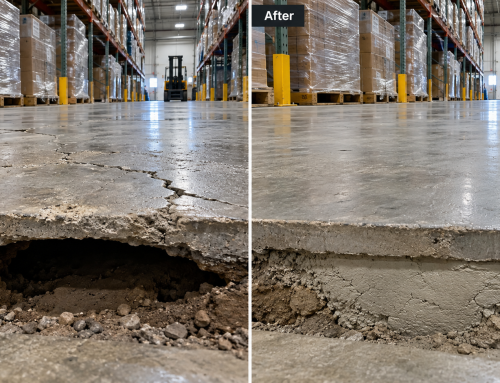
In cases where slab edges have lost support — but the slab itself is otherwise intact — stabilization may be needed along the joint before the surface repair can hold.
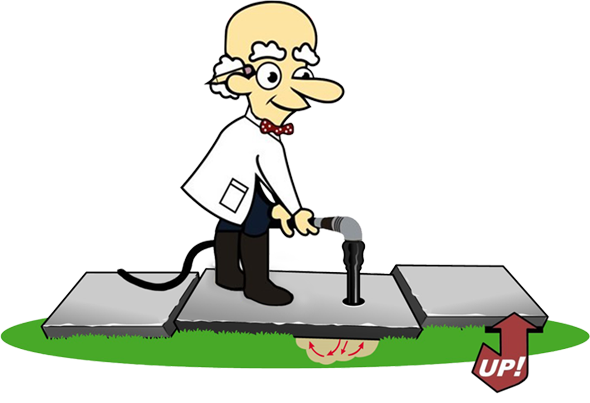
Where equipment access is limited, such as tight areas around the dock pit or along interior slab joints, this can be accomplished with a high-density underseal product applied through the joint itself, without drilling or major disruption.
This isn’t a large-scale lift operation; it’s a targeted stabilization of the slab edge to eliminate rocking and restore bearing before the joint or surface is refaced.
Curb angle area restoration.
If the concrete at the rear of the pit — where the dock leveler curb angle sits — has deteriorated, that area needs to be repaired before any other dock work makes long-term sense. A leveler sitting on broken concrete is still sitting on broken concrete, regardless of what’s been done to the surface.
What a Loading Dock Repair Engagement Looks Like With Warehouse Floor Repairs
We work with facility managers and property owners across New Jersey and Eastern Pennsylvania — warehouses, distribution centers, manufacturing plants, cold storage facilities, and more. Here’s what the process actually looks like when you bring us in.
On-site assessment.
We come out and walk the dock with you. We’re looking at slab movement patterns, checking joint condition, reading crack patterns, evaluating the pit perimeter, and looking at drainage conditions around the apron. We don’t quote jobs sight-unseen, because two docks that look similar can have very different underlying conditions.
Scope of work walkthrough.
We’ll explain exactly what we’re proposing and why — which areas need attention, what methods we’re using, and what the expected outcome is. If there are areas that genuinely need replacement rather than repair, we’ll tell you that directly. No inflating the scope.
The repair.
Depending on the extent of the work, most loading dock repair scopes run one to two days on-site. We work around your operations as much as possible — sequencing dock positions so other bays stay in service while we’re working.
After the repair.
You’ll have a dock that functions the way it’s supposed to: flat, properly jointed, without the lips, voids, and open cracks that were creating hazards and letting water in. We’ll also give you straightforward guidance on anything that would extend the life of the repair — drainage corrections, joint maintenance intervals, and the like.
We serve loading dock facilities throughout New Jersey — including Essex, Union, Hudson, Bergen, Passaic, Morris, Somerset, Middlesex, Monmouth, Burlington, Camden, Gloucester, and Ocean counties — as well as Eastern Pennsylvania, including Philadelphia-area industrial corridors and the Lehigh Valley.
How to Choose the Right Loading Dock Concrete Repair Contractor in NJ
Not every concrete contractor who accepts commercial work understands loading docks. Here’s what to look for — and what to watch out for.
Ask whether they specialize in industrial and commercial concrete.
A contractor who primarily does residential flatwork and takes the occasional warehouse job operates at a different level than one whose entire business is industrial floors and docks. The materials, methods, and understanding of how industrial facilities operate are different.
Require a site visit before any quote.
Any contractor who prices a loading dock repair over the phone is guessing. The condition of the joint system, the state of the pit perimeter, and the extent of edge deterioration — none of that can be assessed remotely. An accurate scope requires an on-site look.
Ask what they’ll do about the joint system.
If a contractor proposes to resurface or patch a dock without addressing the joint condition, ask why. Open, deteriorated joints are usually both a cause and an accelerator of surface damage. A repair that ignores the joints is a repair that will need redoing sooner than it should.
Watch for surface-only proposals on structural problems.
If the slab has visibly settled or there’s a step between slabs, and a contractor proposes to feather mortar over the lip, that patch will crack out within months. The underlying movement hasn’t been addressed.
Licensing and insurance.
For commercial concrete work in New Jersey, the contractor should carry general liability insurance and workers’ compensation. Ask for proof of both before work starts.
Ask specifically about downtime.
For a dock that’s actively in use, the out-of-service window per bay matters. A contractor who can sequence work bay by bay and give you a realistic timeline has done this before.
Schedule a Loading Dock Assessment With Our Experts at Warehouse Floor Repairs
If your loading dock is showing any of the warning signs covered here — uneven surfaces, deteriorated joints, spalling at the pit perimeter, bumpers pulling loose, water infiltrating at the apron — it’s worth getting a professional assessment before the problem compounds.
We work with commercial and industrial facilities across New Jersey and Eastern Pennsylvania. Loading docks are part of our core work, not a sideline.
To schedule an on-site assessment, contact us here. We’ll come out, evaluate the dock, and give you a straight read on what it needs — and what it doesn’t.
Frequently Asked Questions
How long does loading dock concrete repair take in NJ?
It depends on the scope. A focused joint repair and pit perimeter restoration at a single dock bay typically runs one day on-site. More extensive work across multiple bays may take two days. We sequence the work so other dock positions remain in service where possible.
Can you repair a loading dock without shutting down the whole facility?
In most cases, yes. We work bay by bay, which means your other dock positions can typically stay in service while we’re working. We’ll discuss sequencing with you before the job starts.
How much does loading dock concrete repair cost in New Jersey?
Cost depends on the number of bays involved, the condition of the joint system, the extent of pit perimeter deterioration, and whether any slab edge stabilization is needed. We don’t price jobs without seeing them. What we can tell you is that properly scoped repair is consistently less expensive than full replacement — and the disruption to your operation is significantly shorter.
What’s the difference between surface patching and a structural repair?
Surface patching addresses what’s visible on top of the slab — spalls, chips, worn areas. It’s the right answer for cosmetic and minor surface damage. Structural repair addresses what’s driving the damage: failed joints, deteriorated slab edges, loss of support along the slab perimeter. If you’re patching the same spots every year, you’re treating the symptom, not the cause.
Why do loading dock joints fail so much faster than interior floor joints?
Because dock joints take the combined stress of heavy impact (truck approach), repetitive traffic (forklifts crossing the joint thousands of times), and direct weather exposure. Interior floor joints have it easier on all three counts. Dock joints need a filler system and maintenance interval appropriate for that heavier use — most facilities aren’t on one.
Does WarehouseFloorRepair.com work in Eastern Pennsylvania as well as NJ?
Yes. We serve facilities throughout New Jersey and Eastern Pennsylvania, including the Philadelphia industrial corridor and the Lehigh Valley region.