
IN THIS ARTICLE
Discover Hidden Things You Need to Know About Forklift-Damaged Floor Repair As a Facility Manager in New Jersey, USA.
Your forklifts are bouncing at every joint. Operators are slowing down, swerving, and complaining. You’ve had that same stretch of floor patched twice already this year, and it’s breaking down again. Somewhere in the back of your mind, you know an OSHA inspector could walk in tomorrow.
If that sounds familiar, you’re not alone. It’s one of the most common calls we get — facility managers across northern and central New Jersey and eastern Pennsylvania dealing with forklift floor damage that keeps coming back because it was never properly fixed in the first place.
This post covers what you actually need to know: how forklift traffic damages concrete, how to tell whether you’re looking at a surface issue or a structural one, and which repair methods will hold up under daily industrial operations.
Why Forklift Traffic Is So Hard on Concrete Floors
Concrete is tough — but forklifts are not gentle. A loaded forklift with a 10,000 lb capacity concentrates most of that weight over its two rear wheels as a counterbalance. That’s an enormous amount of force hitting the same paths, the same joints, and the same turns, shift after shift.
Joint Edge Spalling
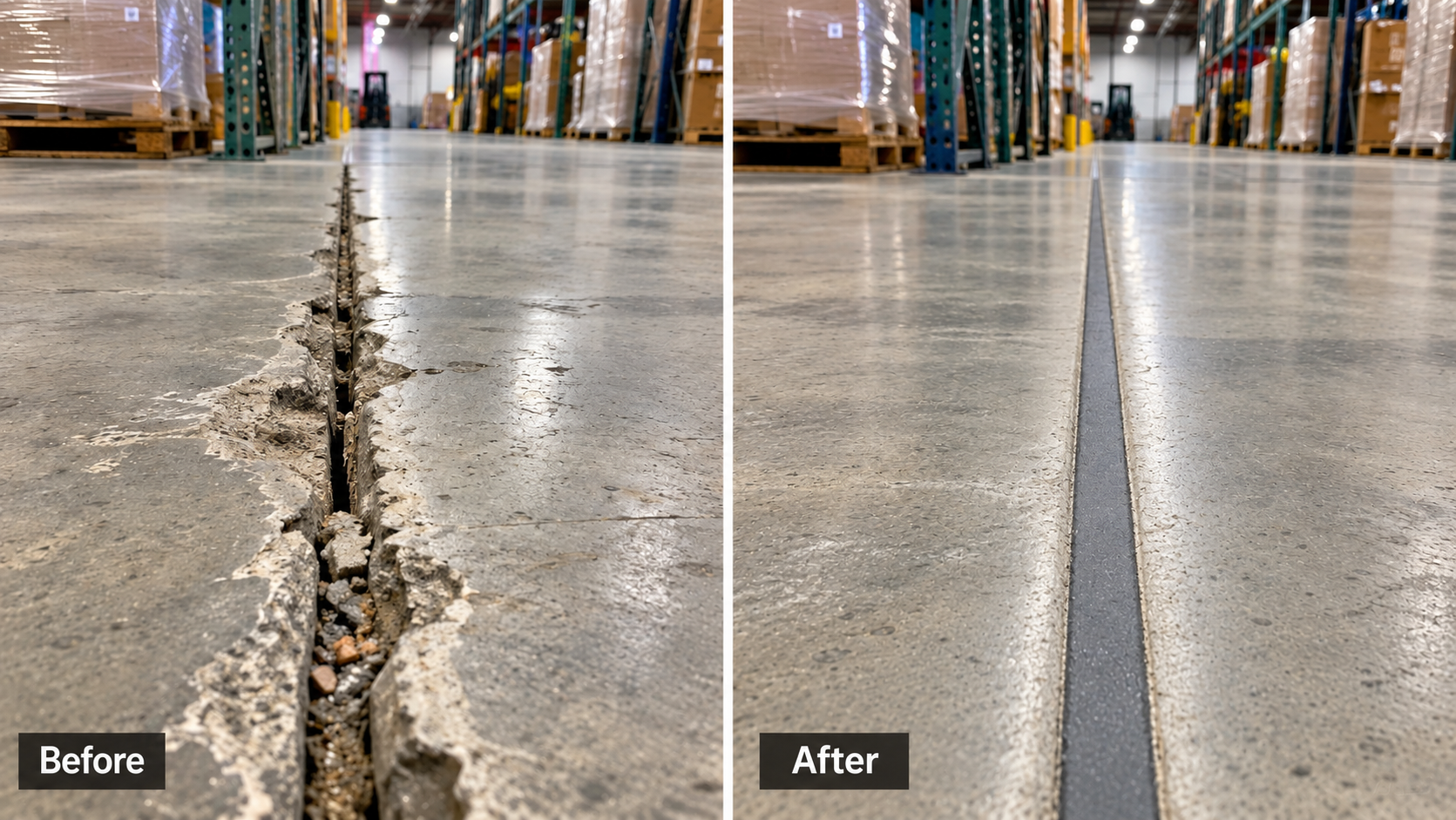
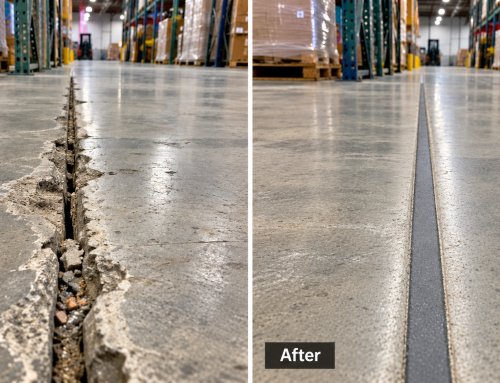
This is the most common damage we see in NJ warehouses, and it tends to get worse faster than facility managers expect. Every time a hard wheel — especially a solid pneumatic or polyurethane tire — rolls over an unsupported joint edge, it chips it a little more. What starts as a small nick becomes a crumbled edge. What was a manageable crack becomes a launch ramp that jolts the forklift on every pass, rattling the machine, the load, and the operator.
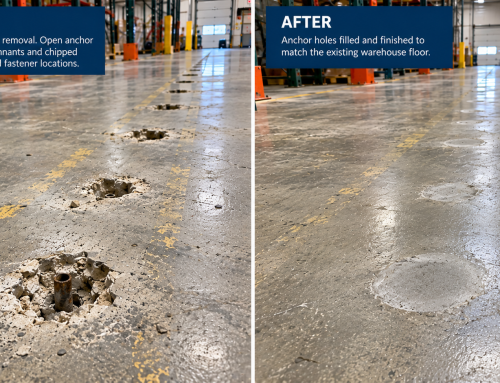
By the time most facilities call us, the joint edges have deteriorated to the point where surface patching alone won’t cut it. The damage needs to be cut back to sound concrete and rebuilt properly.
Surface Cracking and Pitting
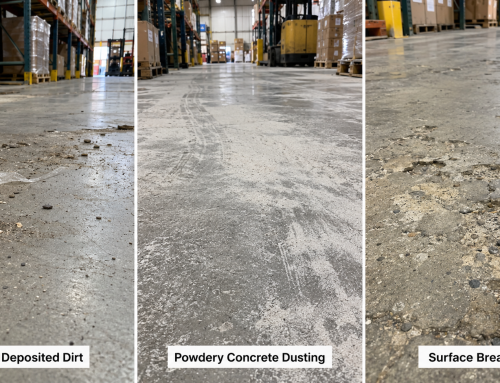
Sharp turns, sudden stops, and repeated impact from dropped pallets all fracture the surface layer of the slab over time. Fine cracks are easy to dismiss as cosmetic — until they start absorbing water, oil, and cleaning chemicals. Once moisture works its way into the aggregate, the problem accelerates. In unheated warehouse bays and dock areas across New Jersey, freeze-thaw cycles through the winter make this significantly worse. Water gets in, freezes, expands, and breaks the concrete apart from the inside.
Slab Settlement
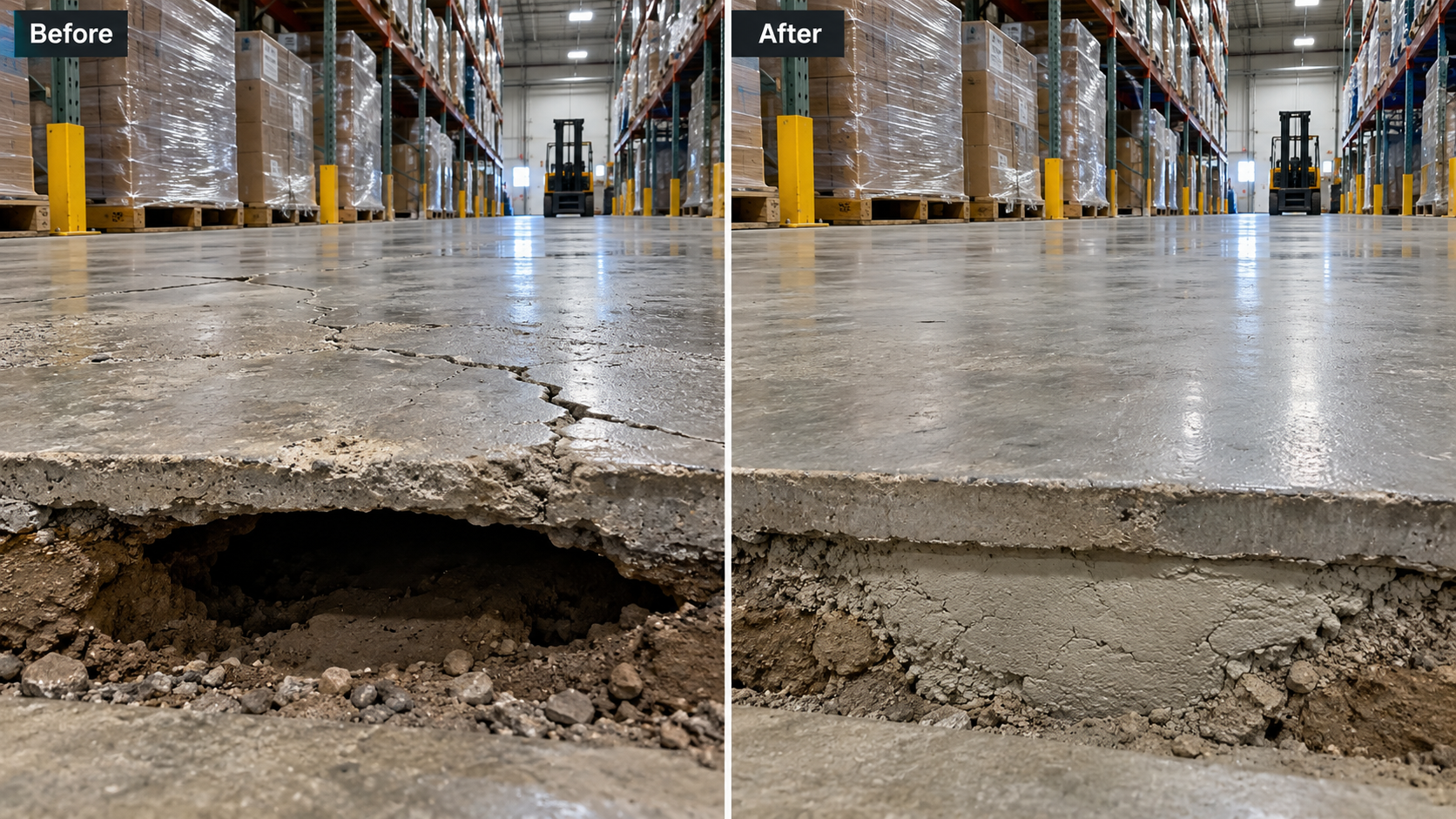
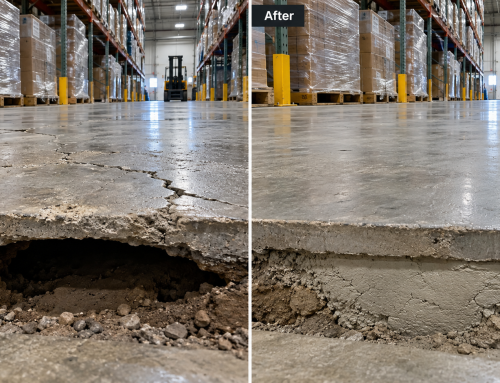
When the subgrade beneath a slab loses support — through soil erosion, poor compaction at original installation, or utility work nearby — the slab drops. That creates a lip at the joint that every forklift has to bump over on every pass. This is not a surface issue. You can patch it at the surface level, but until the underlying void is addressed, the damage will keep coming back. We see this constantly at dock doors and in areas where water has been running under the slab for years.
How to Tell If Your Floor Damage Is Cosmetic or Structural
Not every crack is an emergency. But not every crack is just cosmetic, either. Here’s a straightforward way to assess what you’re dealing with before you call anyone.
Cosmetic — schedule it, don’t panic. Surface scuffing, light pitting, hairline cracks that haven’t widened — these aren’t urgent, but they should be addressed before they become structural. The subgrade is solid, the slab isn’t moving, and an epoxy mortar patch with proper surface prep will hold up well.
Structural concern — get a professional assessment before running heavy traffic through it.
Joint edges chipped wider than a half-inch, cracks that have visibly widened over the past few months, slabs that rock slightly when a forklift passes over them — these are signs the damage has moved beyond cosmetic.
You don’t necessarily need to stop operations, but you should get eyes on it from someone who knows what they’re looking at.
Operational hazard — act now. A visible lip at joints greater than three-quarters of an inch, a slab that has noticeably settled, forklift operators actively swerving to avoid a section of floor — these are the conditions OSHA inspectors flag under 29 CFR 1910.22, which requires employers to maintain walking and working surfaces in safe condition. Restrict traffic in that zone and get an assessment scheduled.
One practical check you can do yourself: walk the floor after hours with a straightedge and a flashlight. Start at the dock doors and main traffic lanes — those take the hardest hit.
Look at the joint edges, check for rocking slabs, and watch for cracks with dust or debris packed into them, which usually means they’ve been moving.
If you’re not sure what severity you’re dealing with, that’s exactly what an on-site assessment is for. We offer free assessments throughout NJ and eastern PA — no obligation, no pressure, just a straight answer about what your floor actually needs.
The Repair Methods That Actually Hold Up Under Forklift Traffic
There’s no shortage of options marketed to facility managers when it comes to floor repair. Not all of them are right for an industrial environment with daily forklift traffic. Here’s what works and why.
Joint Rebuild and Sealing
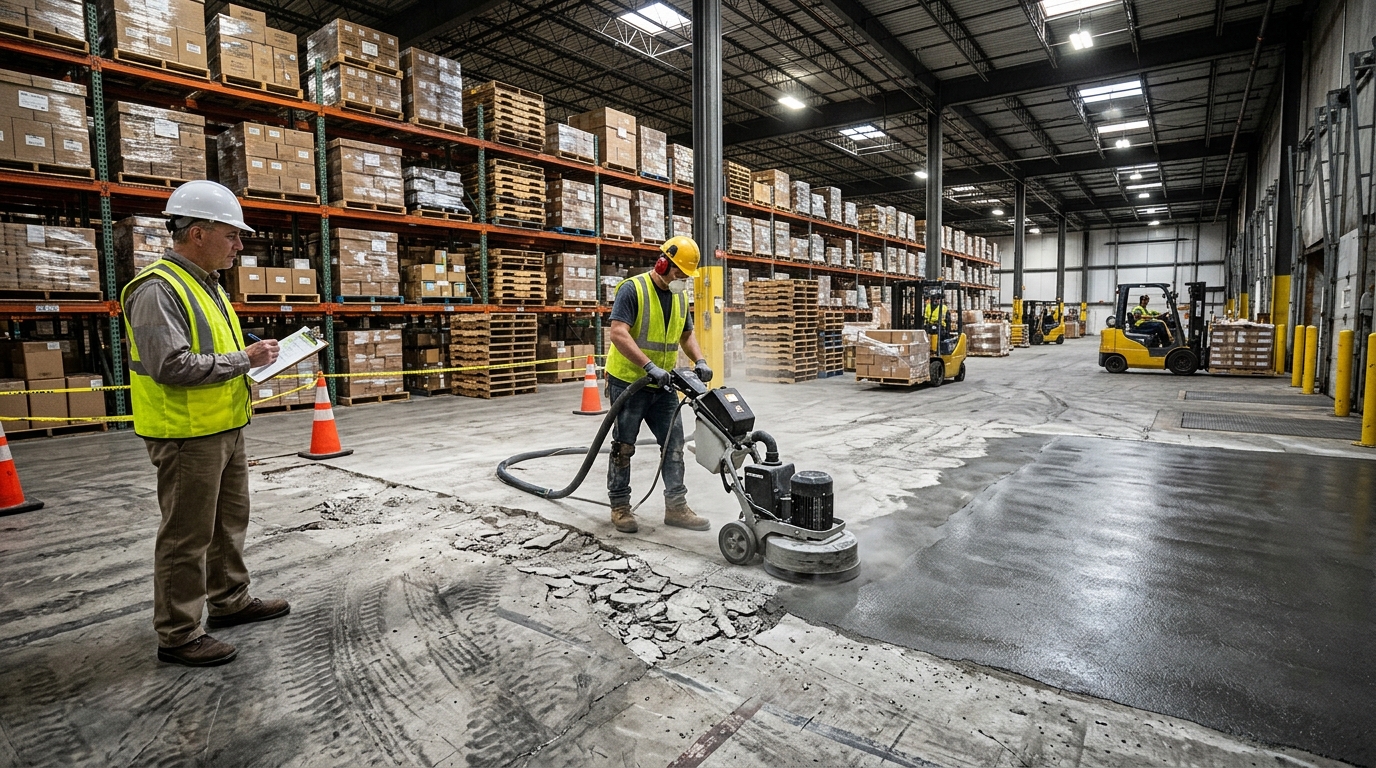
For spalled joint edges, the correct repair starts by saw-cutting the damaged area back to sound concrete on both sides of the joint. The edges are cleaned, primed, and rebuilt with a repair mortar, then the joint itself is filled with a rigid semi-flexible filler — typically polyurea or epoxy — rated for hard-wheel forklift traffic.
Done right, this is the most durable fix available for joint edge damage. The key phrase is “done right” — a joint repair that skips the saw-cutting and surface prep will fail under forklift traffic in months. We’ve seen it happen on floors that were patched by someone else before the facility called us.
Epoxy Mortar Patching
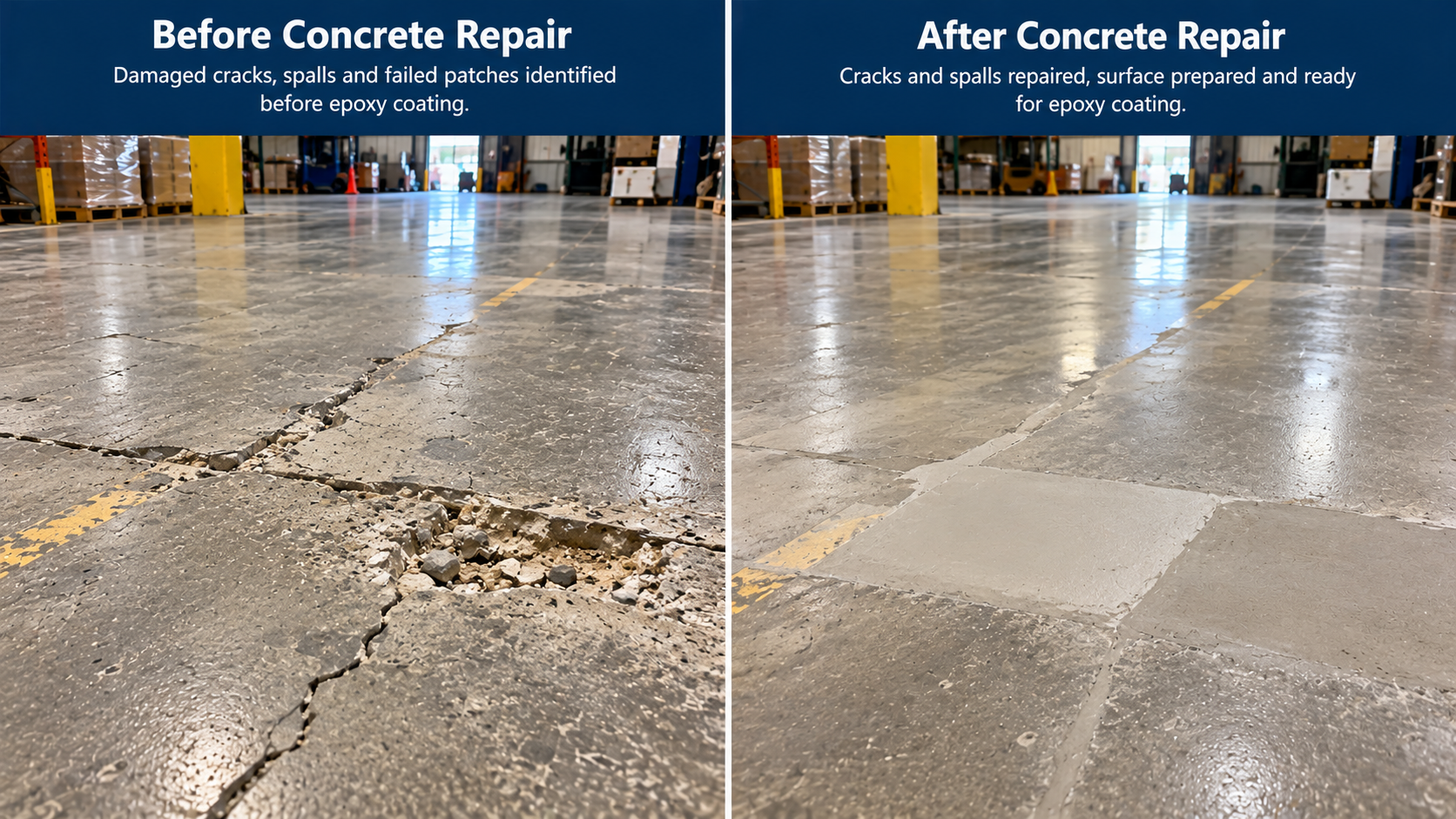
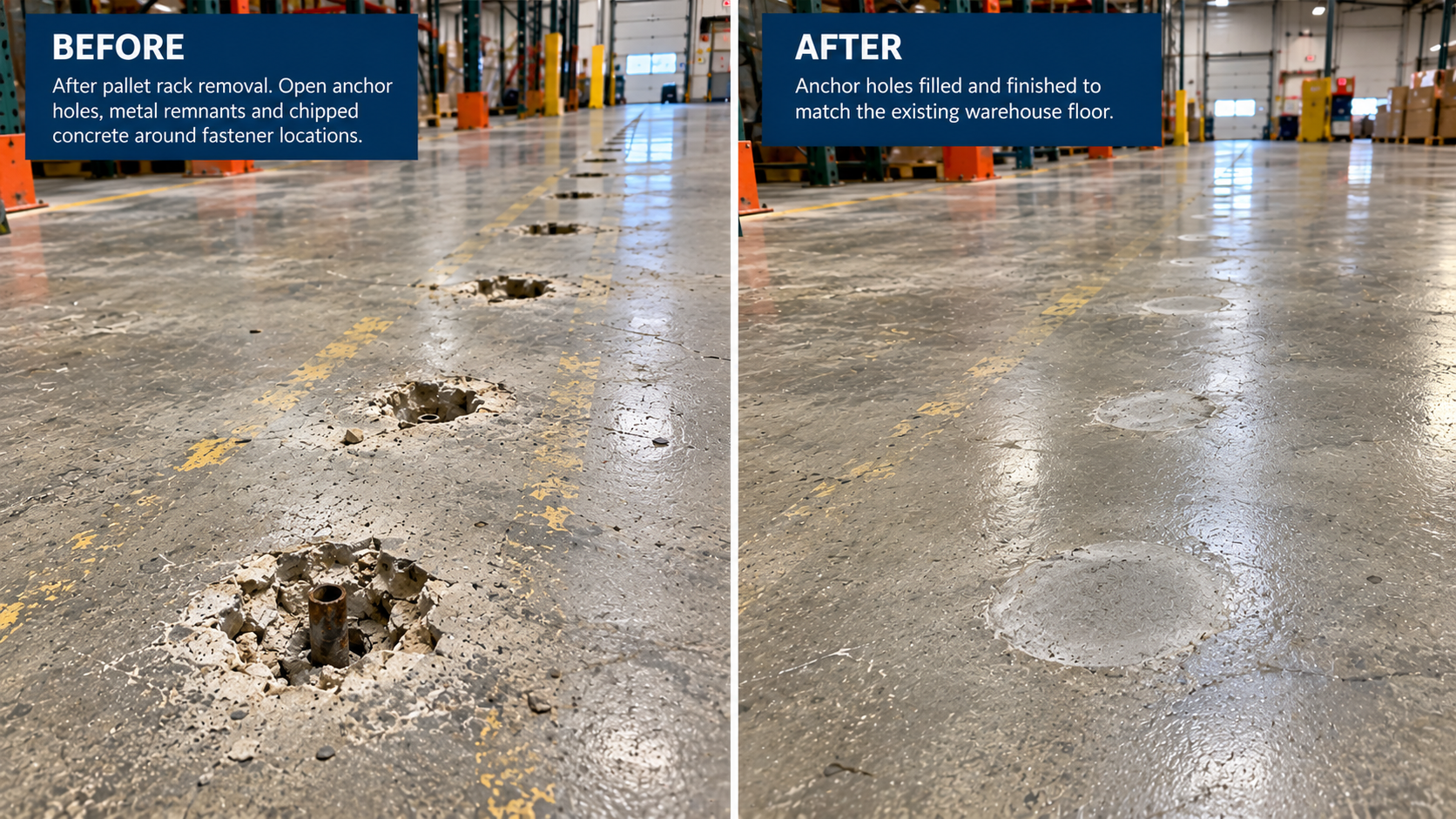
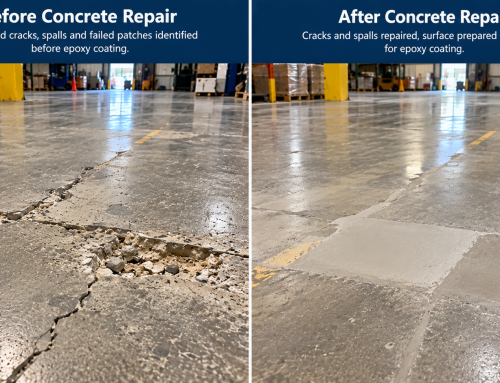
For surface cracks, pitting, and smaller spalled areas away from joints, epoxy mortar patching is the right tool. It bonds tightly to properly prepared concrete, cures quickly, and handles forklift traffic well.
The failure mode we see with patched floors almost always comes down to preparation. The patch is only as strong as what it’s bonded to. If the concrete underneath is weak or contaminated, the patch will pop. If the surface wasn’t properly ground and primed, the patch will pop. The product itself is rarely the problem — the prep is.
Joint Edge Stabilization
In some areas of a warehouse — tight bays, areas with limited equipment access, sections near racking or machinery — there isn’t room to bring in pumps and hoses for larger-scale repair work.
Where a joint edge has lost support underneath and needs to be stabilized before it’s rebuilt, we use a targeted underseal product applied directly to the void at the joint edge.
This isn’t a volume fill or a slab-lifting procedure. It’s a precise, small-scale stabilization step — addressing the lack of support right at the joint before the surface repair goes on top. Done as part of a complete joint rebuild, it gives the repair a stable foundation in spaces where other methods simply can’t reach.
Full Slab Replacement
Replacement is occasionally the only realistic answer — when a slab has failed catastrophically, or when the structural conditions underneath are beyond what repair can address. But in our experience across NJ and eastern PA, that’s the exception, not the rule.
Repair typically costs between a third and half of what replacement costs, and it can usually be done in sections without shutting down operations. We’ll tell you straight if replacement is genuinely the right call. But most damaged floors can be repaired — and repaired to last.
What Facility Managers in NJ and Eastern PA Should Expect from the Process
The two things we hear most from facility managers before they hire us: “I can’t afford to shut down” and “I’ve had this patched before, and it didn’t hold.” Both are fair concerns.
On downtime, we phase repairs by section. The repair zone gets cordoned off, and the rest of the floor stays operational. For most forklift floor damage jobs in NJ, we’re in and out in one to two days without stopping your operation.
Full shutdowns are rare, and we plan around your schedule when they are necessary, including evenings and weekends.
On durability — a properly prepped and installed joint repair or epoxy patch in a standard warehouse environment should last five to ten years.
We’ve had clients reach out a decade later for routine maintenance, not because the repair failed. The ones that fail early almost always fail because of inadequate surface prep or the wrong product for the application. We don’t cut those corners.
One thing worth knowing if you’re in New Jersey: the temperature differential between an unheated dock bay and a conditioned warehouse interior causes real joint movement year-round, and NJ winters make it worse.
We factor that into every product selection on every job. A joint filler that works fine in a climate-controlled facility isn’t necessarily the right choice for a dock door joint in a Middlesex County warehouse in February.
Get a Straight Answer About Your Floor
If you’ve been managing a damaged floor with patches that keep failing, or you’re not sure what you’re actually dealing with, an on-site assessment is the fastest way to get clarity.
Warehouse Floor Repairs has been repairing industrial and warehouse concrete floors across northern and central New Jersey and eastern Pennsylvania for over two decades. We work around your operational schedule — including evenings and weekends — and we provide detailed quotes upfront with no surprises. Licensed, insured, and commercially referenced throughout NJ and eastern PA. Schedule your free floor assessment
Common Questions from NJ Facility Managers
How quickly can forklift floor damage be repaired without shutting down operations?
Most section repairs take one to two days. We work in phases so you’re rerouting traffic, not stopping it. If your facility runs multiple shifts, we can schedule around them.
How do I know if the floor needs patching or full replacement?
An on-site assessment will give you a definitive answer. In most cases, repair is both sufficient and significantly cheaper than replacement. We’ll give you a straight answer either way — if replacement is the only realistic option, we’ll say so.
What does forklift floor damage repair cost in New Jersey?
Costs vary based on the damage type, the repair method, and the square footage involved. Repair is almost always considerably less expensive than replacement, and we provide detailed quotes upfront with no surprises. The assessment is free.
Are cracked warehouse floors an OSHA violation?
They can be. Under 29 CFR 1910.22, employers are responsible for maintaining walking and working surfaces in safe condition. An uneven, cracked, or settled floor in a forklift operating area is exactly the kind of condition that gets flagged during an inspection — and the kind that creates liability if someone gets hurt before it’s addressed.
What causes the same repair spot to keep failing?
Almost always, it’s preparation. A patch bonded to contaminated, weak, or poorly profiled concrete won’t last under forklift traffic regardless of the product used. If a repair keeps failing in the same location, the root cause hasn’t been addressed — whether that’s inadequate surface prep, an unsupported joint edge, or underlying settlement that a surface patch can’t fix.