
IN THIS ARTICLE
All you need to know as a Facility Manager Concerning Warehouse Concrete Floor Repair Cost in NJ
If you are researching warehouse concrete floor repair cost in NJ, you probably already have a problem that can no longer be ignored.
Maybe forklifts are bouncing over damaged joints. Maybe cracks are spreading through busy traffic aisles. Maybe a section of the slab near your loading dock has started to sink, rock, chip, or break apart. Or maybe your maintenance team has patched the same area more than once, only for the damage to come back again.
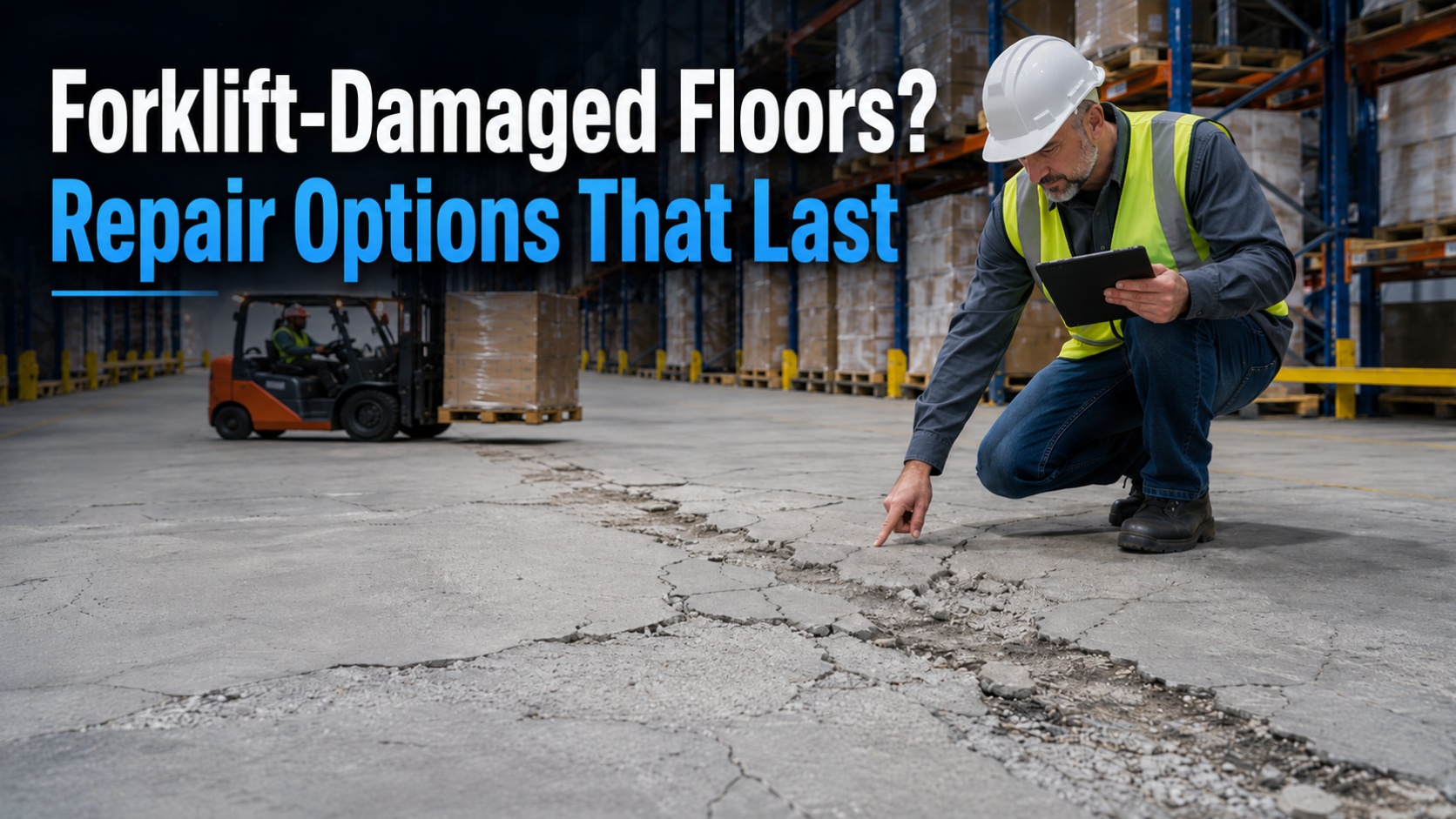
For warehouse facility managers in New Jersey, the cost of concrete floor repair is not only about the contractor’s quote. It is also about safety, downtime, forklift wear, product movement, tenant responsibility, and whether the repair will actually hold up under daily warehouse traffic.
The truth is simple: there is no one-size-fits-all price for warehouse concrete floor repair. A small crack repair is very different from rebuilding failed floor joints across forklift aisles. A surface patch is not the same as stabilizing a settled slab. And a repair done in a low-traffic storage area will not carry the same demands as concrete repair near a loading dock or 24/7 distribution center.
This guide breaks down what affects warehouse floor repair cost in New Jersey, when repair makes sense, when replacement may be necessary, and what facility managers should look for before requesting an estimate.
Why Warehouse Concrete Floor Repair Costs Vary So Much
Two warehouse floors can look damaged in similar ways but require very different repair approaches.
For example, a narrow surface crack in a low-traffic corner may only need cleaning, preparation, and a suitable crack repair material. But a wider crack running through a forklift aisle may point to slab movement, repeated impact, poor support below the slab, or stress from heavy material handling equipment.
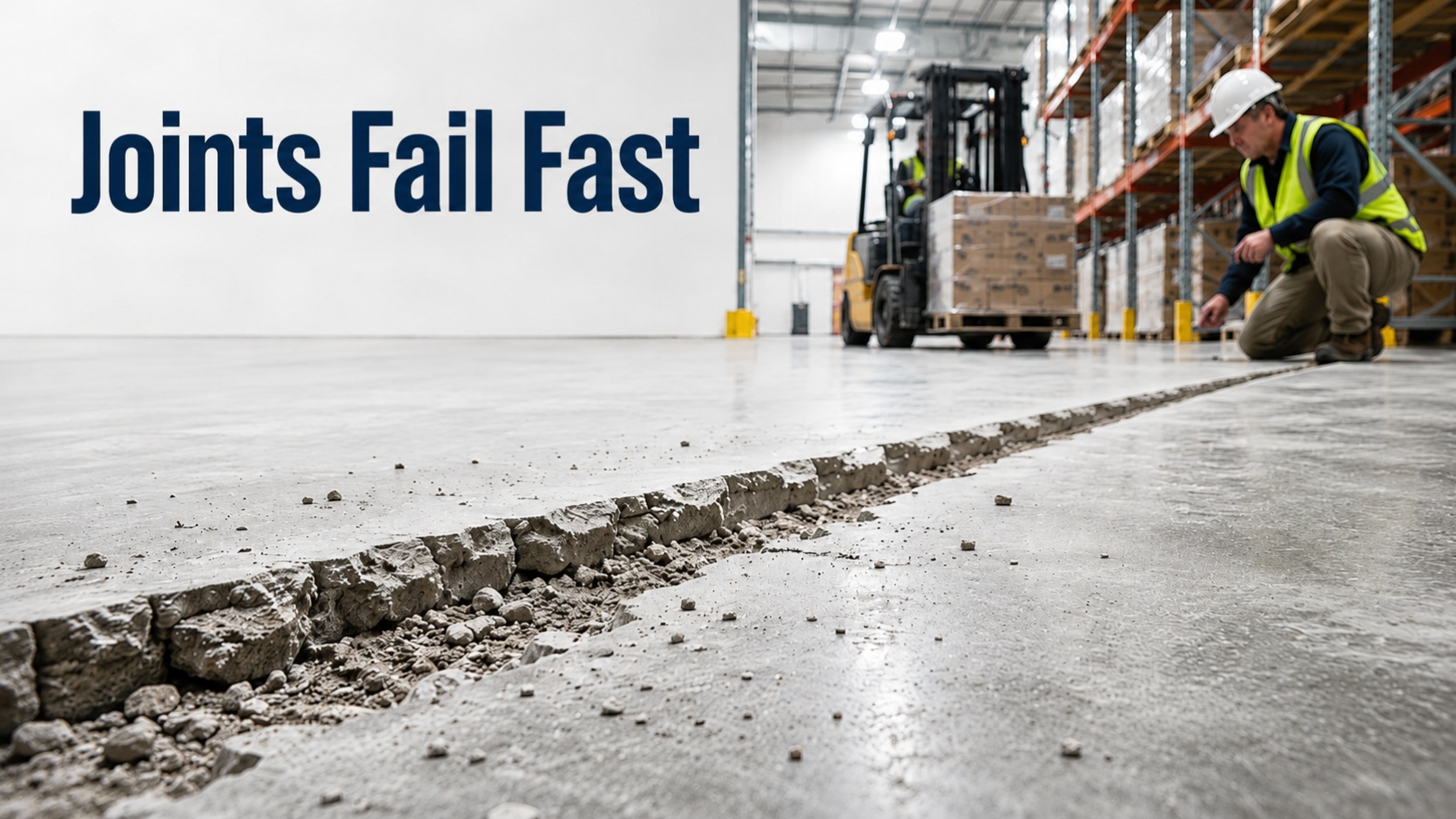
The same is true for floor joints. A chipped joint edge in a storage area may be a small repair. But joint failure in a main forklift lane can become a much larger issue because every forklift pass adds more impact to the damaged edge. Over time, the joint breaks down further, the transition becomes rougher, and operators start slowing down, swerving, or complaining about vibration.
That is why the final cost depends on more than square footage. The real cost drivers are:
- The type of concrete damage
- The depth and severity of the damage
- Whether the slab is stable or moving
- The amount of forklift and pallet jack traffic
- The location of the repair area
- The materials required
- The level of surface preparation needed
- Whether repairs must be phased around active operations
- Whether full replacement is being considered
In other words, a reliable estimate starts with diagnosis. If the cause of the damage is misunderstood, the repair may fail early, and the “cheap” option can become the most expensive option in the long run.
Warehouse Concrete Floor Repair Cost in NJ: What Actually Affects the Quote?
When facility managers ask how much warehouse concrete floor repair costs in NJ, the honest answer is: it depends on what has failed and what the floor needs to do afterward.
Most warehouse floor repair projects are quoted based on the scope of work, not just a flat square-foot number. Some repairs may be measured by linear feet, especially joint repairs or long cracks. Repair area, material type, access conditions, or the amount of preparation and grinding needed may affect others.
Here is a practical way to think about the cost impact:
| Repair Issue | Typical Cost Impact | Why It Affects the Price |
|---|---|---|
| Minor cracks | Lower | Usually requires less preparation, less material, and less downtime. |
| Wide or moving cracks | Medium to high | May require deeper evaluation, stronger repair materials, or stabilization. |
| Damaged floor joints | Medium to high | Joint edges must often be rebuilt to handle repeated forklift traffic. |
| Spalling concrete | Medium | Loose and weak concrete must be removed before repair materials are installed. |
| Forklift-damaged traffic aisles | Medium to high | Repairs must withstand constant impact, turning, braking, and heavy loads. |
| Uneven or sinking slabs | High | May require slab leveling, void filling, or sub-slab stabilization. |
| Loading dock concrete damage | High | Dock areas deal with truck impact, forklift cycles, water exposure, and heavy stress. |
| Full slab replacement | Highest | Demolition, disposal, new concrete, curing time, and operational disruption add cost. |
The key point is this: the cheapest-looking repair is not always the lowest-cost repair. If a repair fails after a few months of forklift traffic, you may pay twice — once for the patch and again for the proper fix.
Crack Repair Cost: Small Surface Crack or Serious Slab Problem?
Cracks are one of the most common reasons facility managers request warehouse floor repair. But not all cracks mean the same thing.
Some cracks are hairline shrinkage cracks. These may be mostly cosmetic at first, although they should still be monitored. Other cracks are wider, deeper, or actively moving. Those are more serious because they can collect debris, create rough surfaces, and spread under forklift traffic.
In busy warehouse environments, crack repair cost depends on:
- The width of the crack
- The depth of the crack
- Whether the crack is moving
- Whether the slab is hollow or unsupported nearby
- Whether forklifts cross the crack repeatedly
- Whether the crack needs routing, cleaning, filling, sealing, or section replacement
If the crack is only repaired at the surface while the slab continues to move, the repair can break down again. That is why a professional concrete crack repair inspection is important before assuming the problem is minor.
For a facility manager, the cost question should not be “How cheap can we fill this crack?” The better question is “What caused the crack, and what repair will survive our traffic?”
Warehouse Floor Joint Repair Cost: Why Joints Can Become Expensive
Floor joints are one of the biggest cost factors in warehouse concrete floor repair.
Joints are necessary because concrete moves. But in warehouses, joints also become repeated impact points. Forklifts, pallet jacks, order pickers, and other material handling equipment cross the same joints thousands of times. Once the joint edge begins to chip, the transition becomes rougher. That rough transition creates more impact. More impact causes more damage. The cycle keeps going.
This is why damaged joints are not just a concrete problem. They can become an operations problem.
Failed joints can lead to:
- Forklift vibration
- Premature wheel wear
- Operator discomfort
- Slower travel speeds
- Trip hazards
- Loose concrete debris
- Recurring patch failures
- More expensive repairs later
The cost of concrete warehouse floor joint repair depends on how many joints are damaged, how long the damaged runs are, how much concrete must be removed, and what repair material is needed to rebuild the edge properly.
If the damaged joint is in a main forklift aisle, the repair also needs to be strong enough for constant wheel impact. A weak patch may look fine after installation, but it may not survive a busy warehouse.
Spalling Repair Cost: When Surface Damage Becomes a Safety Issue
Spalling happens when the concrete surface chips, flakes, breaks, or separates. In warehouses, spalling often appears around joints, loading docks, turning areas, freezer/cooler areas, or high-impact zones where traffic and stress are concentrated.
At first, spalling may look like a surface defect. But it can quickly become more serious.
Loose concrete can create debris. Uneven spots can catch pallet jacks. Forklift wheels can break down the edges further. Dust and broken particles can spread across the facility. If ignored, a small spalled area can become a larger repair area because the weak surrounding concrete keeps breaking away.
The cost of concrete spalling repair depends on:
- The size of the damaged area
- How deep the surface failure goes
- Whether the area is still breaking apart
- The amount of preparation required
- Whether grinding or surface profiling is needed
- The type of repair mortar or industrial-grade material used
- Whether the area must return to service quickly
Facility managers should be careful with quick patching here. Spalling repair usually requires proper preparation. If loose or weak concrete is not removed first, the repair material may not bond correctly, and the damage can return.
Uneven or Sinking Warehouse Floors: Why Leveling Costs More Than Patching
An uneven warehouse floor is a different problem from a surface crack or shallow chip.
If a slab has settled, dipped, rocked, or lost support beneath it, surface patching will not solve the real issue. You may smooth the top temporarily, but the slab can continue to move under forklift loads.
Uneven warehouse floors may be caused by:
- Voids beneath the slab
- Poor original base preparation
- Water movement under the floor
- Soil settlement
- Repeated heavy loading
- Failed support near docks or doorways
- Long-term vibration from material handling equipment
This is where concrete floor leveling may become part of the repair conversation. Leveling or stabilizing a slab usually costs more than a simple surface repair because the contractor must address the support problem, not just the visible damage.
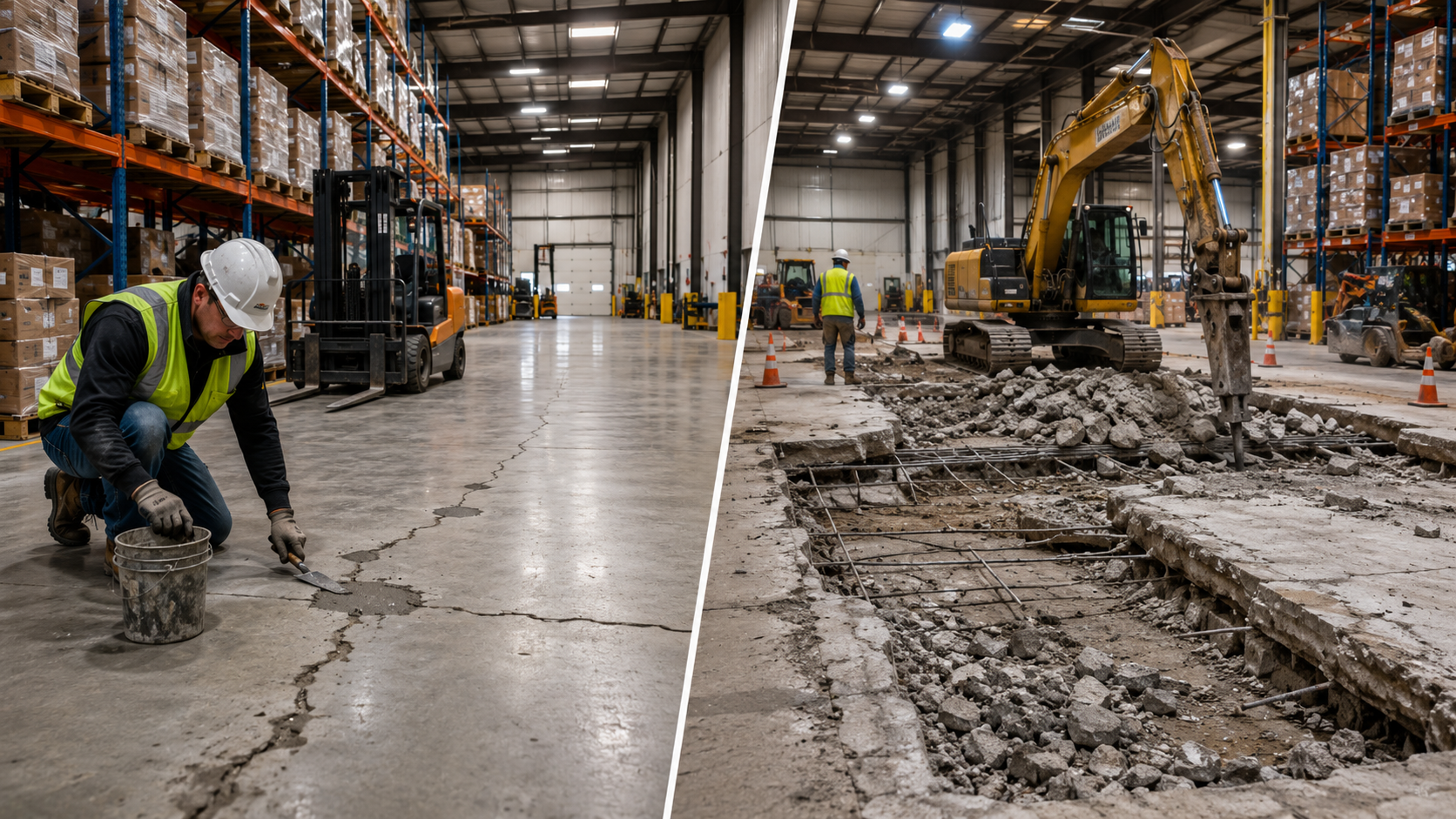
However, slab leveling can still be more cost-effective than replacement when the existing concrete can be restored to safe service. For facility managers, the benefit is not only repair cost savings. It may also reduce downtime, demolition mess, disposal, and long curing delays.
Forklift Traffic Is One of the Biggest Cost Factors
Warehouse floors do not fail in theory. They fail under traffic.
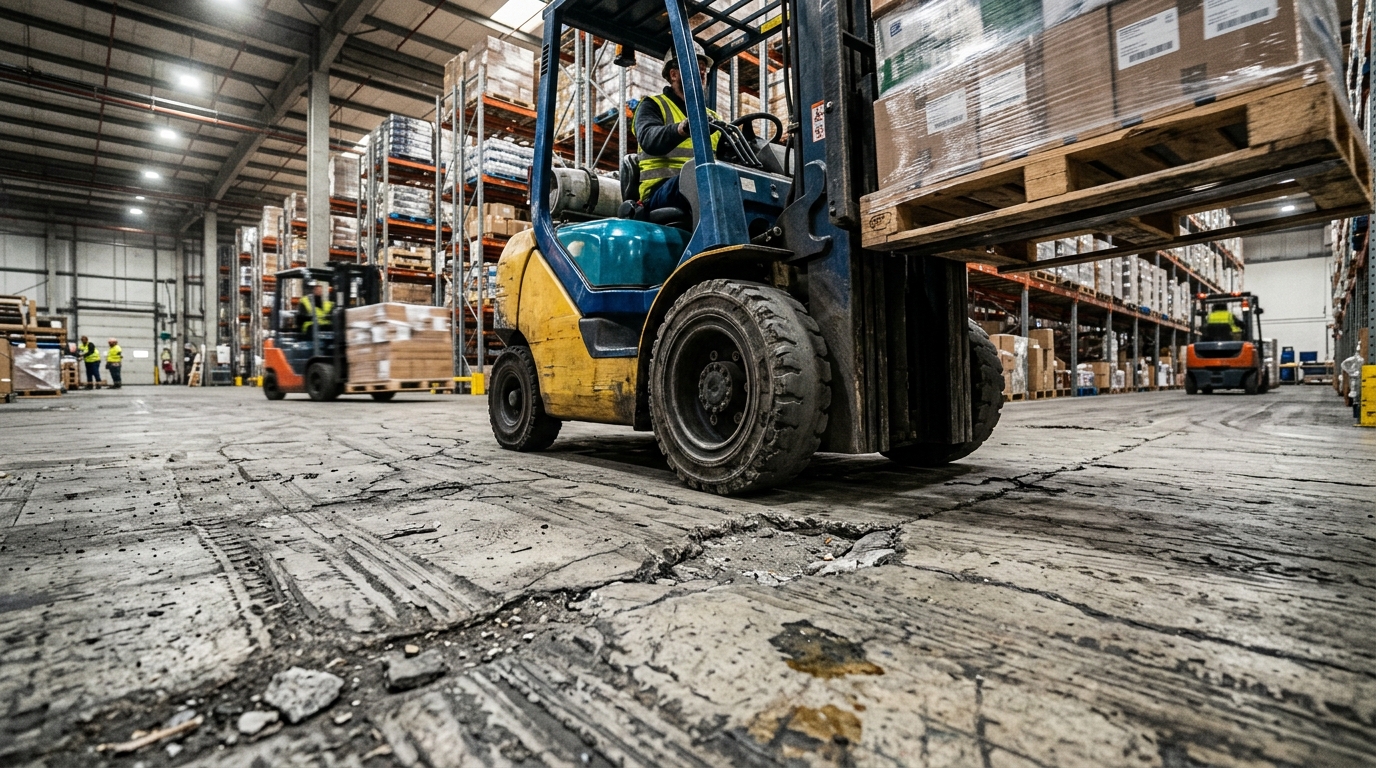
Forklifts concentrate heavy loads through relatively small wheels. When those wheels hit a broken joint, uneven slab, crack edge, or spalled area repeatedly, the damage accelerates. A repair that might survive in a low-traffic storage space may fail quickly in a main travel aisle.
This is why forklift traffic has a major impact on warehouse concrete floor repair cost in NJ.
Areas with constant forklift use may require:
- More aggressive surface preparation
- Stronger repair mortars
- Better joint rebuilding
- Grinding for smoother transitions
- Sub-slab stabilization if the floor is moving
- Phased scheduling to keep operations running
If your operators are slowing down, swerving around damaged areas, or reporting vibration, the floor is already affecting productivity. If your maintenance team keeps replacing forklift wheels faster than expected, the floor may be contributing to the problem. The site’s article on why forklift wheels keep failing is a useful supporting read for that issue.
For more focused guidance, you can also review forklift-damaged floor repair in NJ and warehouse floor cracks from forklift traffic.
Loading Dock Concrete Repair Cost: Why Dock Areas Are Different
Loading dock concrete often costs more to repair than low-traffic floor areas because docks take abuse from several directions at once.
Trucks back in. Forklifts move in and out. Pallets are staged. Water, snow, salt, and temperature changes may affect the concrete near doors. Heavy loads move across the same transition points every day. If the concrete begins to sink, chip, crack, or break near a dock, the damage can spread quickly.
Loading dock floor damage can create serious operational problems:
- Forklifts may hit rough transitions when entering or leaving trailers.
- Dock plates may not sit correctly.
- Water may collect near low spots.
- Operators may need to slow down in critical movement areas.
- Concrete debris can interfere with loading and staging.
- The area may become a safety concern for workers and equipment.
If the issue involves sinking or uneven concrete, a basic patch may not be enough. The slab may need evaluation for support loss, voids, drainage problems, or settlement. For this type of issue, see the related article on loading dock concrete sinking in NJ.
Repair vs. Replacement: Which One Costs Less?
One of the most common questions facility managers ask is whether they should repair the warehouse floor or replace it.
Replacement may sound like the most permanent solution, but it is not always the best first option. Full slab replacement usually involves demolition, hauling broken concrete, preparing the base, pouring new concrete, curing time, and disruption to operations. For busy warehouses, the downtime alone can be painful.
Repair may make more sense when:
- The damage is localized
- The slab is mostly stable
- Joints can be rebuilt
- Cracks can be properly repaired
- Spalling can be removed and patched correctly
- The floor can be leveled or stabilized
- The facility needs to avoid long shutdowns
Replacement may be necessary when:
- The slab is severely broken across large areas
- The concrete has widespread structural failure
- The base below the slab is poor or unstable
- Previous repairs have failed repeatedly
- The floor cannot support current loads
- The damage is too extensive for targeted repair
Before assuming replacement is the only answer, facility managers should compare the full cost of both options. That includes labor, materials, downtime, access limitations, equipment disruption, and the cost of stopping or rerouting warehouse activity.
For a deeper comparison, read warehouse floor repair cost vs. replacement in NJ.
The Hidden Costs Facility Managers Should Not Ignore
The contractor’s repair price is only one part of the real cost.
A damaged warehouse floor can quietly affect the facility long before the repair invoice arrives.
1. Downtime
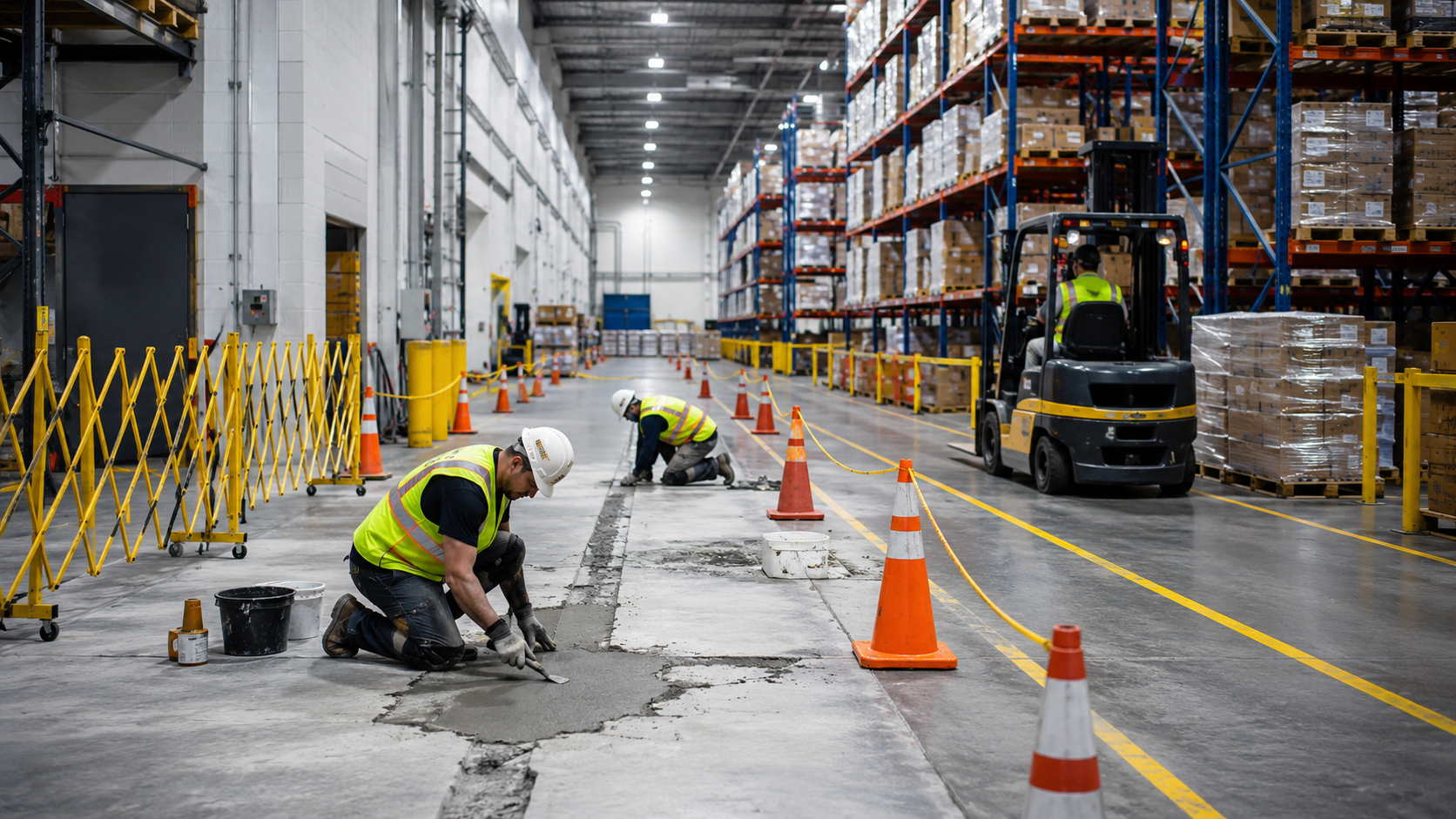
If repairs require shutting down a dock, aisle, freezer, staging area, or traffic lane, that affects scheduling. In some facilities, downtime costs more than the concrete repair itself.
This is especially true for high-volume operations. If your facility runs around the clock, review the related article on concrete floor repair for 24/7 distribution centers in New Jersey.
2. Forklift and Equipment Damage
Rough floors can increase wear on forklift wheels, bearings, pallet jacks, and other equipment. If maintenance costs are rising, the floor may be part of the problem.
3. Safety Risk
Cracks, spalling, uneven joints, and sunken areas can create trip hazards or unstable travel paths. A facility manager should never treat concrete damage as only cosmetic when workers and equipment move through the area every day.
4. Repeat Repairs
A low-cost patch can become expensive if it fails quickly. Failed patches often have to be cut out, cleaned up, and repaired again using a better method.
5. Lost Productivity
Operators naturally slow down when floors are rough. That may seem minor, but in a busy warehouse, slower travel through the same aisles every shift can add up.
What a Contractor Should Inspect Before Giving a Quote
A warehouse concrete floor repair estimate should not be based on guesswork. A qualified repair contractor should inspect the floor and ask practical questions about how the facility operates.
Before quoting, the contractor should look at:
- The type of damage: cracks, joints, spalling, settlement, or surface wear
- The size of the repair area
- The depth of the damage
- Whether the slab is moving or hollow
- Forklift traffic patterns
- Rack layout and aisle access
- Loading dock conditions
- Drainage or moisture issues
- Whether repairs must happen during off-hours
- How soon the repaired area must return to service
- Whether grinding is needed to create a smooth transition
- Whether replacement is actually necessary
The more accurate the inspection, the more accurate the quote. For facility managers, this matters because a vague estimate can lead to change orders, delays, or repairs that do not solve the real problem.
If you are still trying to understand the right approach, this guide on the best repair method for warehouse concrete floors is a helpful next read.
How Facility Managers Can Reduce Warehouse Floor Repair Costs
The best way to reduce warehouse concrete floor repair costs in NJ is not to wait until the damage becomes severe.
Here are practical steps that can help:
Repair Small Problems Early
Small cracks, chipped joints, and minor spalling are usually easier to address before they spread. Once forklift traffic starts breaking down the edges, the repair area often grows.
Inspect Main Forklift Routes Regularly
Most warehouse floor damage does not happen evenly across the entire facility. It usually appears first in main travel aisles, dock approaches, turning points, staging areas, and high-load routes.
Pay Attention to Operator Complaints
If operators say a section of floor feels rough, uneven, hollow, or unstable, do not ignore it. They are often the first people to feel the problem before it becomes obvious visually.
Fix Water and Drainage Problems
Water can worsen settlement, freeze-thaw damage near doors, surface breakdown, and loading dock deterioration. If water is collecting near a damaged slab, the repair plan should address more than the visible concrete.
Avoid Weak Patches in Heavy-Traffic Areas
A patch material that works in a light-duty area may not survive a forklift aisle. Industrial floor repairs need materials and preparation that match the traffic demand.
Group Repairs When Possible
If several areas need attention, it may be more efficient to schedule them together instead of handling repeated small repair calls. This can reduce mobilization, planning, and disruption.
Choose a Contractor That Understands Warehouse Floors
Warehouse concrete repair is different from residential sidewalk or patio repair. The contractor needs to understand forklifts, joints, slab support, surface preparation, industrial repair materials, and operational downtime.
For general service information, visit the main warehouse concrete floor repair page.
When Should You Request a Professional Warehouse Floor Inspection?
You should request a professional inspection when the floor starts affecting safety, equipment movement, or daily operations.
Warning signs include:
- Forklifts bounce or vibrate in certain aisles
- Operators slow down or avoid specific areas
- Floor joints are breaking apart
- Cracks are widening
- Concrete is spalling or flaking
- Loose debris keeps returning
- Slabs feel uneven or hollow
- Pallet jacks catch on rough surfaces
- Loading dock concrete is sinking or breaking
- Previous patches have failed
- There are trip hazards or safety complaints
Do not wait until a small repair becomes a larger capital expense. The earlier the problem is evaluated, the more options you usually have.
Frequently Asked Questions About Warehouse Concrete Floor Repair Cost in NJ
How much does warehouse concrete floor repair cost in NJ?
The cost depends on the type of damage, the size of the repair area, the condition of the slab, the materials needed, the level of forklift traffic, and whether repairs must be phased around active operations. A site inspection is usually the best way to get an accurate quote.
Is warehouse floor repair cheaper than replacement?
In many cases, yes. If the damage is localized and the slab can be stabilized, leveled, patched, or rebuilt in specific areas, repair may cost less than full replacement. Replacement becomes more likely when the slab is severely broken, structurally unsound, or failing across large areas.
Can warehouse floor repairs be done without shutting down the whole facility?
Often, yes. Many warehouse floor repairs can be phased by aisle, dock, traffic lane, or work zone. The best approach depends on the repair method, cure time, access, and how your operation is scheduled.
Why do concrete floor patches fail in warehouses?
Patches often fail because the damaged area was not prepared properly, the wrong material was used, the slab continued moving, or the repair was not designed for forklift traffic. Surface-only repairs can fail quickly when the real issue is poor support, joint movement, or repeated heavy impact.
What type of warehouse floor damage is most expensive to repair?
Large settled slabs, failed loading dock areas, widespread joint damage, severe spalling, and damaged forklift aisles tend to cost more than simple cracks because they usually require more preparation, stronger materials, and a more careful repair plan.
Who should repair a damaged warehouse concrete floor?
Facility managers should work with a contractor experienced in industrial and warehouse concrete floors, not just general concrete work. The contractor should understand crack repair, joint repair, spalling repair, slab leveling, forklift traffic, and phased repair scheduling.
Get a Warehouse Concrete Floor Repair Estimate in NJ
Warehouse floor damage does not fix itself. Cracks spread. Joints break down. Spalling gets worse. Sinking slabs keep moving. And every forklift pass can make the repair area larger.
If you manage a warehouse, distribution center, industrial building, freezer facility, loading dock, or logistics property in New Jersey, the right repair starts with a proper inspection.
Warehouse Floor Repairs can evaluate cracks, damaged joints, spalling, forklift-damaged aisles, uneven slabs, and loading dock concrete problems. From there, you can determine whether the floor needs targeted repair, joint rebuilding, slab leveling, stabilization, or replacement.
To discuss your project, contact Warehouse Floor Repairs or call (908) 369-3110 to schedule a professional evaluation.

- Low-Downtime Concrete Floor Repair for Active Warehouses in NJ - June 30, 2026
- Repair vs Replacement:What to Do With a Damaged Warehouse Concrete Floor - June 30, 2026
- Warehouse Floor Joint Repair: Why Damaged Joints Get Worse Fast - June 30, 2026