
IN THIS ARTICLE
Low-Downtime Warehouse Floor Repair in NJ
Warehouse floor damage is stressful enough. But for most facility managers, the bigger concern is not just the repair itself. It is the downtime.
If a concrete floor crack runs through a main forklift aisle, can the warehouse keep operating? If a damaged floor joint is breaking apart near a loading dock, does that dock have to close? If a slab is uneven in a high-traffic route, can the repair be done without stopping shipping, receiving, production, or order fulfillment?
These are the questions that matter in active facilities.
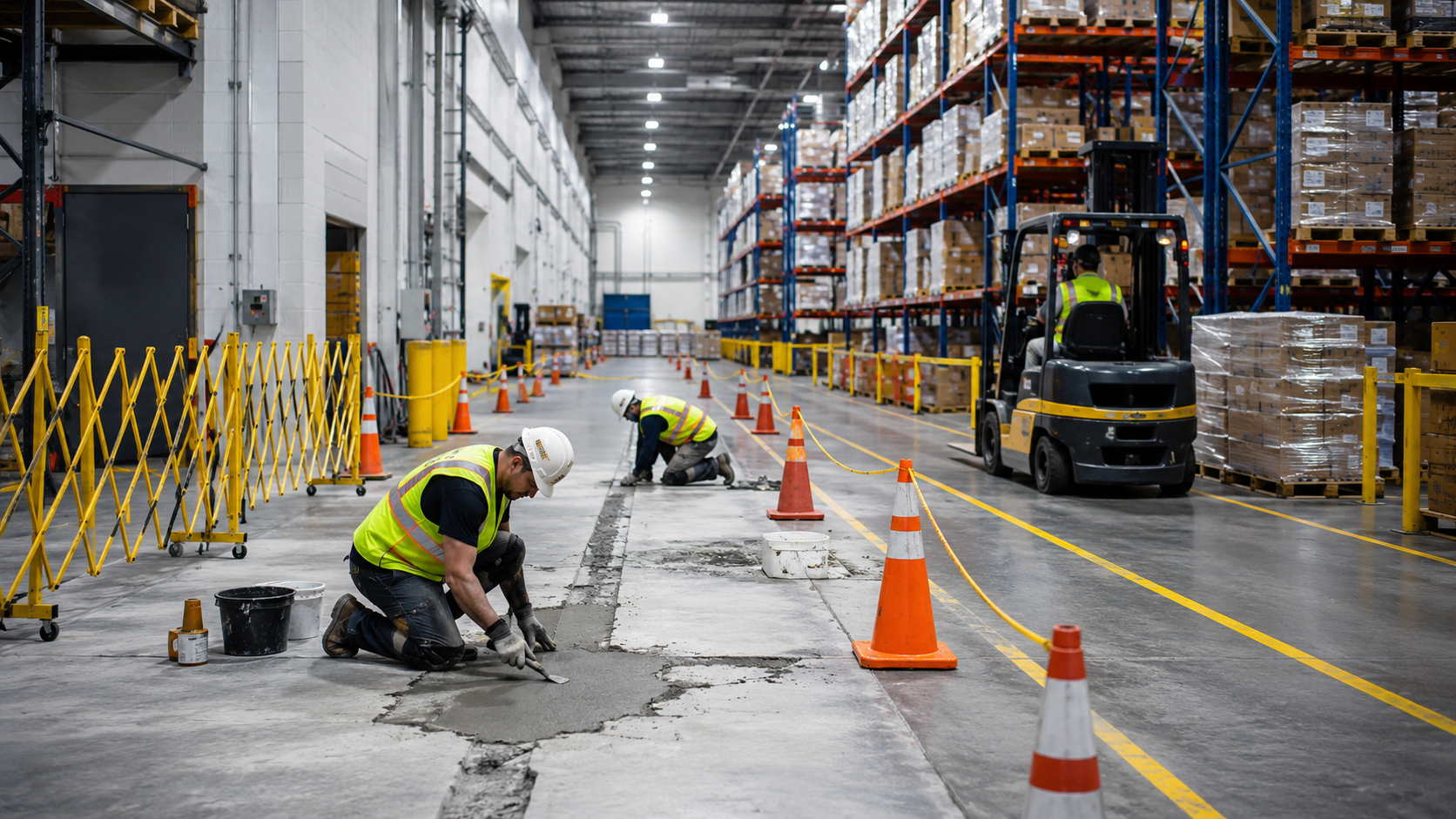
If you are looking for low-downtime warehouse floor repair in NJ, the goal is to repair cracked, spalling, uneven, joint-damaged, or forklift-damaged concrete floors while keeping your warehouse as active, safe, and productive as possible.
That does not mean every repair can be completed instantly. It also does not mean forklifts should run over fresh repair material before it is ready. Low-downtime repair is not about rushing the work. It is about planning the repair around your warehouse operation so the floor can be fixed with minimal disruption.
This guide explains how low-downtime warehouse floor repair works, what types of damage can often be repaired in phases, how to plan around forklift traffic, and when a larger repair window may be necessary.
Why Downtime Matters So Much in Warehouse Floor Repair
In a warehouse, downtime is expensive.
Closing one aisle may slow down picking. Closing one dock may delay shipments. Blocking a forklift route may force operators into inefficient traffic patterns. Shutting down a staging area may affect receiving, loading, inventory movement, or production flow.
That is why concrete repair cost is only one part of the decision. For an active warehouse, the operational disruption can sometimes cost more than the repair itself.
Downtime can affect:
- Shipping schedules
- Receiving operations
- Forklift routes
- Loading dock access
- Labor productivity
- Order fulfillment
- Material staging
- Cold storage or freezer operations
- Manufacturing flow
- Truck scheduling
- Safety controls
- Tenant or landlord responsibilities
- Customer commitments
That is why facility managers should not wait until a floor problem becomes an emergency. Planned floor repair is usually easier to manage than emergency repair. When the work is planned early, you have more options for phasing, scheduling, traffic rerouting, and choosing the least disruptive repair window.
When repairs are delayed too long, the damage may spread into larger traffic areas, forcing a more disruptive repair later.
What Low-Downtime Warehouse Floor Repair Actually Means
Low-downtime warehouse floor repair does not always mean “no downtime.” That would be unrealistic in many cases.
It means the repair is planned to reduce downtime as much as possible while still protecting safety and repair quality.
Depending on the floor condition, low-downtime repair may include:
- Repairing one aisle at a time
- Scheduling work during off-hours
- Using weekend repair windows
- Creating temporary forklift routes
- Repairing one dock approach at a time
- Prioritizing the most hazardous areas first
- Using fast-setting repair materials where appropriate
- Creating safe barricaded work zones
- Coordinating repairs with shift supervisors
- Keeping unaffected areas of the warehouse active
The key is coordination. The contractor needs to understand more than concrete. They need to understand how your warehouse moves.
Which aisles are critical? Which dock doors are busiest? Where do forklifts travel most often? Which areas can be closed temporarily without disrupting the whole facility? Which repairs must be done after hours?
Low downtime does not mean skipping surface preparation, ignoring cure time, or reopening the area too soon. It means the repair plan is built around your operation from the start.
Common Warehouse Floor Problems That Can Often Be Repaired With Limited Downtime
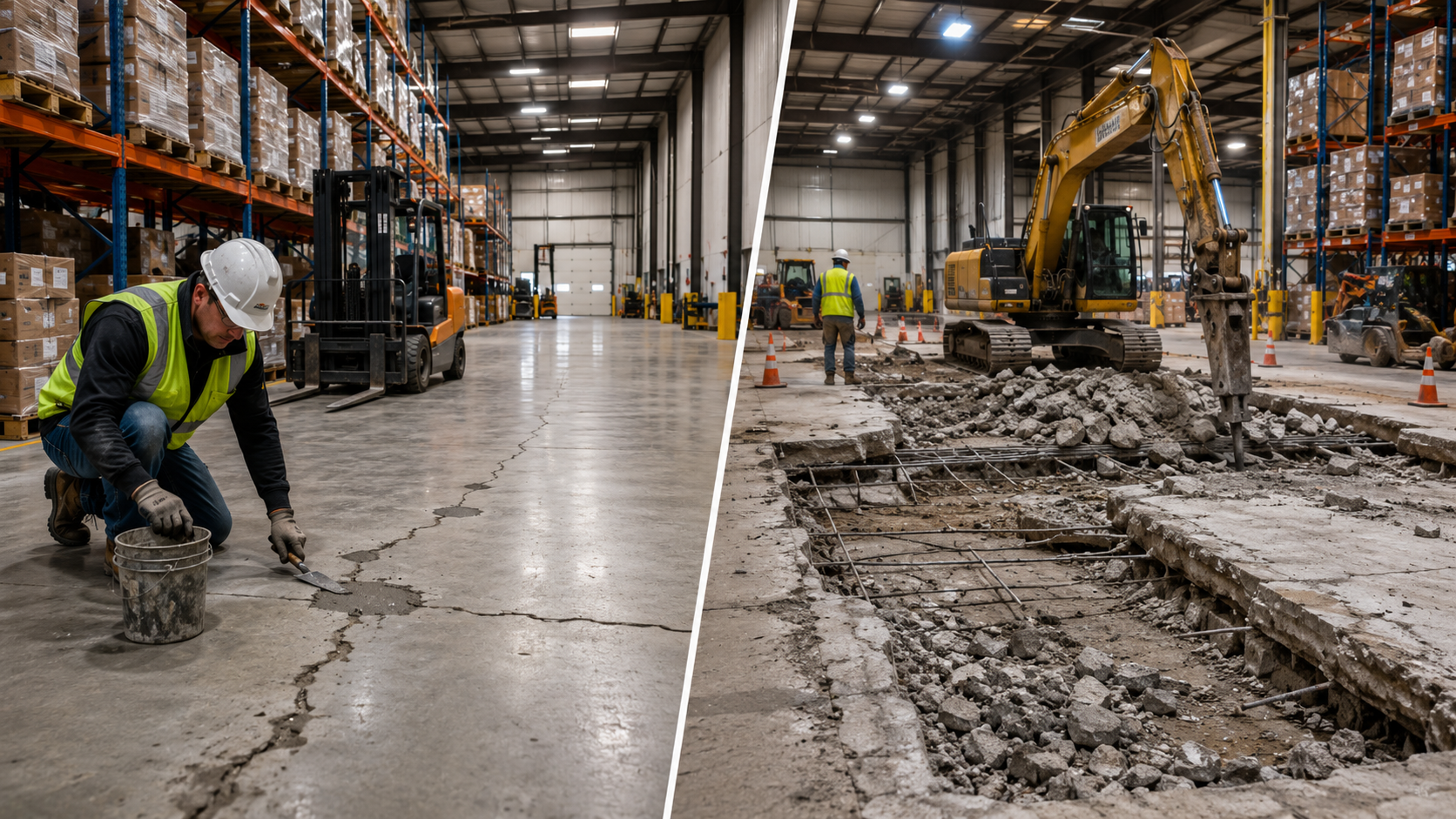
Not every floor problem requires full shutdown or full slab replacement. Many common warehouse concrete issues can be repaired in targeted zones if they are addressed early enough.
Here are the types of damage that can often be handled with a low-downtime plan.
Cracks in Forklift Aisles
Cracks in forklift aisles should never be ignored. Even a narrow crack can widen under repeated traffic, collect debris, or create rough transitions for forklift wheels and pallet jacks.
However, many cracks can be repaired in targeted sections if the slab is stable and the damage has not spread deeply.
Low-downtime crack repair may involve:
- Marking the damaged area
- Rerouting traffic temporarily
- Cleaning and preparing the crack
- Using the appropriate repair material
- Reopening the area only when safe for traffic
If cracks are part of your floor problem, visit the concrete floor crack repair service page. If you are still trying to understand the cause, this guide on causes of concrete floor cracks in warehouses is also useful.
Damaged Warehouse Floor Joints
Floor joints are one of the most common repair areas in active warehouses.
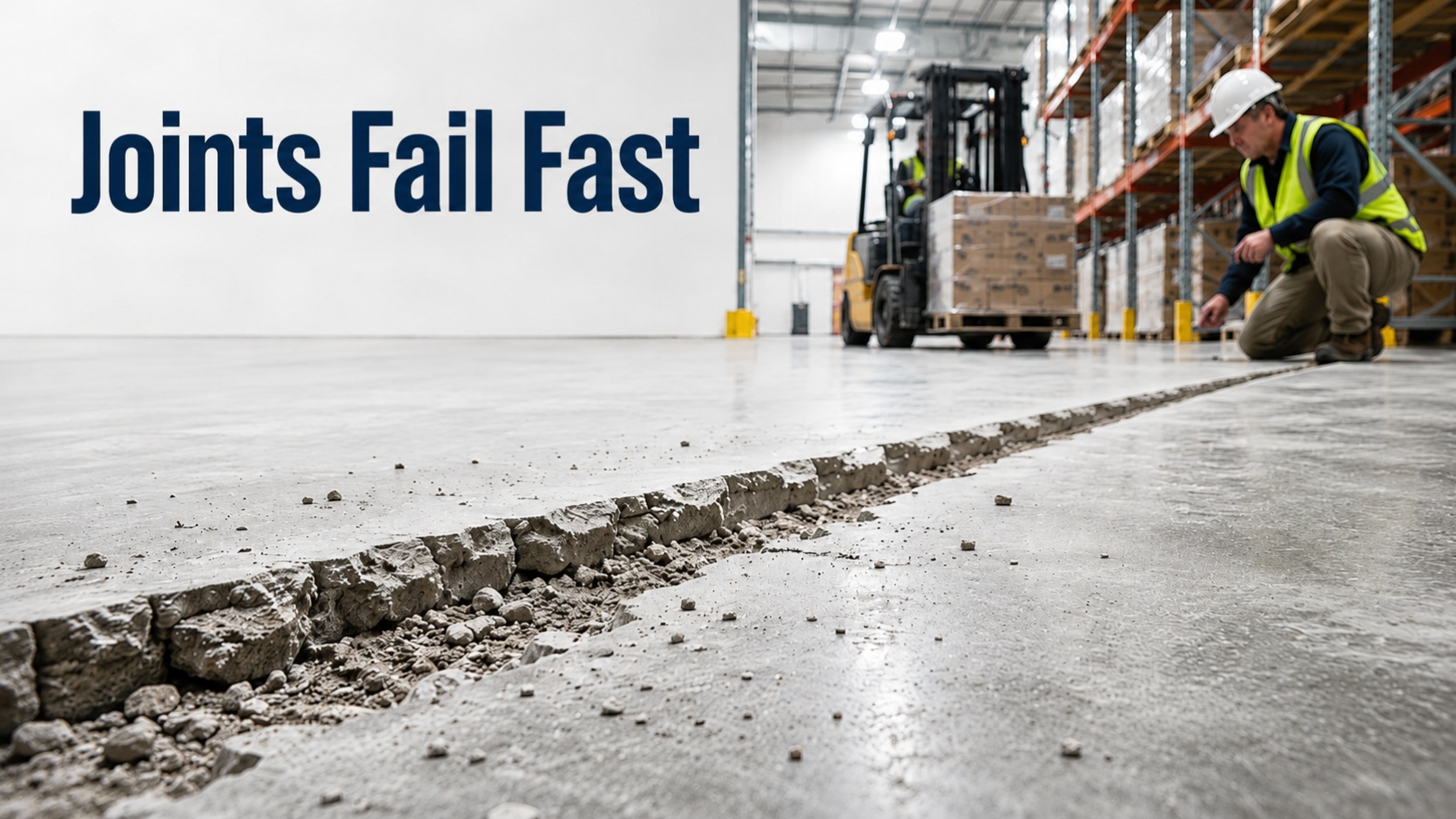
Forklifts, pallet jacks, and loaded carts cross the same joints repeatedly. Once a joint edge chips or breaks, each wheel impact can make the damage worse. If ignored, a small broken joint can turn into a larger repair area.
The good news is that joint repairs can often be phased aisle by aisle or zone by zone.
Depending on the damage, warehouse floor joint repair may include:
- Removing loose concrete
- Cleaning the joint
- Removing failed filler or patch material
- Rebuilding damaged joint edges
- Filling or sealing the joint
- Grinding or finishing the repair for smoother traffic
If your forklifts are bouncing over joints, operators are slowing down, or joint edges are crumbling, review the concrete warehouse floor joint repair page. You can also read causes of floor joint damage in warehouse concrete floors to understand why damaged joints get worse under warehouse traffic.
Concrete Spalling and Surface Breakdown
Spalling happens when the concrete surface chips, flakes, breaks, or separates. In warehouses, it often appears around joints, turning zones, loading docks, freezer areas, or high-traffic forklift lanes.
Localized spalling can often be repaired without replacing the entire slab. But the repair area must be properly prepared. Patching over loose or weak concrete is one of the fastest ways to create a repair that fails early.
Low-downtime spalling repair may involve:
- Isolating the damaged section
- Removing loose or weak concrete
- Grinding or preparing the surface
- Installing a suitable repair material
- Finishing the surface for warehouse traffic
For more information, visit the concrete spalling repair page.
Uneven or Settled Slab Sections
An uneven warehouse floor can be a serious operational issue. Forklifts may dip, bounce, or rock in certain areas. Pallet jacks may catch at slab transitions. Operators may slow down or avoid the area entirely.
In some cases, an uneven slab can be leveled or stabilized without full replacement. That can reduce downtime compared with breaking out and repouring large sections of concrete.
Concrete floor leveling may be considered when:
- One slab panel has settled
- Forklifts dip or rock in a specific section
- There is an uneven transition between panels
- Cracks keep returning around a low area
- The slab is mostly intact but no longer level
If settlement or uneven slabs are part of the problem, visit the concrete floor leveling service page.
Forklift-Damaged Traffic Lanes
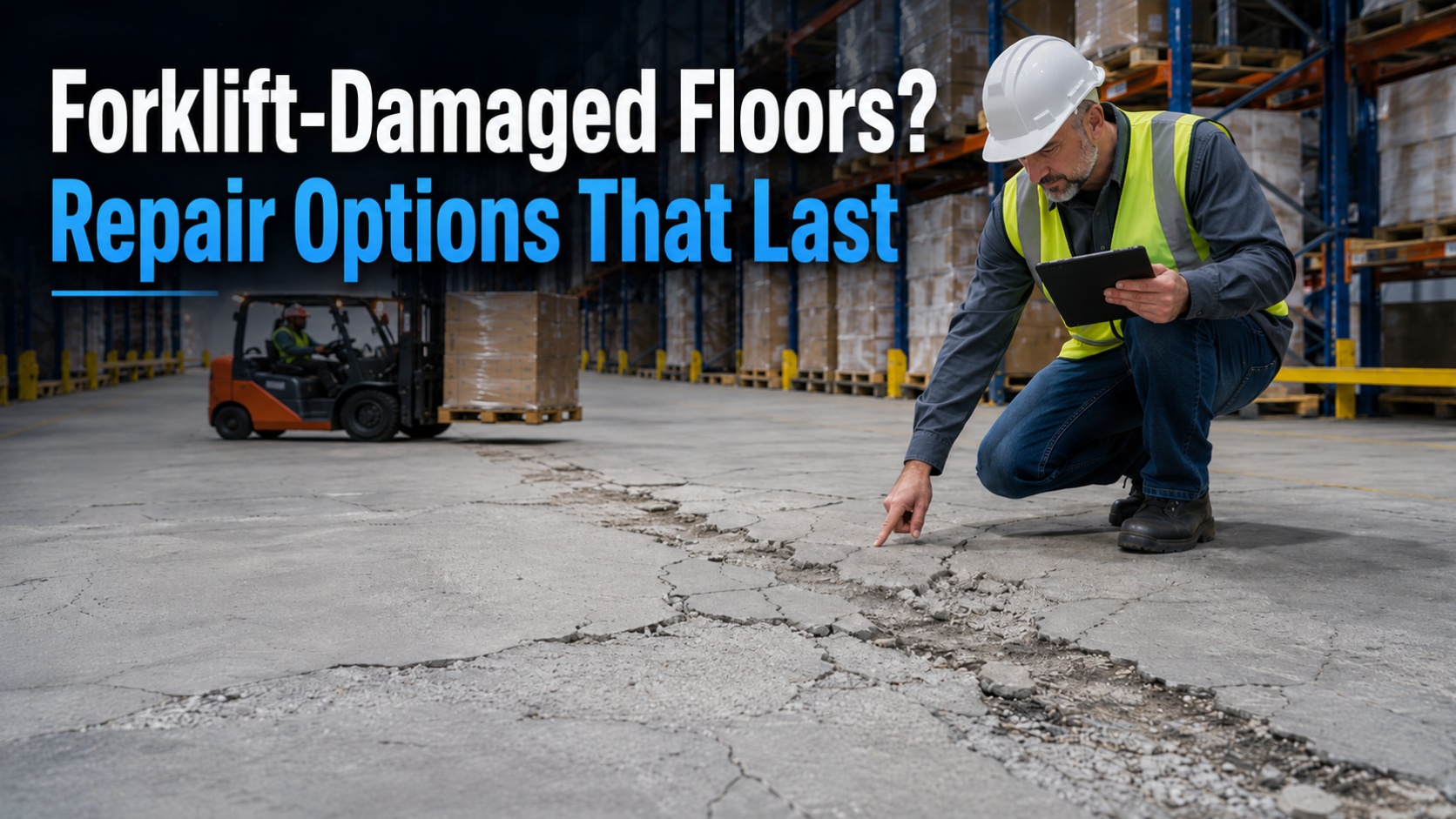
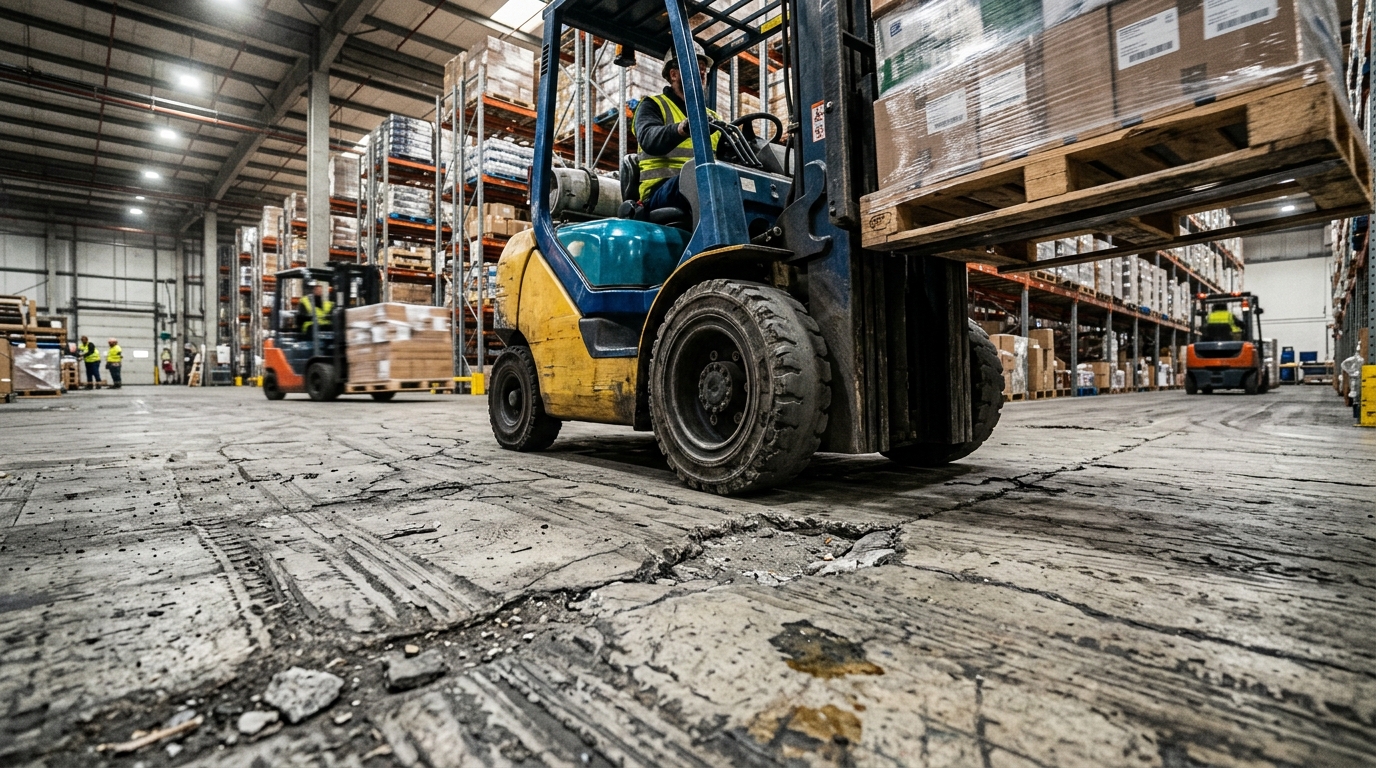
Forklift traffic can damage warehouse floors in several ways. It can widen cracks, chip joint edges, break down spalling areas, and punish weak patches.
Low-downtime repair may be possible when forklift damage is concentrated in specific lanes, turning zones, or dock approaches. The work can often be planned around traffic patterns instead of shutting down the entire facility.
If forklift traffic is a major part of the damage, read warehouse floor cracks from forklift traffic and how to protect warehouse concrete floors from forklift damage.
How Phased Repairs Help Keep the Warehouse Running
Phasing is one of the most important strategies for low-downtime warehouse floor repair.
Instead of closing a large section of the facility, the repair can be broken into smaller work zones. This allows the warehouse to continue operating around the repair area.
For example, a facility may repair one aisle, one dock approach, one joint line, or one damaged traffic lane at a time.
| Repair Area | Low-Downtime Strategy |
|---|---|
| Main forklift aisle | Temporary reroute and off-hour repair |
| Loading dock approach | Dock-by-dock scheduling |
| Damaged floor joint | Aisle-by-aisle repair |
| Localized crack | Short barricaded work zone |
| Spalling patch | Repair during low-traffic period |
| Uneven slab | Scheduled leveling window |
| 24/7 facility | Prioritized phased repair plan |
A phased repair plan may include:
- Identifying the most urgent safety hazards first
- Separating active traffic lanes from work zones
- Coordinating with forklift operators and supervisors
- Scheduling noisy or disruptive work outside peak hours
- Closing one zone while keeping another zone open
- Reopening completed areas before moving to the next zone
This type of planning is especially useful in distribution centers, logistics buildings, food storage warehouses, cold storage facilities, manufacturing spaces, and high-traffic industrial buildings where a complete shutdown is not realistic.
Fast-Setting Materials: Helpful, But Not Magic
Fast-setting repair materials can be very helpful in low-downtime warehouse floor repair. They may allow certain repair areas to return to service faster than traditional materials.
But fast-setting material is not magic.
The repair still needs proper preparation. Loose concrete still has to be removed. The surface still needs to be clean and ready to bond. The repair material still needs enough time before it can handle forklift traffic.
Fast-setting materials can help reduce downtime, but they cannot rescue a poorly prepared repair.
Before using any fast-return repair method, the contractor should consider:
- The type of damage
- The depth of the repair
- The expected forklift traffic
- The temperature and moisture conditions
- The repair material’s return-to-service time
- Whether the area will receive heavy wheel loads
- Whether the repair is in a turning zone or straight travel path
In other words, speed matters, but performance matters more. A repair that reopens quickly but fails under traffic is not a low-downtime success. It is a future disruption waiting to happen.
Why Preparation Still Matters in Low-Downtime Repairs
When a warehouse is active, there is always pressure to move quickly. But skipping preparation is one of the most expensive mistakes a facility can make.
Proper preparation may include:
- Cleaning the damaged area
- Removing loose concrete
- Cutting or routing cracks
- Removing failed patch material
- Preparing joint edges
- Grinding rough surfaces
- Checking for slab movement
- Managing moisture or contamination
- Protecting nearby active areas from dust and debris
Preparation is what helps the repair bond properly and survive traffic. Without it, even a high-quality repair material may fail.
This is especially important in forklift aisles and loading dock areas. These zones receive repeated impact, vibration, and heavy loading. A weak repair will not last long there.
For a broader look at warehouse floor conditions that need attention, read common issues with warehouse concrete floors and how to fix them.
Can Forklifts Keep Running During Floor Repairs?
In many cases, forklifts can continue operating in other parts of the warehouse while floor repairs are underway. But they should not run through the active repair zone, and they should not cross fresh repairs before the material is ready.
Safe forklift coordination may include:
- Temporary traffic routes
- Cones and barricades
- Clear signs or instructions for operators
- Communication with shift supervisors
- Dock or aisle closure notices
- Repair-zone cleanup before reopening
- Reopening only when the repair is ready for traffic
Facility managers should not rely on verbal warnings alone. In a busy warehouse, drivers need clear physical barriers and route changes. Everyone should know which areas are closed, which routes are open, and when the repaired area can be used again.
Forklift operators should also be encouraged to report rough travel paths, bouncing, wheel impact, or repeated problem areas. These reports can help identify repair priorities before a small issue becomes a larger downtime problem.
If forklift wheels are wearing faster than expected, the floor may be part of the issue. Read why your forklift wheels keep failing for more insight.
Low-Downtime Repair for 24/7 Distribution Centers
Some facilities do not have a natural shutdown window.
Trucks arrive late at night. Forklifts run through every shift. Orders leave the building seven days a week. In these environments, concrete floor repair requires careful staging.
Low-downtime planning for a 24/7 facility may include:
- Breaking the project into smaller work zones
- Repairing the highest-risk areas first
- Scheduling work during lower-volume shifts
- Using alternate forklift lanes
- Coordinating with warehouse supervisors before each phase
- Keeping repair zones clearly barricaded
- Choosing repair methods that match the return-to-service needs
The goal is to avoid turning one floor problem into a facility-wide operations problem.
For more on this type of environment, read concrete floor repair for 24/7 distribution centers in New Jersey.
When Low-Downtime Repair Is Not Enough
Low-downtime repair is a smart goal, but it is not always possible for every floor problem.
Some conditions may require a larger repair window, more equipment, or more extensive work. Facility managers should know when a quick or phased repair may not be enough.
Low-downtime repair may not be realistic when:
- The slab is severely broken
- Damage is widespread across multiple areas
- Settlement affects several slab panels
- The floor has major structural failure
- Loading dock damage is severe
- Previous repairs keep failing
- The concrete needs removal and replacement
- The repair area cannot safely remain near active traffic
In these cases, the facility may need a more detailed repair plan, a longer closure window, or a replacement evaluation.
If you are unsure whether your floor should be repaired or replaced, see warehouse floor repair cost vs. replacement in NJ. If your issue is near a dock area, this article on loading dock concrete sinking in NJ may also help.
How Facility Managers Can Prepare for a Low-Downtime Repair Project
The smoother the preparation, the lower the disruption.
Before repair work begins, facility managers should gather practical information about the floor and the operation.
Use this checklist:
- Identify the most critical aisles and docks
- Mark high-priority damage areas
- Share forklift traffic patterns with the contractor
- Choose low-traffic repair windows
- Notify shift supervisors before work starts
- Plan alternate forklift and pallet jack routes
- Move inventory away from repair zones if needed
- Clear the repair area of pallets, debris, or equipment
- Review barricade and safety needs
- Confirm expected return-to-service time
- Decide which repairs should happen first
- Coordinate with the landlord or tenant if responsibility is shared
Do not underestimate this step. A good contractor can repair concrete, but the facility team understands the workflow. When both sides coordinate, the repair is more likely to stay on schedule and cause less disruption.
Choosing a Warehouse Floor Repair Contractor for Active Facilities
Not every concrete contractor is the right fit for an active warehouse.
Warehouse floor repair requires more than basic concrete knowledge. The contractor should understand industrial traffic, forklift routes, joint damage, slab movement, material cure times, safety planning, and phased scheduling.
Look for a contractor that understands:
- Warehouse concrete floor repair
- Forklift traffic and wheel impact
- Concrete floor crack repair
- Warehouse floor joint repair
- Concrete spalling repair
- Concrete floor leveling
- Fast-setting repair products
- Traffic control and barricading
- Phased repair scheduling
- Industrial repair materials
- Safe reopening requirements
Most importantly, the contractor should ask about your operation before recommending a repair plan. If they do not ask about traffic flow, shift schedule, dock activity, forklift routes, or downtime limits, they may not be thinking like an active warehouse repair partner.
For general service information, visit the warehouse concrete floor repair page.
Frequently Asked Questions About Low-Downtime Warehouse Floor Repair in NJ
Can warehouse floor repairs be done without shutting down operations?
Often, yes. Many repairs can be phased by aisle, dock, traffic lane, or work zone. The entire warehouse may not need to shut down if the repair area can be safely isolated and traffic can be rerouted.
What types of warehouse floor repairs can be low-downtime?
Crack repair, joint repair, spalling repair, localized patching, and some concrete floor leveling projects may be planned to reduce downtime. The best approach depends on the damage type, repair method, traffic level, and return-to-service needs.
Can forklifts keep operating during concrete floor repair?
Forklifts can often keep operating in other areas with proper routing, barricades, and communication. However, forklifts should not travel through active repair zones or over fresh repairs until the material is ready for traffic.
Do fast-setting repair materials eliminate downtime?
No. Fast-setting materials can reduce downtime, but they do not eliminate the need for surface preparation, cure time, traffic control, and safe reopening. Fast repairs still need to be done correctly.
How do you repair warehouse floors in a 24/7 facility?
Repairs are usually phased in smaller zones, scheduled around lower-traffic periods, and coordinated with supervisors. The repair plan should prioritize safety hazards, critical traffic paths, and areas that most affect operations.
When is low-downtime repair not possible?
Low-downtime repair may not be possible when the slab is severely broken, damage is widespread, major settlement is present, or concrete removal and replacement are required. In those cases, a larger repair window may be safer and more realistic.
Schedule Low-Downtime Warehouse Floor Repair in NJ
If your warehouse floor is cracked, spalling, uneven, forklift-damaged, breaking at the joints, or sinking near loading docks, you may not need to shut down your entire facility to fix it.
With the right repair plan, many damaged concrete floor areas can be repaired in phases while operations continue safely around the work zone.
Warehouse Floor Repairs helps New Jersey facility managers plan concrete floor repairs around active operations, including crack repair, joint repair, spalling repair, concrete floor leveling, and forklift-damaged traffic lane repairs.
To discuss your facility, contact Warehouse Floor Repairs or call (908) 369-3110 to request an evaluation.

- Low-Downtime Concrete Floor Repair for Active Warehouses in NJ - June 30, 2026
- Repair vs Replacement:What to Do With a Damaged Warehouse Concrete Floor - June 30, 2026
- Warehouse Floor Joint Repair: Why Damaged Joints Get Worse Fast - June 30, 2026